 Anacortes Roofing
 If you're planning a reroof in Anacortes or anywhere else in Skagit County, one of the first decisions you'll run into is shingle type: architectural (also called dimensional or laminate) versus traditional 3-tab. Both are asphalt shingles, both are installed by the same crews using similar methods, and both will keep water out of your house when installed correctly. But they are not the same product, and the differences matter more here than they might in a drier, calmer climate. This page walks through what actually separates the two, so you can make a decision based on facts rather than a sales pitch.
The Basic Difference
A 3-tab shingle is a single layer of asphalt cut into three even tabs, laid flat, and designed to look uniform across the roof. It's been the standard "builder grade" shingle for decades because it's inexpensive and straightforward to install.
An architectural shingle is built from two or more laminated layers of asphalt, fused together to create a thicker, staggered, dimensional look. Instead of a flat repeating pattern, you get shadow lines and varied tab shapes that mimic the look of wood shake or slate from a distance. The extra material isn't just cosmetic — it changes how the shingle performs.
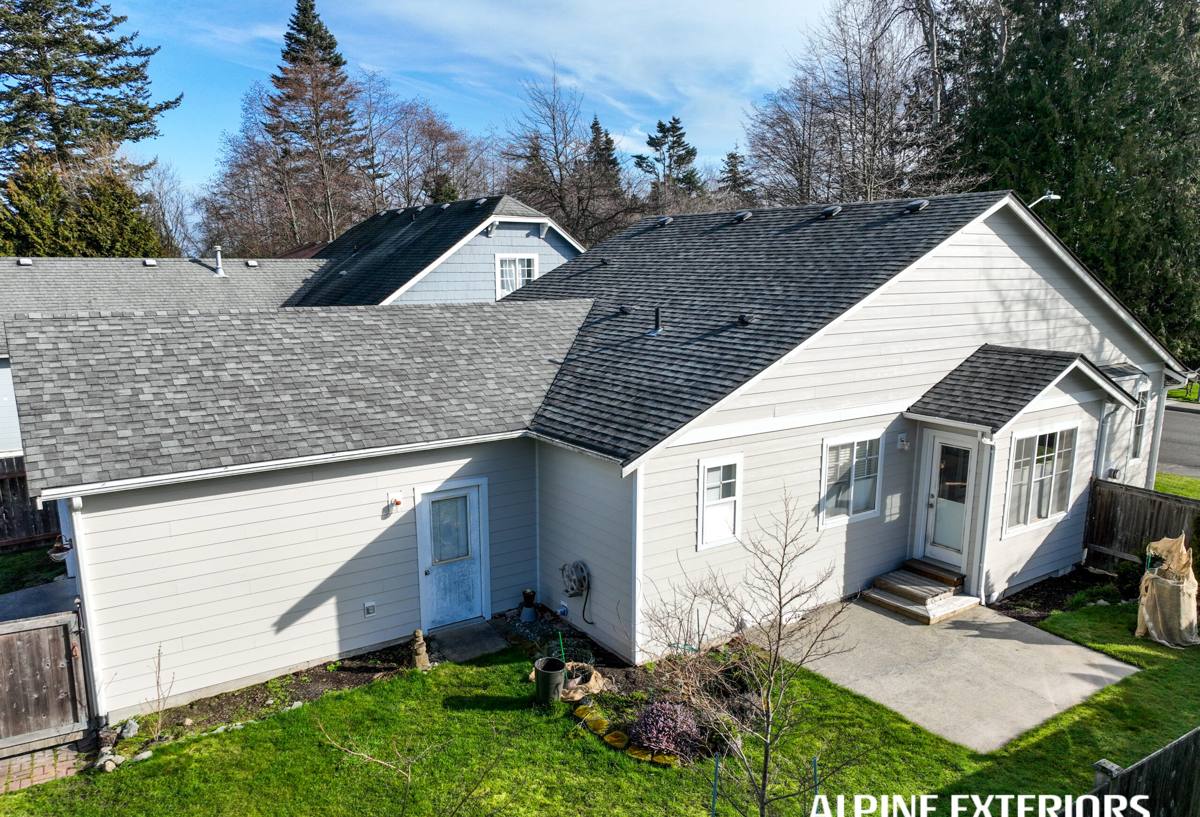
Weight, Thickness, and Wind Performance
This is the part that matters most for our area. Anacortes sits right on the water, and homes here take on exposure that inland Skagit County properties don't see as much of: salt-laden air, sustained onshore wind, and the occasional winter windstorm that comes through Rosario Strait and the San Juans with real force.
Architectural shingles typically weigh 50 to 80 percent more per square than 3-tab shingles, and that added mass, combined with their laminated construction, generally gives them a higher wind rating — many architectural products are rated for gusts in the 130 mph range, compared to 60-80 mph for standard 3-tab. Manufacturer wind ratings are tested under specific lab conditions, not a guarantee for every roof, but as a general rule, the added lamination gives a shingle more to resist uplift with.
Nail placement and fastening pattern matter just as much as the shingle itself for wind resistance — a correctly installed 3-tab roof will outperform a poorly installed architectural roof every time. Installation quality is not a place to cut corners regardless of which product you choose.
How They Handle Our Moss and Moisture Season
Skagit County's long wet season, filtered light under mature trees, and salt-humid air off Fidalgo Bay create ideal conditions for moss growth on north-facing and shaded roof slopes. Neither shingle type is moss-proof, and no shingle is. But a few things are worth knowing:
- Architectural shingles' textured, staggered surface holds slightly more organic debris and moisture in the shadow lines than the flatter profile of a 3-tab shingle, which can mean marginally more moss activity in heavily shaded spots.
- 3-tab shingles shed surface water a bit faster because there's less surface texture for debris to catch on, but they're also thinner, which can make them more prone to curling and cracking as they age and dry out.
- Regardless of shingle type, the real defense against moss is roof design and maintenance — canopy trim-back, gutter clearing, and periodic soft washing — not the shingle brand.
- Many architectural shingle lines are available with algae-resistant (AR) granules that use copper or zinc compounds to slow moss and algae growth. This is a worthwhile upgrade for shaded roofs in our area and is offered on most 3-tab lines too, so it's not exclusively an architectural feature.
Lifespan and Warranty Structure
Manufacturers typically warranty 3-tab shingles for 20 to 25 years and architectural shingles for 30 years, with some premium architectural lines offering 40-year or limited-lifetime coverage. In practice, real-world lifespan depends heavily on ventilation, installation, and local exposure — a well-installed 3-tab roof in a mild microclimate can outlast a poorly ventilated architectural roof in a harsher one.
Where architectural shingles have a genuine edge is in the wind and impact warranty terms, which are usually stronger than what's offered on 3-tab products, and in the fact that most major manufacturers have been phasing 3-tab lines out of their premium tiers in favor of laminated products. That's a market trend worth knowing about, not a claim that 3-tab is a bad product — it still has a place on some budgets and some roof styles.
Cost Comparison
Architectural shingles cost more than 3-tab, both in material and typically in labor, since the heavier bundles and staggered installation pattern take somewhat more time to install correctly. The table below is a general guide to how the two compare — treat it as a framework for the conversation, not a quote.
| Factor | 3-Tab Shingles | Architectural Shingles |
|---|---|---|
| Relative material cost | Lower | Moderate to higher |
| Typical wind rating | 60-80 mph | 110-130 mph |
| Typical manufacturer warranty | 20-25 years | 30-40 years / limited lifetime |
| Weight per square | Lighter | 50-80% heavier |
| Visual profile | Flat, uniform pattern | Dimensional, shadow-line texture |
| Resale/curb appeal impact | Neutral to modest | Generally favorable |
Appearance and Resale Considerations
Architectural shingles have largely become the market standard for a reason beyond performance — the dimensional look reads as a more finished, higher-end roof, and it tends to be what buyers and appraisers expect to see on a home in this price range in Anacortes and the surrounding waterfront communities. 3-tab shingles aren't outdated or wrong, but on higher-value homes or homes where curb appeal is a priority, the visual gap is noticeable, especially on roofs with visible street-facing slopes.
On simpler roof lines, outbuildings, rentals, or budget-driven reroofs, 3-tab remains a legitimate, cost-effective choice that will do its job.
When 3-Tab Still Makes Sense
- Budget is the primary driver and the roof is not highly visible from the street
- The structure is a shop, rental, or secondary building rather than the primary residence
- You're matching an existing 3-tab roof on an addition or partial reroof
- The roof has a shorter remaining useful life for the structure overall (e.g., a planned future remodel or teardown)
When Architectural Makes More Sense
- The home is exposed to direct wind off the water or open fields
- You want the strongest available warranty and wind coverage
- Curb appeal or resale value is a consideration
- You're doing a full reroof and want to minimize the odds of doing this again in 15 years
Installation Details That Matter More Than the Shingle Brand
Whichever product you choose, a handful of installation details determine how well it actually performs in our climate:
- Ventilation — intake and exhaust airflow in the attic keeps shingles from cooking from underneath and prevents moisture buildup that feeds moss and rot on the deck below.
- Underlayment — a quality synthetic or ice-and-water underlayment matters as much as the shingle on a roof that sees this much rain.
- Nailing pattern — correct nail count and placement is what the wind rating is actually tested against; skipping this undermines any shingle's rated performance.
- Flashing — valleys, chimneys, and vent penetrations are where most leaks originate, regardless of shingle type.
- Drip edge and starter strip — small details that prevent wind-driven rain from getting under the first course.
A Practical Checklist Before You Decide
- Get the roof's exposure assessed — is it in a wind corridor, near open water, or shaded and prone to moss?
- Ask any contractor you're considering for their manufacturer certification level, not just "we install X brand"
- Compare warranty terms side by side, not just years — wind and algae coverage differ by product line
- Confirm the ventilation plan is part of the quote, not an afterthought
- Ask what underlayment and flashing details are included, especially in valleys
- Get the cost difference between 3-tab and architectural in writing for your specific roof, not a general estimate
Our Take
For most full reroofs in Anacortes and Skagit County, we lean toward architectural shingles as the better long-term value given the wind exposure and moss pressure this area sees — the added upfront cost is generally offset by longer service life and stronger wind and warranty coverage. That said, 3-tab is not a poor product, and there are legitimate situations — budget, secondary structures, partial matches — where it's the right call. The right answer depends on your specific roof, its exposure, and your plans for the home, not a blanket rule.
If you'd like a straight answer for your specific roof, we're happy to take a look and walk you through the options in plain terms. Reach out for a free, no-pressure estimate using the form below.