 Anacortes Roofing
 Siding Replacement in Conway: What This Part of Skagit County Deals With
Conway sits low in the Skagit River delta, in the farm country between Mount Vernon and Stanwood, close enough to Skagit Bay that homes here take on a real mix of exterior stresses most inland Washington towns never see. Salt-tinged air moves in off the water, rain arrives sideways as often as it falls straight down, and the flat, damp lowland around the river keeps humidity high enough that moss and mildew barely take a season off. None of that is unusual for Skagit County as a whole, but the combination of river-bottom moisture and open exposure to weather rolling in off the bay makes Conway a demanding spot for exterior siding, and it's a big part of why so many older homes here are carrying siding that failed well before it should have.
We install James Hardie fiber cement siding exclusively for Conway homeowners and across our Skagit County service area. It's the one product we've found that actually holds up to what this stretch of the delta throws at a house, year after year, and we don't offer alternatives we can't fully stand behind here.
Salt Air and River-Delta Moisture
Even a few miles from open saltwater, homes near the Skagit River delta pick up a steady dose of salt-laden air, and that air doesn't stay outside. It works into fasteners, flashing, and any siding finish that isn't built to resist corrosion. Combine that with the ambient moisture that comes off low-lying farmland and river bottomland, and you get a climate that keeps exterior materials damp, or fully wet, for long stretches of the year rather than drying out between storms the way a more sheltered inland property might.
Wind-Driven Rain on Open, Flat Lots
A lot of Conway is flat, open farmland with fewer hills and ridgelines to break up incoming weather than you'd find closer to town in Anacortes or up in the surrounding foothills. That means wind-driven rain often hits walls at an angle instead of falling straight down, pushing water into lap joints, trim seams, and any gap in the water-resistive barrier that a simple straight-down rain test would never expose. Siding systems that perform fine on a sheltered, tree-shaded lot can still fail here specifically because of that sideways load working at joints year after year.
A Moss and Mildew Season That Barely Ends
Mild temperatures, consistent moisture, and shade from mature trees along the river corridor add up to a long moss and algae season across this part of the county. Any siding material that's even slightly porous, or that holds water against the substrate instead of shedding it, becomes a growth surface over time. It usually shows up first on north-facing walls and anywhere shaded by trees or outbuildings, well before it's obvious from the road.
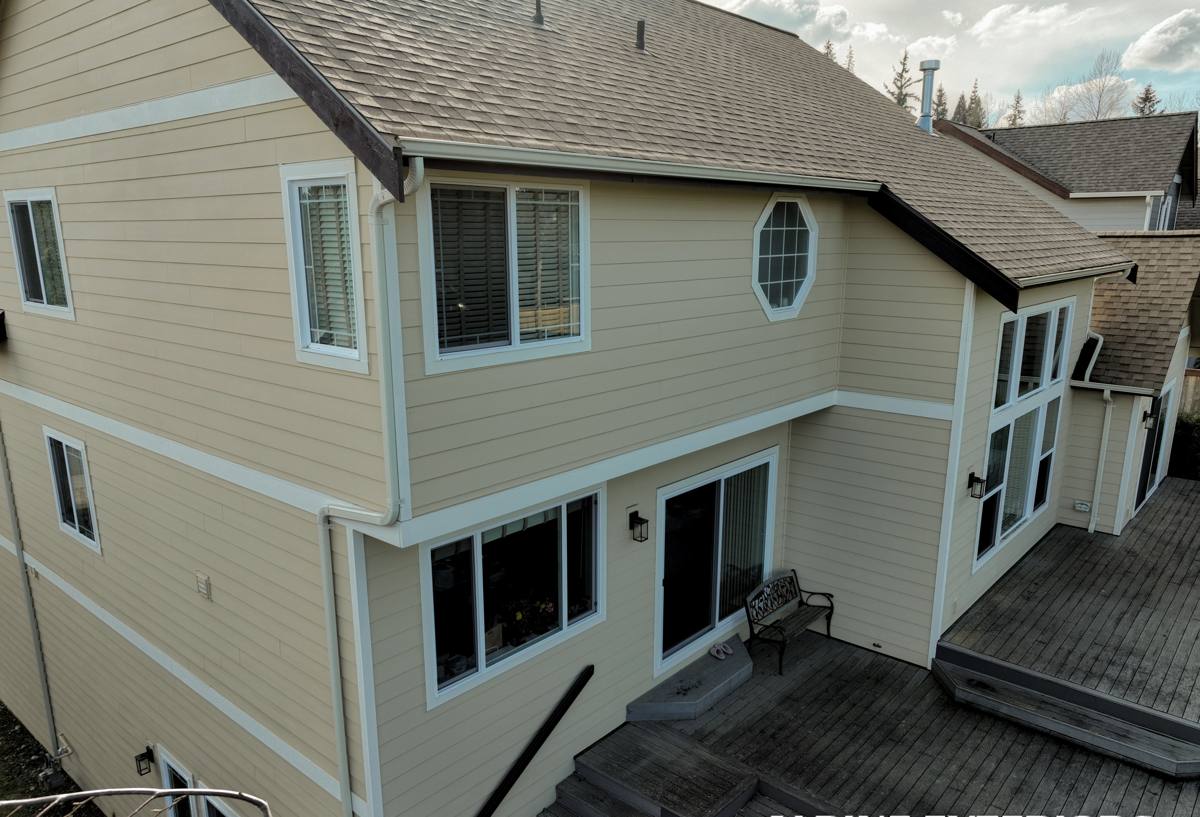
Signs a Conway Home Needs Siding Replacement, Not Just a Patch
Not every siding problem calls for a full tear-off, but in a climate like this, siding that's been quietly failing behind the surface is common enough that we always look past what's visible from the driveway before recommending anything. These are the signs that usually point to replacement rather than a simple repair:
- Soft, spongy, or crumbling siding, especially near the bottom of walls or around window and door trim
- Moss or dark staining that returns within weeks of being cleaned off
- Visible warping, cupping, or delamination on older wood-based or engineered wood siding
- Cracked, chipped, or missing boards after wind events off the bay
- Gaps opening up at seams, corners, or trim joints where water can track behind the wall
- A musty smell or visible mold on interior surfaces of exterior walls, which often points to moisture already trapped behind the siding
- Rising heating bills that suggest the wall assembly is no longer sealing the way it should
Why We Only Install James Hardie Fiber Cement
We used to work with a broader range of siding products. We narrowed that down to one system, and the decision came from what we kept finding on tear-offs in exactly this kind of climate: river-adjacent, salt-exposed, and wet more months of the year than not.
- Non-combustible core: fiber cement doesn't feed a fire the way wood-based products can, which matters for household safety and for insurance underwriting on rural Skagit County properties.
- Factory-applied ColorPlus finish: color and protective coating are baked on under controlled factory conditions rather than brushed on in the field, so it resists fading, chalking, and moisture damage far longer than a field-applied paint job.
- Climate-engineered HZ product lines: Hardie's HZ5 formulation is built for regions with sustained moisture and freeze-thaw cycling, which describes the Skagit delta well.
- Dimensional stability: fiber cement doesn't swell, cup, or warp the way engineered wood siding can after repeated wet-season moisture cycles.
- A strong transferable warranty: backed by Hardie, provided the installation follows spec, which is exactly why we treat installation quality as seriously as the material choice.
We don't install LP SmartSide, vinyl siding, Cemplank, Allura, primed spruce, or cedar. Every one of those products has a legitimate place in the market, and plenty of homeowners elsewhere are satisfied with them. But for a climate that keeps a wall damp this much of the year, we made a professional call to stand fully behind one system rather than offer a cheaper option that quietly shifts maintenance risk onto the homeowner over the years that follow.
What a Correct Siding Replacement Involves
Tear-Off vs. Overlay
On a lot of older Conway homes, especially ones that have been through a few decades of river-bottom humidity, we recommend a full tear-off rather than siding over what's already there. Overlaying traps whatever moisture damage already exists behind a fresh layer, which just delays a bigger problem instead of solving it. A tear-off also lets us actually see the sheathing and framing underneath, which matters in a climate where hidden rot behind old siding is common enough that we'd rather confirm it than guess.
Flashing and the Water-Resistive Barrier
Siding only performs as well as what's behind it. We pay close attention to how house wrap, flashing, and window and door openings integrate with the new siding, because that's where wind-driven rain off the bay actually finds its way in when a job is rushed. Head flashing above openings, proper kick-out flashing where rooflines meet walls, and correctly lapped house wrap are small details, but they're the difference between a wall that sheds water and one that slowly absorbs it over several wet seasons.
Fastening and Clearances
James Hardie siding has to be fastened and clearanced to spec to perform the way it's engineered to: correct nail patterns, proper gaps at butt joints, and adequate clearance from grade, roofing, and decks. Cutting these details short is one of the most common ways a good product ends up with a bad reputation on a given home, and it's a big part of why we treat installation detail as seriously as the material itself.
Hardie Product Lines We Use in Conway
| Product Line | Best For | Notes |
|---|---|---|
| HardiePlank Lap Siding | Most Conway homes, farmhouse and traditional styles | Smooth or cedar-textured finish, wide ColorPlus color range |
| HardiePanel Vertical Siding | Gable ends, accent walls, outbuildings | Clean vertical lines, pairs well with lap siding |
| HardieTrim Boards | Window and door surrounds, corners, fascia | Resists the swelling and rot common with wood trim in this climate |
| HZ5 Climate Engineered | Homes with sustained moisture and salt exposure | Formulated for wetter climate zones like the Skagit delta |
Siding Replacement Cost Factors in Conway
| Factor | What It Affects | Why It Matters Here |
|---|---|---|
| Home size and wall complexity | Total material and labor | More corners, dormers, and trim mean more joints exposed to wind-driven rain |
| Tear-off vs. overlay | Labor scope and substrate access | Tear-off reveals hidden moisture damage that's common in river-adjacent lowland homes |
| Substrate condition | Repair costs before new siding goes on | Years of trapped moisture behind failing siding can rot sheathing and framing |
| Trim and color selection | Material cost and finish longevity | ColorPlus factory finish holds up better against salt air and UV than field-applied paint |
| Site access and lot layout | Labor time and equipment staging | Larger farm lots or tree-lined properties can add setup and material staging time |
Exact numbers depend on the specific home and on what we find once tear-off starts, which is why we walk the property in person and give a written scope rather than quoting off a generic price list.
Our Siding Replacement Process
- An in-person walk-around to assess current siding condition, trim, flashing, and any visible moisture damage
- An honest read on whether the home needs full replacement, a partial re-side, or targeted repair
- Tear-off of failing siding and inspection of sheathing and framing for hidden rot or moisture damage
- Repair of any damaged substrate before new siding goes on, never buried under a fresh layer
- Installation of house wrap, flashing, and James Hardie siding to manufacturer spec, with attention to fastening, clearances, and joint detailing
- A final walk-through so you know exactly what was done and what to expect going forward
Why a Crew That Already Works Conway Matters
Skagit County's microclimates aren't uniform. A home tucked into town in Anacortes deals with different exposure than a home out on the open, low-lying farmland around Conway. We've worked enough homes in this part of the county to know which wall orientations take the worst of the wind off the bay, where moss keeps coming back no matter how often it's cleaned, and which flashing and drainage details actually matter here versus which ones are just code minimums somewhere drier. That local knowledge shapes how we scope a Conway job before a single tool comes out of the truck.
It also means we're not guessing about the practical realities of rural and farm-adjacent properties: longer driveways, outbuildings, well and septic layouts, and site access that looks different from a standard in-town lot. Knowing those details ahead of time keeps a project moving on schedule instead of hitting surprises mid-job.
If your Conway home has siding that's failing, aging, or just due for an honest second opinion, we're glad to take a look. Reach out using the form below to schedule a free, no-pressure estimate, and we'll tell you plainly what your home needs and why.