 Anacortes Roofing
 Why Burlington Decks Take More Than a Standard Build
Burlington sits close enough to the water and the marine air moving in off Fidalgo Bay and the Salish Sea that decks here age differently than decks built further inland. Add in Skagit County's long, wet shoulder seasons and the shade cover from mature fir and cedar that lines so many Burlington lots, and you get a climate that's genuinely tough on outdoor structures: salt-laden air that speeds up corrosion on fasteners and hardware, driving rain that finds its way into any gap in the flashing or decking, and a moss and algae season that can stretch from October well into April.
None of that means a deck can't last decades in Burlington. It means the build has to account for those conditions from the footings up, not just at the surface. A deck that looks fine going in but wasn't detailed for this climate usually starts showing problems within the first two or three wet seasons — soft spots at the ledger board, black streaking on the decking, corroded screw heads, or a substructure that's staying damp longer than it should between rains.
What a Correctly Built Burlington Deck Actually Involves
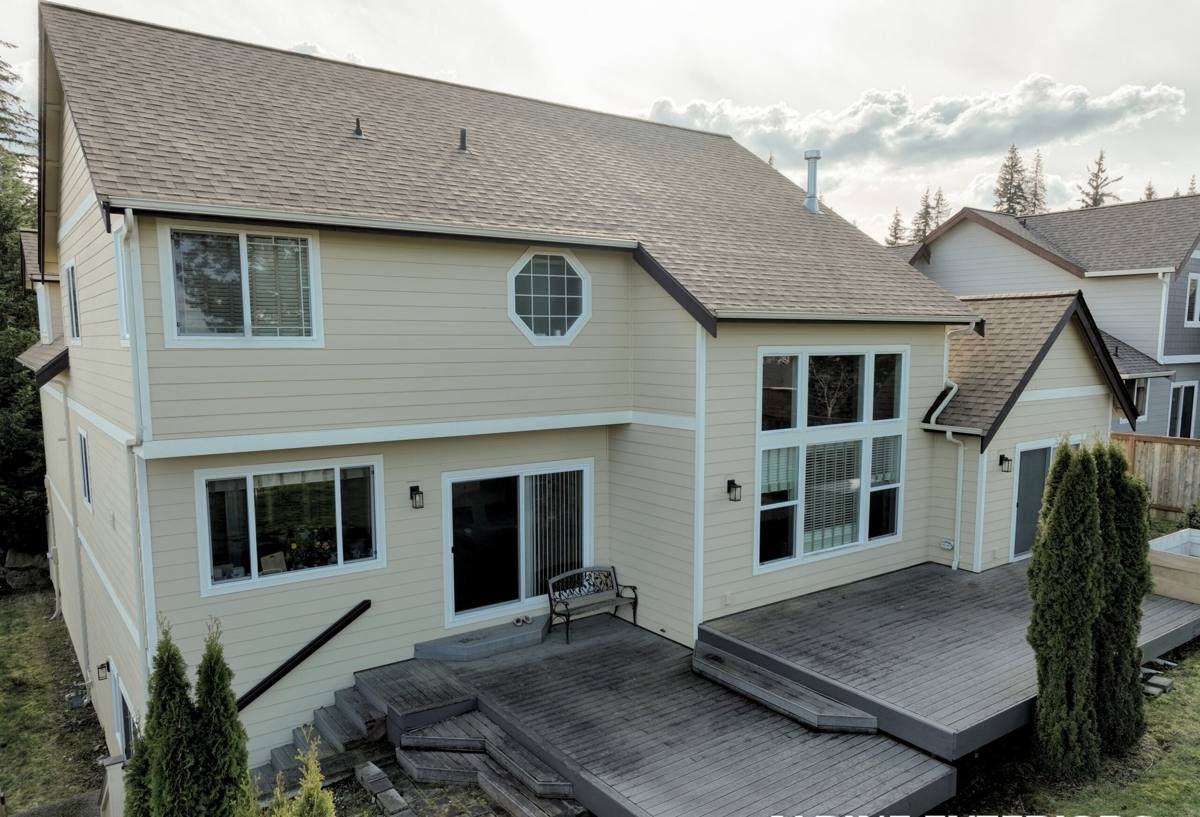
A deck is really three separate systems working together: the structure (footings, posts, beams, joists), the surface (decking boards and fasteners), and the water management (flashing, ledger attachment, drainage under and around the deck). In this part of Skagit County, all three need extra attention.
Footings and Framing
Frost depth and drainage both matter here. Footings need to be sized and set correctly for the soil conditions on the lot — Burlington has areas with heavier clay content that drain slowly, which changes how footings and post bases should be handled to avoid standing water against untreated wood. Framing lumber should be rated for ground contact or exterior exposure where it's within splash range of grade, and every structural connection — joist hangers, post caps, ledger bolts — should be hot-dip galvanized or stainless, not the cheaper electro-galvanized hardware that starts rusting within a season or two of salt-tinged coastal air.
The Ledger Connection
Where a deck attaches to the house is the single most common source of rot and water damage on any deck in western Washington. It needs proper flashing that directs water out and away from the house band board, not caulk alone, which fails over time. This is the detail that separates a deck that's structurally sound for 25+ years from one that develops hidden rot behind the siding within a decade.
Decking and Fasteners
The board material and the fasteners holding it down both need to handle repeated wet-dry cycles and airborne salt without corroding, cupping, or splitting. We'll cover material choice in more detail below, but the short version is: whatever surface you choose, the hardware holding it in place has to be rated for coastal exposure, and the spacing and pattern need to allow the boards to move slightly with moisture without buckling.
Choosing a Decking Material for This Climate
There's no single "best" decking material — there's a best fit for your budget, your maintenance appetite, and how much shade and moss exposure your particular lot gets. Here's how the common options actually perform in Burlington's conditions:
| Material | How it handles moisture and moss | Maintenance | Typical lifespan |
|---|---|---|---|
| Pressure-treated wood | Absorbs moisture readily; needs a clear path for it to dry between rains or moss and mildew take hold fast | Annual cleaning and re-sealing/staining | 10-15 years before major boards need replacing |
| Cedar | Naturally rot-resistant but still needs airflow underneath; greys and can grow moss if left unsealed in shaded spots | Periodic sealing to hold color and resist moss | 15-20 years with upkeep |
| Composite decking | Doesn't absorb water the way wood does, but lower-quality composites can still grow surface algae in shaded, damp spots | Occasional washing; no sealing or staining | 25-30 years, varies by product warranty |
| PVC/capped polymer | Fully sealed surface resists moisture and moss growth best of the group | Lowest — soap and water washing | 25+ years, typically the longest manufacturer warranties |
Our standard on any job is to walk a homeowner through the honest trade-offs rather than push whatever's cheapest to install. A shaded, north-facing deck under fir trees is a very different moss risk than an open, south-facing deck, and that should factor into the material conversation.
Drainage and Airflow Under the Deck
This is the part of the job most homeowners never see and most lower-bid contractors skip. A deck built low to the ground with poor airflow underneath will trap moisture, and that trapped moisture is exactly what moss, mildew, and eventually rot need to get established — both under the decking and in the framing below. Correct build practice includes keeping adequate clearance between the underside of the joists and the ground, grading the soil under the deck so water moves away rather than pooling, and, where the deck is low or covered, sometimes adding a below-deck drainage system so the space underneath can be used without turning into a wet, mossy crawlspace.
On covered decks and decks under heavy tree canopy — common in Burlington's more wooded lots — this drainage planning matters even more, since natural sun exposure that would otherwise dry the structure out between storms is limited.
Our Process, Start to Finish
- On-site assessment. We look at sun and shade exposure, grade and drainage, proximity to the house's siding and roofline, and how the space will actually be used (dining, grilling, hot tub, simple sitting area) — all of which change the structural and material recommendations.
- Design and material selection. We walk through decking options honestly, including maintenance expectations, and size the structure to the intended use and any features like built-in seating, stairs, or railing style.
- Permitting. Most decks above a certain height or attached to the house require a permit through the local jurisdiction. We handle the paperwork and make sure the design meets current code for railings, guards, and structural load.
- Footings and framing. Footings are set to proper depth and bearing, framing goes up with corrosion-resistant hardware throughout, and the ledger connection is flashed correctly before any decking goes down.
- Decking installation. Boards are fastened with hardware matched to the material and spaced to allow for normal seasonal movement.
- Railing, stairs, and finish details. Guardrails, stair stringers, and any skirting or lighting are installed to code and finished to match the home.
- Final walkthrough. We go over care and maintenance specific to the material you chose, so you know what upkeep to expect before the first wet season hits.
Permits and Local Code in Skagit County
Deck permitting requirements depend on the deck's height, size, and whether it's attached to the house, and Burlington falls under Skagit County or local municipal review depending on the exact parcel. Guardrail height, baluster spacing, and stair rise/run all have to meet current building code, and inspections are typically required at the footing stage and again at final. Skipping permits on an attached deck is one of the more common issues we find when we're called out to repair or replace a deck someone else built — it can create real problems at resale, since an unpermitted structure often has to be brought up to code or removed before a sale closes.
Moss, Algae, and Long-Term Maintenance
Even a well-built deck needs some seasonal attention in this climate. Moss and algae growth is mostly a function of moisture, shade, and airflow — the same factors we account for in the build — but every deck benefits from periodic cleaning, especially going into the wetter months. A simple maintenance rhythm goes a long way:
- Sweep debris (needles, leaves, seed pods) off the surface regularly so it doesn't trap moisture against the boards
- Wash the deck surface at least once a year to remove early moss and algae growth before it gets a foothold
- Check and clear any gaps between boards that have filled with debris, since that's where moisture sits longest
- Inspect fasteners and hardware periodically for rust staining, which shows up faster in coastal air than inland
- Reseal or restain wood decking on the schedule the product calls for — skipping a cycle in this climate shows up fast
- Keep an eye on the area under the deck for standing water or blocked drainage after heavy rain events
Why Hiring a Crew That Already Works Burlington Matters
A lot of deck problems we get called to fix didn't start as bad workmanship — they started as a good build that wasn't detailed for this specific climate. A crew that builds decks in drier inland regions, or that's used to a milder rain pattern, doesn't always think through ledger flashing, hardware corrosion resistance, or under-deck drainage the same way a crew that works Anacortes, Burlington, and the rest of Skagit County day in and day out does. Knowing which lots in this area tend to hold moisture, which exposures grow moss fastest, and how the local permitting process runs isn't something you pick up from a manual — it comes from building here repeatedly and seeing what holds up and what doesn't a few years down the line.
What a Realistic Estimate Depends On
Every deck project is priced around a handful of concrete factors, and being upfront about them from the start avoids surprises later:
| Factor | Why it moves the price |
|---|---|
| Size and shape | Square footage and complexity (multiple levels, angles, built-in features) directly affect material and labor |
| Decking material | Pressure-treated, cedar, composite, and PVC all sit at different price points and long-term value |
| Height and stairs | Elevated decks need more substantial framing, railing, and often multiple stair runs |
| Site access and grade | Sloped lots, tight access, or poor existing drainage add site work before the deck itself goes up |
| Permitting scope | Attached decks and taller structures require more design documentation and inspection steps |
We give straightforward, written estimates that break these factors out, so you can see exactly what's driving the number rather than getting a single lump figure.
If you're planning a new deck or replacing one that's showing its age, we're happy to come take a look and put together a free, no-pressure estimate — there's a simple form below to get started.