 Anacortes Roofing
 Metal Roofing Built for Sedro-Woolley's Weather
Sedro-Woolley sits inland from the coast, but it doesn't escape what Skagit County throws at a roof over the course of a year. Homes here see long stretches of driving rain off the Puget Sound weather systems, humid air that never fully dries out in the winter months, and shaded, moisture-holding rooflines that grow moss faster than most homeowners expect. Add the salt-tinged air that moves inland from the Sound and the Strait on windier days, and you have a climate that is genuinely hard on roofing materials — even ones that hold up fine elsewhere in the country.
Metal roofing, installed correctly, is one of the better answers to that combination. It sheds water fast, gives moss less to grip onto, and doesn't absorb moisture the way organic roofing materials do. But "metal roofing" covers a wide range of products and installation quality, and a roof that's wrong for this climate — or just installed carelessly — can fail in ways that are expensive to fix. This page is about what a metal roof needs to get right specifically for a Sedro-Woolley home, not metal roofing in general.
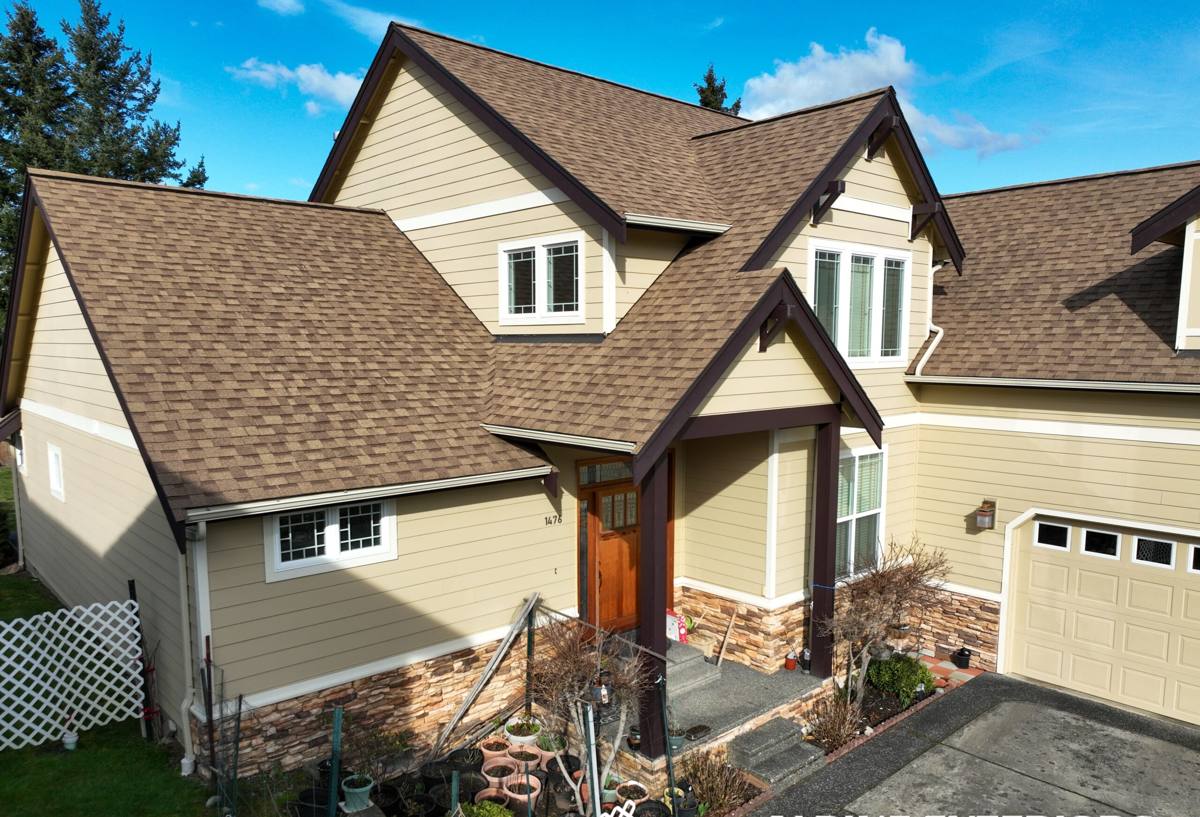
What Driving Rain and Moss Season Actually Do to a Roof
It helps to be specific about the failure modes we're designing against, because they shape every material and installation decision that follows.
Driving Rain and Wind-Driven Water
Storms in this part of Washington rarely come straight down. Wind pushes rain sideways and up under laps, ridge caps, and flashing details that would be fine in a calmer climate. Any seam, fastener, or transition that relies on gravity alone to shed water is a weak point here. That's why seam design and flashing detail matter more in Skagit County than the base material choice itself.
Moss and Sustained Moisture
Moss doesn't need direct standing water — it needs shade, organic debris, and roof surfaces that stay damp for days at a time, which describes a lot of tree-covered lots around Sedro-Woolley for a good chunk of the year. Moss holds moisture against the roof surface, works into fastener penetrations and laps, and on organic materials it can start breaking down the surface itself. Metal doesn't feed moss growth the way asphalt granules or wood shakes do, but moss and debris still need to be kept off a metal roof, especially in valleys and behind chimneys or dormers where debris naturally collects.
Salt-Influenced Air
Homes closer to the water deal with this more directly, but salt-laden air travels further inland than people assume, especially with prevailing winds. Salt exposure accelerates corrosion on unprotected fasteners, cut edges, and lower-grade coatings. It's a real factor in material selection for this region even for homes that aren't waterfront.
Metal Roofing Systems: Choosing the Right Fit
Not every metal roof product performs the same way under these conditions. We generally narrow the conversation to two categories for residential work in this area.
| System | How It Sheds Water | Fastener Exposure | Best Fit |
|---|---|---|---|
| Standing seam | Raised, interlocking vertical seams — no exposed fastener path for water to find | Concealed clips, no surface penetrations | Full roofs, low-slope sections, homes with heavy tree cover or wind exposure |
| Exposed-fastener metal panel | Overlapping ribbed panels with gasketed screws through the panel face | Exposed screws, gaskets wear over time | Outbuildings, garages, budget-conscious projects on simpler rooflines |
Exposed-fastener panels aren't a bad product — they're a legitimate, lower-cost option, and we install them when that's the right call for the structure and the budget. But every exposed fastener is a future maintenance point, and in a climate with this much sustained rain, those gaskets are working harder and wearing faster than they would in a drier region. For primary Sedro-Woolley homes, especially anything with valleys, dormers, or a lower slope, we steer most homeowners toward standing seam because it removes that maintenance liability almost entirely.
Panel Material and Coating
Steel and aluminum are both viable here. Aluminum has a natural edge on corrosion resistance in salt-influenced air since it doesn't rely on a coating alone to resist rust — it forms its own oxide layer. Steel panels need a quality coating system (a Galvalume or similar substrate with a good paint finish) to get comparable long-term performance. We'll walk through which makes sense for your specific site rather than defaulting to one across the board.
What a Correct Metal Roof Installation Actually Involves
The panel itself is maybe a third of what determines how a metal roof performs in this climate. The rest is in details that aren't visible once the job is done.
- Underlayment: A high-temp synthetic or self-adhered underlayment underneath the panels, not a bare deck. This is the backup layer if wind-driven rain ever gets past the panel seams.
- Deck condition: Any soft, water-damaged decking gets found and replaced before a single panel goes on — covering a bad deck with new metal just hides the problem.
- Ice and water shield at vulnerable points: Valleys, eaves, and around penetrations get additional waterproof membrane, not just underlayment.
- Flashing at every transition: Chimneys, skylights, sidewalls, and valleys need custom-formed flashing integrated with the panel system — not caulk standing in for proper metalwork.
- Ventilation: Metal roofs still need a properly vented attic or roof assembly to manage condensation from the underside, which matters in a humid climate like ours.
- Fastener and clip spacing rated for local wind exposure: Clip and fastener spacing should match manufacturer specs for the wind exposure of your specific site, not a generic pattern.
Our Process for Sedro-Woolley Roofs
1. On-Site Evaluation
We walk the roof and attic, not just look from the ground. That means checking deck condition, existing ventilation, moss and debris buildup, and how water is currently moving off the roof — where it pools, where it's been getting under laps, where tree cover is creating persistent damp spots.
2. System Recommendation
Based on that walk-through, we recommend a panel system, material, and finish suited to your roof's slope, exposure, and how much shade and moss pressure it actually deals with — not a one-size answer.
3. Tear-Off and Deck Repair
Old roofing comes off, the deck gets inspected board by board, and anything compromised by past moisture gets replaced before underlayment goes down.
4. Installation
Underlayment, ice and water shield at critical points, panels, and custom flashing go in following manufacturer specs for this wind and rain exposure — not shortcuts to save a day of labor.
5. Cleanup and Walkthrough
Site gets cleared of scrap metal, fasteners, and debris, and we walk the finished roof with you so you know what maintenance, if any, it'll actually need going forward.
Keeping a Metal Roof Performing Long-Term
Metal roofing needs less maintenance than most materials, but "less" isn't "none," especially with the tree cover common around Sedro-Woolley.
- Clear leaves, needles, and debris out of valleys and behind chimneys or dormers a couple times a year — this is where moss gets its foothold even on metal.
- Keep gutters and downspouts clear so water isn't backing up against the eave edge.
- Trim back overhanging branches that keep sections of the roof shaded and damp longer than the rest.
- Have seams, flashing, and any fastener penetrations glanced at periodically, especially after a hard windstorm.
- Don't pressure-wash a metal roof — it can drive water under laps and damage coatings; a soft brush or low-pressure rinse is enough.
What It Costs — and What Actually Drives the Number
We're not going to quote a price without seeing the roof, but here's what actually moves the number up or down on a Sedro-Woolley metal roofing project.
| Factor | Why It Matters |
|---|---|
| Panel system (standing seam vs. exposed-fastener) | Standing seam costs more upfront but removes long-term fastener maintenance |
| Roof complexity | Valleys, dormers, and multiple roof planes mean more custom flashing labor |
| Deck condition | Water-damaged decking found during tear-off adds repair cost, but skipping it costs far more later |
| Material (steel vs. aluminum) | Aluminum typically costs more but offers better inherent corrosion resistance |
| Access and pitch | Steep or hard-to-access rooflines take longer and require more safety setup |
Broadly, metal roofing costs more upfront than asphalt shingles, and that's a fair tradeoff to weigh — but it's also the reason we walk every homeowner through actual factors instead of a flat per-square rule of thumb that doesn't reflect your roof.
Why Hiring a Crew That Already Works This Area Matters
A roofing crew that regularly works Skagit County and the Sedro-Woolley area already knows how this climate behaves on a roof — how moss builds in shaded valleys here, how far wind-driven rain travels under a poorly lapped seam, what kind of underlayment and flashing detail actually holds up through a wet Pacific Northwest winter. That's different from general roofing experience picked up in a drier climate. It shows up in the small decisions: where extra ice and water shield goes, how flashing gets formed at a valley, what fastener spacing a specific site's wind exposure actually calls for.
It also matters for follow-through. A local crew is the one you can call back in five years if a flashing detail needs a look, not a company that did one job in the area and moved on.
Get a Straightforward Estimate
If you're weighing a metal roof for a Sedro-Woolley home, we're happy to walk the roof, look at the deck and ventilation, and give you an honest read on what system fits the site and what it'll cost — no pressure, no inflated quote to negotiate down from. Use the form below to request a free estimate.