 Anacortes Roofing
 Siding Repair in Burlington: A Different Job Than It Looks Like
Burlington sits low in the Skagit Valley, close enough to the water and the flats that homes here take a steady beating from salt-tinged air, wind-driven rain, and long stretches of gray, wet weather that barely let a wall dry out between storms. That combination is hard on siding in ways that aren't always obvious from the curb. A house can look fine from the street and still have soft trim, hidden rot behind a butt joint, or moss working its way into a seam that's been open for two winters. Siding repair in a climate like this isn't just patching a hole — it's figuring out why that spot failed in the first place and fixing it so it doesn't fail again next season.
We work on homes throughout Burlington and the surrounding Skagit County area regularly, which matters more than it sounds like it should. A crew that's diagnosed dozens of similar homes in this exact climate recognizes the early signs of moisture intrusion, knows which siding materials hold up here and which ones don't, and isn't guessing at what a Burlington winter does to an exterior wall over ten or fifteen years.
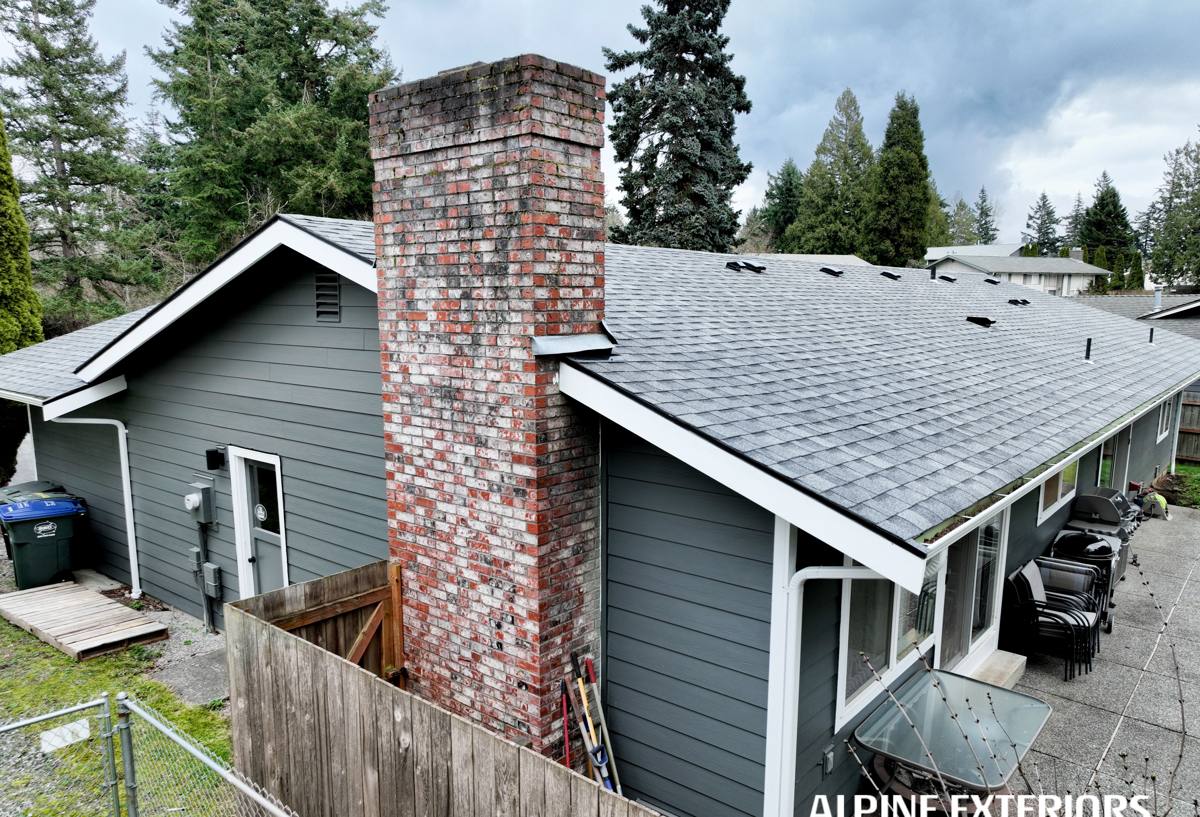
What Salt Air, Driving Rain, and Moss Actually Do to Siding
Salt Air
Burlington isn't oceanfront, but it's close enough to Puget Sound and the tidal flats that salt-laden air still reaches homes here, especially on west- and southwest-facing walls that catch the prevailing wind. Salt air accelerates corrosion on fasteners, flashing, and any exposed metal trim. When nails or screws holding siding in place start to rust, they lose their grip, and panels or boards can work loose. Corroded flashing above windows and doors stops shedding water the way it should, which is often the real root cause behind a stain or soft spot that looks like a straightforward siding problem.
Driving Rain
Wind-driven rain doesn't just run down a wall — it gets pushed sideways and upward into seams, laps, and butt joints that were never designed to handle water moving against gravity. Over time, that pressure finds every gap in caulking, every under-caulked joint, and every spot where siding wasn't installed with the right clearance or overlap. Once water gets behind the siding, it can sit there for days in our climate before anything dries out, which is exactly the environment rot and mold need to take hold.
Moss Season
Skagit County's moss season runs long — realistically most of the year in shaded, damp spots. Moss and algae hold moisture directly against the siding surface, keep it from drying between rain events, and slowly work into any seam, crack, or nail hole they can find. On the wrong material, sustained moss contact can soften the substrate underneath. It also traps debris and organic material that feeds further growth, so a section left untreated tends to get worse, not better, year over year.
How to Tell When Siding Needs Repair — Not Just a Wash
A lot of Burlington homeowners call us after noticing something small and are surprised to learn it points to a bigger issue underneath. Here's what we look for during an inspection, and what each sign usually means:
| What You See | What It Often Means |
|---|---|
| Dark streaking or persistent moss below a joint | Water is tracking through a seam and staying wet longer than the surrounding wall |
| Soft or spongy spot when pressed | Moisture has reached the substrate; likely rot has already started |
| Peeling or bubbling paint in one localized area | Trapped moisture behind the siding is pushing the finish off from underneath |
| Visible gaps at butt joints or corners | Caulking has failed or was never sufficient for wind-driven rain exposure |
| Rust streaks below fasteners | Fasteners are corroding, which weakens their hold over time |
| Warping or cupping boards | The material has absorbed water repeatedly and is losing dimensional stability |
Any one of these on its own might be a small fix. Several together, especially clustered on one elevation, usually means water has been getting in for a while and the repair needs to address the entry point, not just the visible symptom.
What a Correct Siding Repair Actually Involves
The difference between a repair that lasts and one that fails again in two years almost always comes down to what happens before the new siding goes on. A patch nailed over rotted sheathing looks fine on day one and fails again by the next wet season. Here's the sequence we follow on every repair:
- Remove the damaged section and open up enough surrounding area to see the true extent of the problem, not just the visible spot.
- Inspect the sheathing and framing underneath. If water has reached the wood structure, that has to be addressed before any new siding goes back on — covering rotted sheathing with new siding just hides the problem.
- Check and correct the flashing and weather-resistive barrier. Most recurring siding failures trace back to flashing that was missing, damaged, or installed wrong the first time.
- Replace with matched materials installed to the manufacturer's specified clearances, overlaps, and fastener schedule — not just "close enough."
- Seal and finish correctly, using the right caulking in the right joints (and not over-caulking joints that are designed to allow drainage).
- Match the finish so the repair blends with the surrounding siding rather than leaving an obvious patch.
Skipping steps 2 and 3 is the single most common shortcut we see in repair work done elsewhere, and it's the reason the same wall ends up needing repair again a couple of winters later.
Why We Repair With James Hardie Fiber Cement
We install and repair with James Hardie fiber cement siding exclusively — we don't install vinyl, LP SmartSide, or other engineered wood or fiber cement alternatives. That's a deliberate standard, not a limitation on options. For a climate like Burlington's, with salt air, sustained damp, and a moss season that lasts most of the year, fiber cement holds up in ways that matter:
- It's non-combustible, which matters increasingly across the Pacific Northwest.
- It doesn't absorb and swell with moisture the way engineered wood products can, so it's far less prone to the soft, rotting failure mode we see in older or lower-grade siding.
- James Hardie's ColorPlus factory finish is baked on and warranted against fading and peeling, which matters on a repair — a factory-matched color holds up better long-term than a field-painted patch.
- Hardie's HZ5 product line is engineered specifically for regions with heavy moisture exposure, which fits Skagit County's climate profile well.
- It carries a strong transferable warranty, which protects the investment if the home changes hands.
When we repair a section of Hardie siding, we can match it to the existing material precisely — same plank profile, same ColorPlus finish — so the repair doesn't stand out as a patch job. That's harder to achieve with vinyl or wood-based sidings, which fade, warp, or weather unevenly compared to the surrounding original material even when the replacement piece is new.
Repair vs. Replace: How We Help You Decide
Not every siding problem in Burlington calls for a full re-side, and we're not going to tell you it does when it doesn't. The honest answer depends on how widespread the damage is and what's causing it.
| Situation | Usually Points To |
|---|---|
| Isolated damage on one wall or a small cluster of boards | Targeted repair, assuming the underlying sheathing is sound |
| Recurring failures in the same spot after prior repairs | An unresolved flashing or drainage issue that needs to be fixed, not just re-patched |
| Widespread soft spots, warping, or moss across multiple elevations | The siding system as a whole may be past its service life |
| Siding is an older material not rated for this climate (older wood, some engineered products) | Worth discussing a phased or full replacement in a moisture-resistant material |
| Damage limited to trim, corners, or caulking | Often a simpler, lower-cost fix that stops water intrusion before it spreads |
We'll always start with an honest inspection and tell you which category your home actually falls into, rather than defaulting to the most expensive answer.
Our Process, Start to Finish
Here's what to expect when you call us for a siding repair in Burlington:
- Inspection. We walk the exterior, check moisture readings where needed, and identify not just the visible damage but the likely cause.
- Straight answer. You get a clear explanation of what's actually going on, what's driving it, and what your realistic options are — repair, phased repair, or full replacement — without upselling.
- Written scope and estimate. No surprise add-ons once work has started.
- Repair work. Damaged sections are removed, the structure underneath is inspected and corrected if needed, flashing and moisture barriers are addressed, and new James Hardie material is installed to spec.
- Cleanup and final walkthrough. We show you the completed work and explain what was done and why.
Preventing the Next Repair
A few habits go a long way toward keeping Burlington siding in good shape between inspections:
- Keep gutters clear so overflow doesn't run down and saturate wall sections repeatedly.
- Trim back vegetation and tree cover that keeps a wall shaded and damp longer than it needs to be — this is the single biggest driver of persistent moss.
- Re-caulk joints at the first sign of cracking or separation, before wind-driven rain has a chance to get behind them.
- Have siding inspected after any major windstorm, since driving rain can force water into joints that were previously sealed.
- Address soft spots or staining as soon as they're noticed — moisture damage in this climate spreads faster than most homeowners expect.
Local Experience Matters More Than It Seems
Skagit County's coastal-influenced, high-moisture climate isn't the same as siding conditions further inland or in drier parts of the state, and repairs done without accounting for that tend to fail again quickly. A crew that regularly works Burlington homes already knows which elevations take the worst of the driving rain, how aggressive the moss season really gets in shaded yards near the valley, and how salt air affects fasteners and flashing over time. That local pattern recognition is part of what makes a repair last — it's the difference between fixing what's visible and fixing what's actually wrong.
If you're seeing staining, soft spots, moss buildup, or gaps in your siding, we're happy to take a look and give you a straightforward assessment. Reach out for a free, no-pressure estimate using the form below.