 Anacortes Roofing
 Conway sits low in the Skagit River delta, close enough to Skagit Bay and Puget Sound to catch salt-laden air off the water, and low enough that fog, standing moisture, and heavy fall rain linger longer than they do on higher ground. If you own a home in or around Conway and you're staring down a roof replacement, the job isn't quite the same as replacing a roof in a drier inland town. The materials, the details, and the sequencing all need to account for what this specific stretch of Skagit County throws at a roof year after year.
This page covers what a correct roof replacement looks like for Conway homes specifically — the climate factors that matter, what a thorough tear-off and install actually involves, how we sequence the work, and why a crew that already works this area consistently gets better long-term results than a one-off install from a company that doesn't know the ground conditions here.
Why Conway's Climate Is Harder on Roofs Than It Looks
Conway doesn't get extreme weather in the way some parts of the country do. There's no hail season, no hurricane risk, nothing dramatic. The problem is persistence. Three things work on a Conway roof nearly year-round:
- Salt air. Proximity to Skagit Bay and the Sound means airborne salt settles on roofing metal, fasteners, and flashing. Over years, that accelerates corrosion on anything that isn't rated for coastal exposure.
- Driving rain. Skagit County storms often come in sideways off the water, which pushes water up and under roofing components that would stay dry in a straight-down rain. Laps, seams, and flashing details that would be fine elsewhere need to be tighter here.
- A long moss and moisture season. Low elevation, tree cover, and extended damp stretches from fall through spring give moss and algae a long runway. Once moss gets a foothold under shingle tabs or in valleys, it holds moisture against the roof deck and shortens the life of everything underneath it.
None of these individually destroy a roof overnight. Together, over 15-20 years, they're exactly why some roofs in this area fail early — not from a single bad storm, but from slow, cumulative moisture and corrosion in the spots that were undersized or under-detailed on day one.
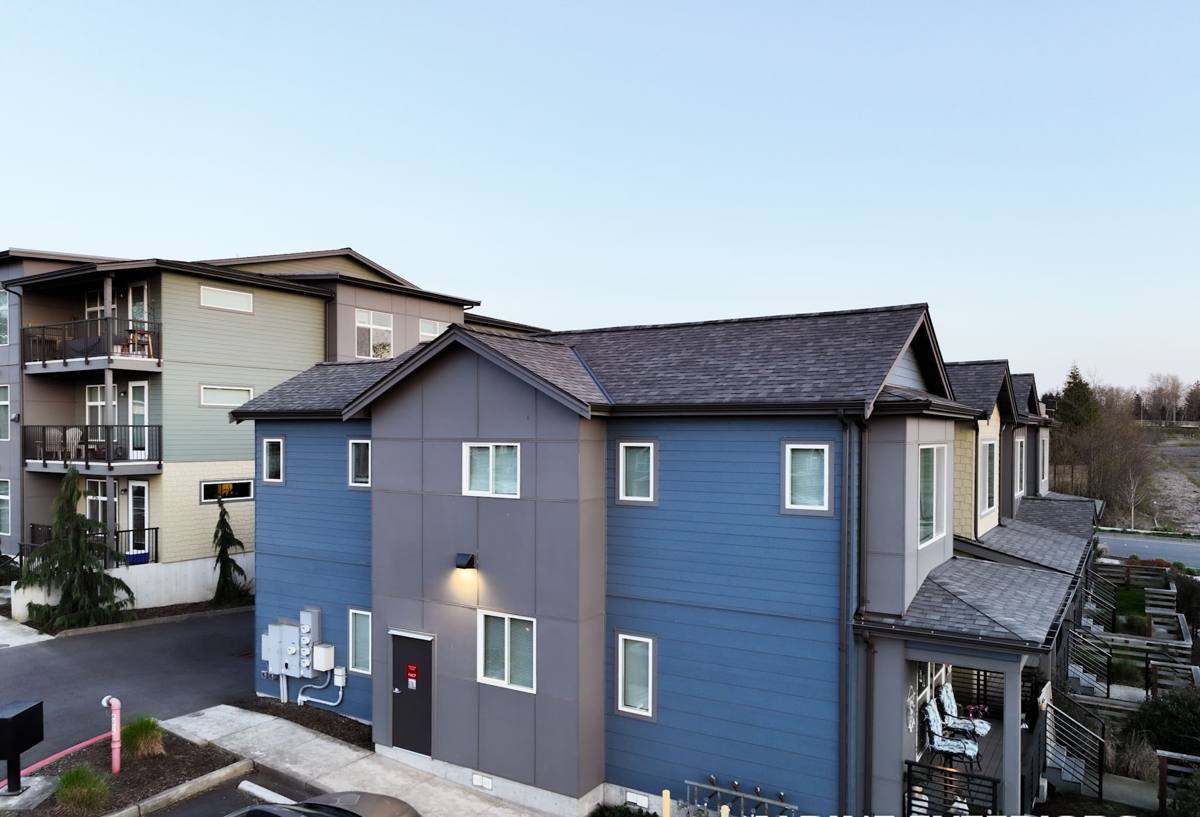
Signs a Conway Roof Is Actually Due for Replacement
Not every roof in rough shape needs full replacement — but in a climate like this, homeowners often wait too long because the damage isn't obvious from the ground. Things we look for during an assessment:
- Granule loss on asphalt shingles, especially in valleys and on south- and west-facing slopes that take the brunt of wind-driven rain
- Moss buildup at butt joints and in valleys, even if it looks minor from the driveway
- Soft or spongy decking felt underfoot, usually a sign moisture has already reached the plywood
- Rusting or streaking at flashing points — chimneys, vent boots, valleys — which shows up faster here than in drier inland areas
- Daylight or staining in the attic near roof penetrations
- A roof approaching or past its rated lifespan, particularly if the original install used minimal underlayment or standard-grade fasteners not suited for coastal exposure
If a roof is showing two or more of these, replacement is usually the more cost-effective call versus continued patching, because patch repairs on a roof this age tend to just chase the next leak rather than solve the underlying moisture problem.
What a Correct Replacement Involves Here
Full Tear-Off, Not Overlay
We don't recommend overlaying a new layer of shingles over an old roof in this climate. Overlays trap moisture between layers, and in an area with Conway's moss and moisture exposure, that trapped moisture is a problem waiting to happen. A full tear-off lets us inspect and repair the deck itself — which matters, because deck damage is common on older roofs here and it's invisible until the old roofing is off.
Deck Inspection and Repair
Once the old roofing is stripped, we check the sheathing for soft spots, delamination, and rot — particularly around valleys, chimneys, and any area where past flashing was undersized. Any compromised decking gets replaced before anything new goes down. Skipping this step is one of the most common shortcuts in cheap re-roofs, and it's the reason some "new" roofs leak within a few years.
Underlayment Built for Wet Climates
Standard felt underlayment is not what we'd choose for a Conway home. We use synthetic or ice-and-water shield underlayment in the areas that matter most — eaves, valleys, and around penetrations — because wind-driven rain in this area can push water further up-slope than it would in a calmer climate. This is one of the highest-value upgrades on a coastal-exposure roof and it's invisible once the roof is finished, which is exactly why it's worth asking about during any quote.
Flashing and Fastener Selection
Salt air corrodes standard galvanized fasteners and flashing faster than it would inland. We spec corrosion-resistant flashing and fasteners at chimneys, valleys, vents, and skylights — the points where a roof is most likely to leak first. This is a detail that's easy to skip on a bid to save a few dollars, and it's usually the first thing that fails on a poorly built roof near the water.
Ventilation
Proper intake and exhaust ventilation matters everywhere, but in a damp climate like Conway's it does double duty — it helps the roof deck dry out between rain events instead of staying perpetually damp, which is part of what keeps moss from establishing as aggressively and helps the deck itself last longer.
Material Choices for a Coastal-Exposure Home
There's no single "right" roofing material for every home — it depends on budget, roof pitch, architecture, and how long you plan to own the home. Here's how the common options stack up for a Conway property specifically.
| Material | How It Handles Salt Air & Rain | Moss Resistance | Typical Lifespan Here |
|---|---|---|---|
| Architectural asphalt shingle | Good with proper flashing and fasteners; standard choice | Moderate — benefits from algae-resistant granules | 20-25 years with correct install |
| Standing seam metal | Excellent when specified with coastal-rated coatings and fasteners | High — sheds moisture, little for moss to grip | 40-50+ years |
| Composite/synthetic shake | Good; resists moisture absorption better than wood | Moderate to high | 30-40 years |
| Cedar shake | Requires diligent maintenance in this climate; absorbs moisture | Low — high maintenance burden to control moss and rot | Highly maintenance-dependent |
We don't push cedar shake on homes in this specific microclimate. It's not that the product is inherently bad — it's that untreated wood roofing in a persistently damp, moss-prone environment like Conway's demands a maintenance schedule most homeowners don't keep up with, and the moisture retention works against the wood over time. If a homeowner wants that look, we'll talk through the honest maintenance commitment involved before recommending it.
Our Replacement Process, Start to Finish
- On-site assessment. We walk the roof and attic, note the deck condition, existing ventilation, and any problem areas specific to the home's exposure and tree cover.
- Written estimate. A clear scope of work — materials, underlayment spec, flashing plan, and any deck repair allowance — so there's no ambiguity about what's included.
- Scheduling around weather. We plan tear-off and dry-in around forecast windows. In a wet climate, timing matters more than in a dry one — we don't leave a deck exposed longer than necessary.
- Tear-off and deck inspection. Old roofing removed, deck inspected and repaired as needed, documented before covering.
- Underlayment and flashing install. Ice-and-water shield at vulnerable points, corrosion-resistant flashing at every penetration.
- Roofing material install. Installed to manufacturer spec, with attention to fastening patterns suited for wind exposure this close to the water.
- Final inspection and cleanup. Full walk-through, magnetic sweep for debris, and a review of what was done.
Pre-Estimate Checklist for Conway Homeowners
If you're getting quotes for a roof replacement, here's what's worth confirming with any contractor before you sign anything:
- Is the underlayment spec upgraded for wind-driven rain, or is it standard felt?
- Are flashing and fasteners rated for salt-air/coastal exposure, or standard galvanized?
- Does the quote include deck inspection and a repair allowance, or is it assumed the deck is fine?
- Is ventilation being addressed, or just the roofing surface?
- Is the crew full tear-off, or are they proposing an overlay?
- What's the manufacturer's warranty, and does it require using their full underlayment/flashing system to stay valid?
Why Local Experience in This Specific Area Matters
Roofing crews that mostly work drier, inland parts of Skagit County or elsewhere in Washington sometimes underestimate what a Conway property actually needs — because on paper, a roof replacement looks the same everywhere. The difference shows up in the details: which fasteners get specified, how much ice-and-water shield goes down, whether the crew treats moss as a design consideration or an afterthought. A crew that regularly works homes in this delta and near-coastal stretch of the county already knows where water tends to intrude on local roof lines, which flashing details fail first, and how much moss pressure to plan for based on tree cover and sun exposure.
That familiarity isn't a marketing point — it changes real decisions on the job, like where to add extra underlayment, which valley details need reinforcing, and how aggressively to spec corrosion-resistant hardware. It's the difference between a roof that's technically installed to code and one that's actually built for where it sits.
Timing a Replacement Around Skagit County Weather
Roofing can be done in Skagit County most of the year, but the ideal windows avoid the heaviest, most sustained rain stretches. We plan tear-offs around multi-day dry forecasts whenever possible, and we don't leave a deck open overnight without weatherproofing if rain is a realistic risk. If you're planning ahead, late spring through early fall generally offers the most predictable scheduling, though we do replacements outside that window when the forecast cooperates and the home's condition doesn't allow for waiting.
If your roof is showing its age, or you just want a straight answer about how many years you realistically have left before replacement makes more sense than repair, we're happy to take a look. We offer free, no-pressure estimates for Conway homeowners — use the form below to get started.