 Anacortes Roofing
 West Anacortes Sits in a Tougher Weather Lane
West Anacortes homes take on a different weather load than houses tucked farther inland on Fidalgo Island. Being closer to open water means more direct exposure to salt-laden air, wind-driven rain that hits siding sideways instead of falling straight down, and the kind of persistent shade and dampness that lets moss and algae get a foothold on north- and west-facing walls. None of this is unusual for Skagit County's marine climate, but it does mean the siding on a West Anacortes home is working harder, year-round, than siding on a similar house fifty miles inland.
That combination — salt, moisture, and shade — doesn't ruin siding overnight. It works slowly, finding every weak seam, every under-caulked joint, every spot where water can get behind the surface and stay there instead of draining back out. Over years, that's what separates a siding job that still looks tight after a decade from one that's cupping, staining, or rotting at the bottom courses.
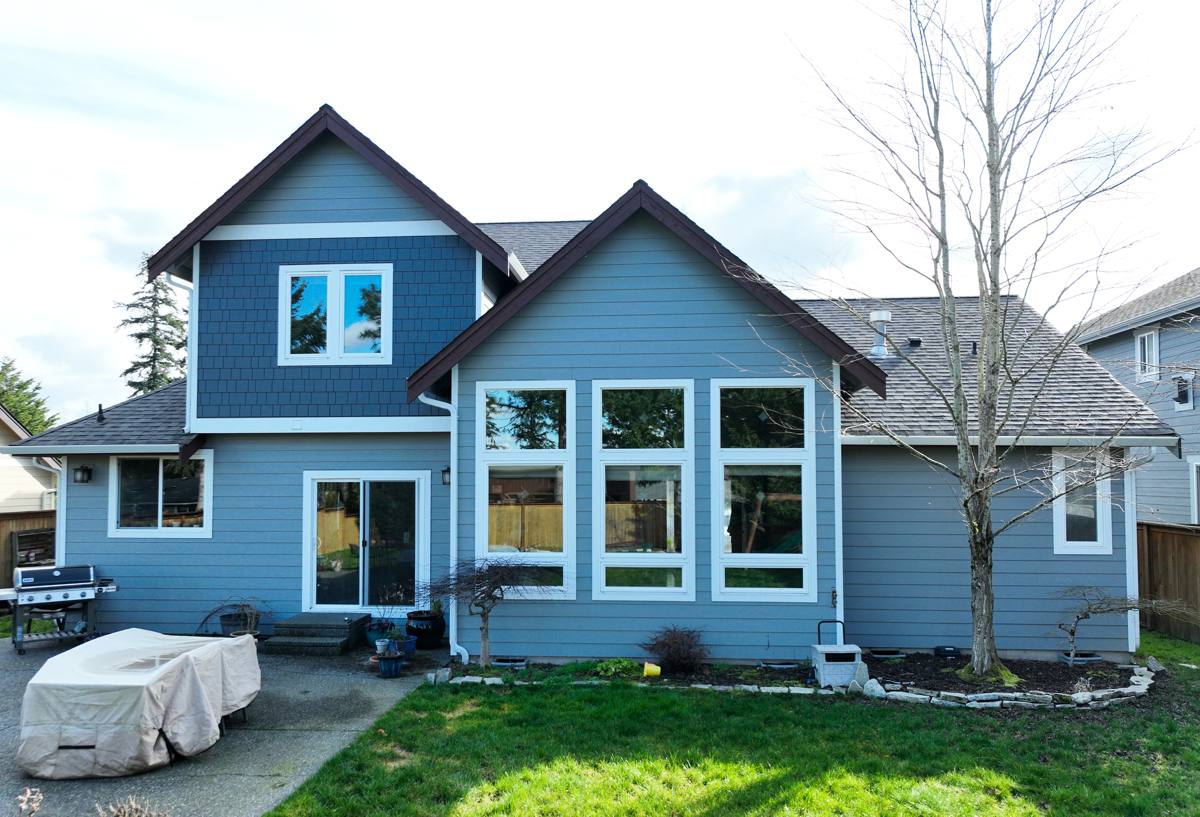
What This Exposure Does to the Wrong Siding Choice
Moisture That Doesn't Dry Out Fast
Coastal humidity and frequent rain mean siding here rarely gets a long, dry stretch to fully release moisture it's absorbed. Materials that swell, wick water, or hold dampness against the wall assembly are at a real disadvantage in this environment. Wood-based products and some engineered wood sidings can swell at cut edges and fastener holes when they take on water repeatedly without enough drying time between storms.
Moss and Algae Take Hold Fast in Shade
Anacortes has plenty of tree cover and shaded exposures, and combined with marine humidity, that creates ideal conditions for moss and algae growth on siding, especially on north-facing and heavily shaded walls. Textured or porous surfaces give moss more to grip onto, and once it's established, it holds moisture against the siding face longer than a bare wall would.
Salt Air Accelerates Wear on Fasteners and Finishes
Salt-laden air is harder on exposed metal fasteners, trim, and lower-quality paint films than inland air. Finishes that aren't formulated to hold up to marine conditions tend to chalk, fade, or fail at the edges sooner here than they would in a drier, less coastal setting.
Why We Install Only James Hardie Fiber Cement
We standardized on James Hardie fiber cement siding because it's engineered specifically to resist the conditions that cause problems on the coast: moisture, freeze-thaw cycling, and sun and salt exposure. It's a cement-and-cellulose composite, not a wood product, so it doesn't swell, rot, or feed moss the way organic materials can. Hardie's HZ5 product line is engineered for climates that see cold, wet winters — a good match for Skagit County.
Fiber cement is also non-combustible, which matters given the wildfire smoke and dry-season fire risk the Pacific Northwest has seen in recent summers. And Hardie's factory-applied ColorPlus finish is baked on under controlled conditions, giving it better fade and adhesion performance than field-applied paint on cut or profiled edges — the exact spots where finish failure usually starts on a marine-exposed home.
We don't install vinyl, LP SmartSide, cedar, primed spruce, or other fiber cement brands. That's not a knock on every use case for those products — it's that after years of exterior work in this specific climate, we've standardized our crews, our fastening schedules, and our warranty backing around one system we trust to perform here, and we'd rather do one thing very well than several things adequately.
Material Comparison for a Marine Exposure
| Material | Moisture Behavior | Moss/Algae Resistance | Typical Maintenance |
|---|---|---|---|
| James Hardie Fiber Cement | Does not swell or rot; engineered for wet climates | Smooth ColorPlus finish sheds growth better than porous surfaces | Occasional gentle wash; repaint only if uncoated cut edges are exposed |
| Vinyl Siding | Doesn't absorb water, but panels can warp or gap in wind-driven rain | Can develop surface algae film, especially in shaded areas | Periodic washing; panels can crack in impacts and are hard to color-match when repaired |
| Cedar / Wood Siding | Absorbs moisture; needs consistent drying time between rain events | Organic material is more prone to moss and rot without upkeep | Regular refinishing, caulking, and moss treatment |
| LP SmartSide (Engineered Wood) | Treated to resist moisture, but cut edges and fastener points are moisture-sensitive if not sealed correctly | Moderate; depends heavily on correct installation and upkeep | Field-applied finish needs monitoring at seams and edges over time |
What a Correct Fiber Cement Installation Involves
Getting the Water Management Layer Right
Fiber cement siding is only as good as what's behind it. A correct install starts with a proper weather-resistive barrier, correctly lapped and taped, with flashing at every window, door, and horizontal transition so water is directed out and away from the wall assembly, not trapped behind the siding.
Clearances That Matter More Here Than Elsewhere
James Hardie specifies minimum clearances from the siding's bottom edge to grade, roofing, decks, and other horizontal surfaces. In a wet, shaded climate like West Anacortes, we don't treat those clearances as suggestions — they're the difference between water draining away and water sitting against the bottom course where moss and staining start first.
Fastening and Joint Treatment
Fasteners need to be corrosion-resistant and driven correctly — not overdriven, which can crack the material or compromise its water resistance. Butt joints and panel seams get treated according to Hardie's specifications, with factory-primed or ColorPlus-finished edges kept sealed against moisture intrusion.
Cutting and Dust Control
Fiber cement generates silica dust when cut, so correct cutting practices (dust-reducing shears or saws with vacuum attachments, in well-ventilated conditions) protect both the installation crew and the surrounding property.
Our Process for a West Anacortes Home
- On-site assessment — we look at the home's specific exposure: which walls face prevailing wind and rain, where shade and moss are already a problem, and where existing siding is showing early wear.
- Moisture and substrate check — before new siding goes up, we check for hidden water damage or rot in the sheathing so we're not covering up a problem that will resurface.
- Water barrier and flashing detail — house wrap, flashing, and drainage details go in first, since this is the layer that determines long-term performance more than the siding itself.
- Hardie installation to spec — panels or lap siding installed with correct clearances, fastening, and joint treatment for our climate zone.
- Trim, caulking, and final detailing — the finish details at corners, windows, and transitions are where most long-term leaks originate if rushed.
- Walkthrough and cleanup — a final check against the home's specific exposure points before we call the job done.
Product Options for This Climate
James Hardie's lineup gives us a few ways to match the look a homeowner wants without compromising on performance:
- HardiePlank lap siding — the most common choice, available in several profiles and widths, giving a traditional horizontal look.
- HardiePanel vertical siding — often used for accent areas, gables, or a more modern look, sometimes paired with battens.
- HardieShingle siding — a shingle-style profile for homes wanting that look without the maintenance burden of real wood shingles.
- ColorPlus Technology finishes — factory-applied, baked-on color options that hold up better at cut edges than field-applied paint, which matters in a climate where finish failure usually starts at exposed edges.
Living With Fiber Cement Siding on the Coast
Fiber cement asks less of a homeowner than most alternatives, but "low maintenance" isn't "no maintenance," especially in a shaded, humid environment. A few habits keep it performing the way it's designed to:
- Rinse siding periodically with a garden hose, focusing on shaded, north-facing walls where moss and algae are most likely to start
- Keep gutters clear so overflow doesn't run down the wall face repeatedly
- Trim back vegetation and tree limbs that keep siding shaded and damp longer than it needs to be
- Check caulking at trim and window joints every year or two and re-caulk if it's cracking or pulling away
- Watch the bottom courses near grade and decks for any staining or softness, which can signal a clearance or drainage issue
Why Hiring a Crew That Already Works This Area Matters
Siding installation isn't one-size-fits-all across Skagit County. A crew that regularly works West Anacortes has already seen which walls take the worst of the wind-driven rain, where moss shows up first, and how the local marine exposure changes the small details — clearance heights, flashing choices, caulking schedules — that a generic install might get wrong. That local pattern recognition is what keeps a siding job performing well ten and fifteen years out, not just on the day it's finished.
We back our installations with correct installation practices and stand behind them with James Hardie's manufacturer warranty on the product itself, which is designed to be transferable if the home changes hands.
If you're weighing your siding options for a West Anacortes home, we're happy to take a look, walk the exterior with you, and give you a straightforward, no-pressure estimate — no obligation, just an honest read on what your home needs.