 Anacortes Roofing
 Flounder Bay Siding Takes a Different Kind of Beating
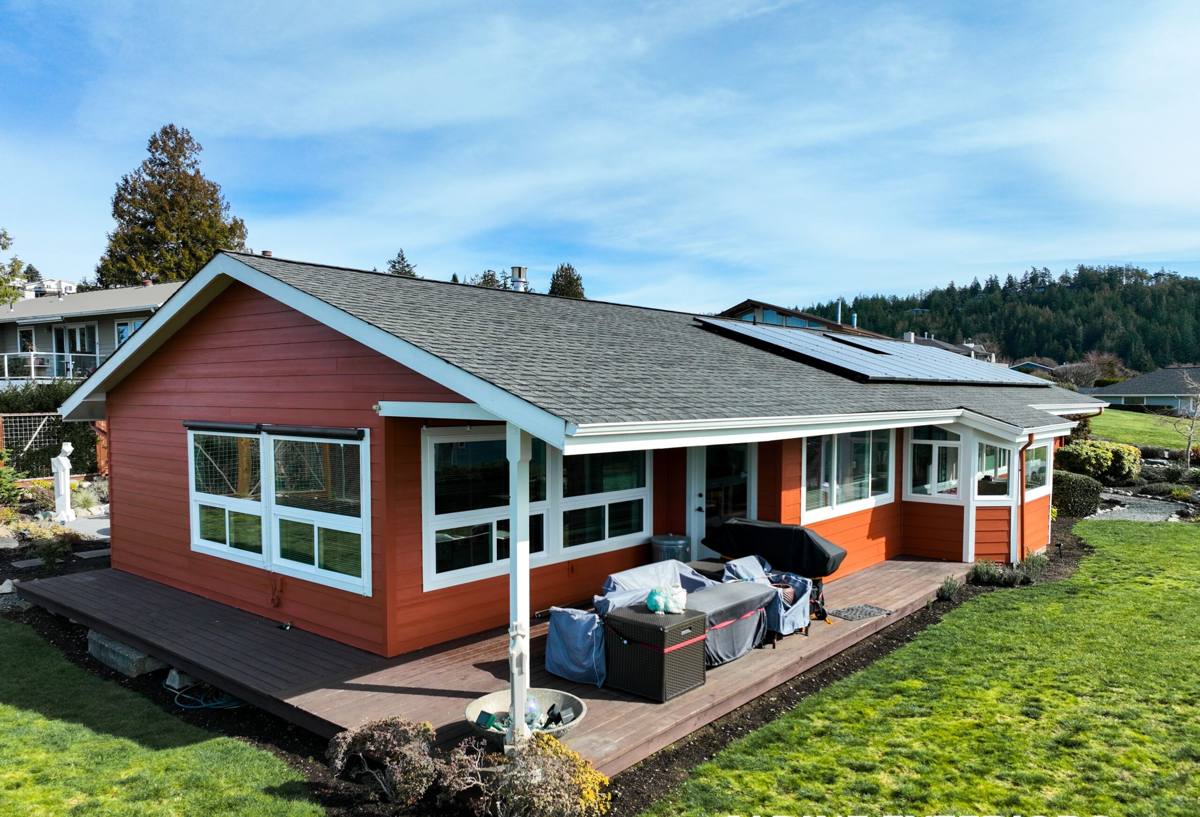
Homes around Flounder Bay sit close enough to the water that siding has to deal with more than ordinary Pacific Northwest weather. Salt-laden air off the marine waters near Anacortes works its way into seams, fastener heads, and any gap in the paint film. Add the driving rain that comes with wind off open water, and you get moisture finding its way behind siding through paths that would stay dry a mile inland. Then there's moss season — long and mild here in Skagit County — which turns north-facing walls and anything shaded by trees or neighboring structures into a slow-growing carpet of organic material that holds moisture against the wall for months at a time.
None of this means Flounder Bay is a bad place to own a home with wood-look siding. It means the siding has to be the right product, installed correctly, and repaired correctly when something goes wrong. A patch job that would hold up fine in a drier part of the state can fail fast this close to the water.
What Salt Air, Rain, and Moss Actually Do to Siding
Salt air and fastener corrosion
Airborne salt accelerates corrosion on exposed or under-driven fasteners, trim flashing, and any metal transition. Once a fastener starts rusting, it loses grip, siding boards work loose, and the fastener hole itself becomes an entry point for water. This is a slow process — it can take years to show up as a visible problem — but it's constant for homes near Flounder Bay in a way it simply isn't for homes further from the water.
Driving rain and wind-driven moisture
Wind off the water pushes rain sideways and upward into laps, corner boards, and anywhere trim meets a wall. Standard lap siding relies on gravity and correct overlap to shed water downward — wind-driven rain defeats that assumption at exposed corners and gable ends far more often here than on a sheltered inland lot.
Moss, algae, and trapped moisture
Moss doesn't just look bad. It holds water against the siding surface long after a storm has passed, which keeps the substrate damp and, on moisture-sensitive materials, invites rot or delamination. Anacortes' long wet season gives moss and algae months of the ideal growing conditions each year, so a wall that never gets direct sun can develop a moisture problem well before the paint itself starts to fail.
Signs Your Siding Needs Repair — Not Full Replacement
Most siding problems we see in this area are still repairable if they're caught before the damage spreads to the wall assembly behind the siding. Here's what to look for during a walk-around, especially after a wet winter:
- Soft or spongy spots when you press on a board, especially near the bottom courses or below windows
- Visible gaps, cupping, or buckling at butt joints and corners
- Rust streaks running down from fastener heads or metal trim
- Paint that's peeling or bubbling in a localized area rather than uniformly across the wall
- Moss or algae buildup that stays damp for days after rain stops
- Cracked or chipped boards near ground level, decks, or downspout discharge points
- Visible daylight or drafts at trim boards from inside an attic or crawlspace
If damage is limited to a few boards, isolated fastener failures, or a section of trim, repair is usually the right call. If soft spots show up in multiple areas, or you find moisture damage to the sheathing behind the siding when a board is pulled, that's a sign the problem has moved past what a patch can fix — and we'll tell you that honestly rather than repair over a hidden problem.
What a Correct Siding Repair Actually Involves
Finding the real cause, not just the visible damage
The visible damage — a cracked board, a stained corner — is usually a symptom. Before we replace anything, we trace where water is actually getting in. That might be a failed caulk joint, a flashing detail that was never installed correctly, a fastener that backed out, or grading and drainage pushing splash-back onto the wall. Repairing the board without fixing the entry point just buys you a repeat visit in a year or two.
Checking what's behind the siding
Any time we pull a damaged board, we check the water-resistive barrier and sheathing behind it. In a marine climate like this one, a small leak that's been active for a season or two can already be affecting the substrate even if the siding itself looks only mildly damaged. Catching that early is far cheaper than catching it late.
Matching material and finish
A repair should be close to invisible. That means matching board profile, exposure, and — where the siding is James Hardie ColorPlus — matching the factory finish rather than hand-brushing a close-but-not-quite paint color over new boards. Mismatched patches are one of the most common signs of a rushed repair.
Correct fastening and sealing for this climate
Given the corrosion exposure near the water, we use fasteners and flashing details rated for it, seal transitions with products built for exterior movement and moisture, and make sure new boards are fastened per manufacturer spec rather than "close enough."
Why the Siding Material Itself Changes What "Repair" Means
Not all siding repairs are equal, because not all siding behaves the same way once water gets behind it. This matters a lot for a shoreline-adjacent area like Flounder Bay, where moisture exposure is higher than average for Skagit County.
| Siding Type | How It Typically Fails Near Water | Repairability |
|---|---|---|
| James Hardie fiber cement | Fails at installation errors (poor flashing, wrong fastening) rather than the material itself; the board is non-combustible and doesn't rot | Individual boards can be cut out and replaced cleanly; ColorPlus finish can be matched |
| Vinyl | Cracks and becomes brittle with UV and temperature swings; wind can work panels loose at the coast | Repairs are usually visible since older vinyl color fades and discontinued profiles are hard to match |
| Wood or primed spruce | Absorbs moisture directly; rot spreads inside the board even when the surface looks intact | Often requires replacing more material than is visibly damaged, since rot travels |
| LP SmartSide / engineered wood | Edge and seam swelling if caulking and paint maintenance lapse, especially at cut ends | Repairable, but swollen sections often need replacement rather than patching |
We install and repair James Hardie fiber cement exclusively. That's a professional standard we hold for good reason: it's non-combustible, it's engineered in HZ5 formulations specifically for climates like ours, and because it doesn't absorb and swell the way wood-based products can, a well-diagnosed repair tends to stay fixed. That said, if your home already has vinyl, cedar, or LP siding, we'll still assess and repair it honestly — we just won't install those products new, and we'll explain why if a repair isn't the right long-term answer for the damage we find.
Our Repair Process
- Inspection and diagnosis — we look at the damaged area and the surrounding wall, not just the spot you called about, since Flounder Bay's exposure means problems often show up in more than one place at once
- Explaining what we find — including whether it's a true repair or whether damage has spread far enough that replacement of a section (or the wall) makes more sense
- Sourcing matching material — profile, exposure, and finish matched as closely as possible
- Removing only what's damaged — cutting back to sound material and checking the water-resistive barrier underneath
- Correcting the root cause — flashing, fastening, sealant, or drainage detail that let water in to begin with
- Installing and finishing the repair — to manufacturer spec, with attention to how the patch will weather against the existing wall over time
Why It Matters That We Already Work Flounder Bay
A crew that's worked the neighborhoods around Anacortes' waterfront knows which wall orientations take the worst of the wind-driven rain, which areas hold moss longest through the wet season, and what correct flashing looks like on homes built at different points over the years. That's not something you can fully substitute with a generic siding checklist — a repair strategy that's fine for an inland Skagit County home may not hold up on a lot with direct water exposure, and vice versa. We'd rather diagnose it right the first time than have you calling us back after the next winter storm.
Keeping Repaired Siding From Failing Again
A good repair is only half the equation — how the wall is maintained afterward matters just as much in this climate:
- Rinse moss and algae off shaded or north-facing walls before it builds up thick enough to hold moisture
- Keep gutters clear so overflow isn't running down the wall face
- Check caulk at trim and corner boards annually — this is usually the first thing to fail near the water
- Keep landscaping and irrigation from spraying directly onto the siding
- Address small issues (a loose board, a hairline crack) promptly rather than waiting for them to become water damage
What Affects the Cost of a Siding Repair
| Factor | Why It Matters |
|---|---|
| Extent of hidden water damage | Sheathing or framing damage behind the siding adds scope beyond the visible boards |
| Accessibility | Second-story walls, tight side yards, or areas near the water's edge take more time and equipment |
| Siding type and age | Matching a discontinued vinyl profile or an older Hardie color run is harder than matching current product lines |
| Root cause complexity | A simple fastener fix costs far less than correcting a flashing detail that requires opening up trim or a window surround |
| Finish matching | Factory-finished ColorPlus boards blend better than field-painted patches, which affects both cost and final appearance |
We give straight answers on which of these apply before any work starts, so there aren't surprises once a wall is opened up.
If you're seeing soft spots, moss buildup, or paint failure on a Flounder Bay home, we're happy to come take a look. Estimates are free, there's no pressure, and if what you've got is a true repair rather than a bigger project, we'll tell you that plainly. Use the form below to get on our schedule.