 Anacortes Roofing
 Bow's Siding Takes a Different Kind of Beating Than Town Does
Bow sits close enough to Samish Bay and the open water of Skagit County's coastline that homes here deal with a slightly different set of problems than a house a few miles inland in Anacortes proper. There's salt-laden air rolling off the bay, long stretches of driving rain that comes in sideways off the water, and shaded, tree-lined lots that hold moisture and grow moss for most of the year. None of that is dramatic on its own. The problem is what it does cumulatively, year after year, to whatever material is covering your walls.
A siding product that performs fine in a dry inland climate can struggle here. Salt air accelerates corrosion of fasteners and trim. Driving rain finds every gap, seam, and poorly flashed joint. Moss and algae hold moisture directly against the surface of the siding for weeks at a time, especially on north-facing walls and anything shaded by fir or cedar trees. This page is about what that means specifically for James Hardie fiber cement siding installed on a Bow home, and why the installation details matter as much as the product itself.
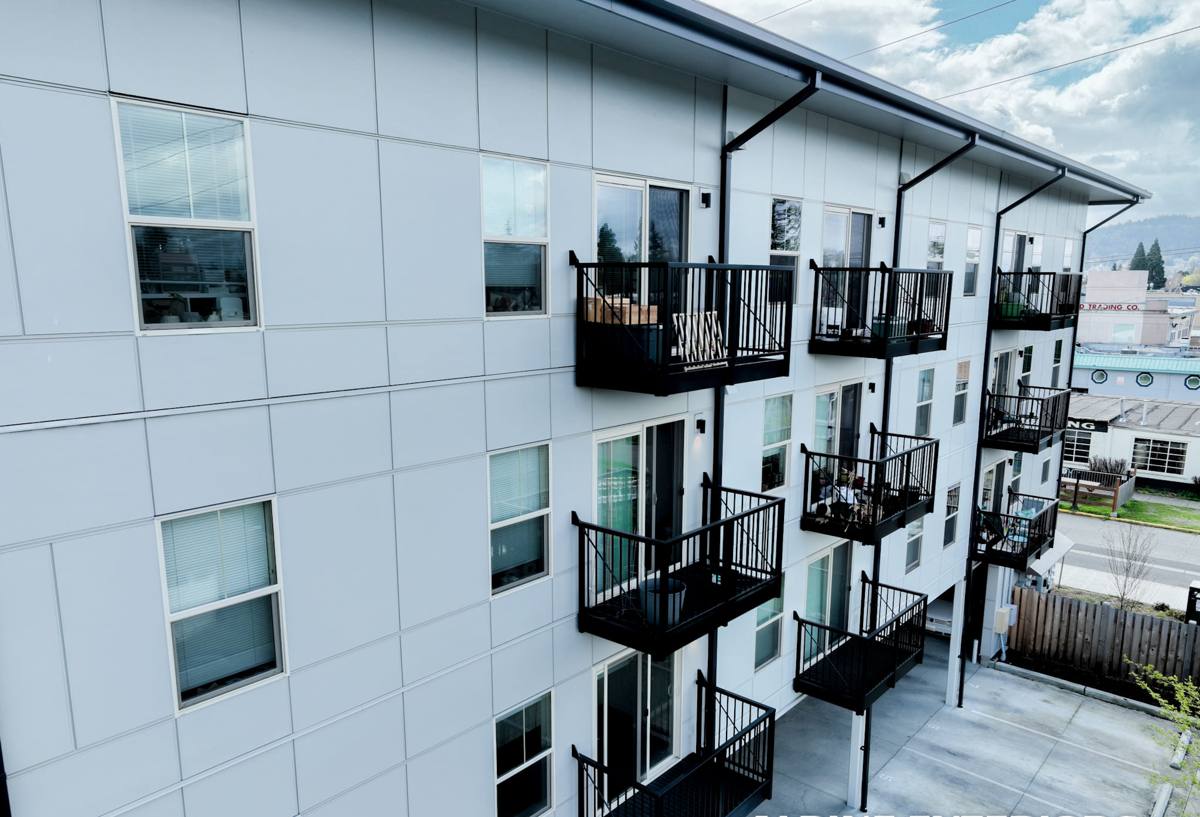
What Salt Air, Rain, and Moss Actually Do to a Wall Over Time
Salt Air
Airborne salt is corrosive to metal. Over years, it attacks exposed fasteners, flashing, and trim connectors faster than it would in a dry inland town. Siding systems that rely on exposed metal fasteners or thin trim pieces are more vulnerable here than they'd be twenty miles east.
Driving Rain
Wind-driven rain off the bay doesn't just fall straight down — it pushes horizontally into laps, seams, and butt joints. A siding system depends on correct overlap, flashing, and a working drainage plane behind it to shed that water. If any of those details are wrong, water gets behind the siding instead of running off it, and that's where rot starts — quietly, out of sight, for years before anyone notices.
Moss and Long-Term Moisture
Skagit County's moss season runs long, and shaded or tree-covered lots in Bow tend to hold it worse than open, sunnier sites. Moss and algae aren't just cosmetic — they hold moisture directly against the siding surface, which matters a lot more for materials that absorb water (wood, some composites) than for materials engineered to resist it. Moss also tends to build up fastest in the areas that get the least sun and the least airflow, which is often the same areas where a wall is most exposed to wind-driven rain.
Why We Install Only James Hardie Fiber Cement
We made a decision a long time ago to install one siding system and stand behind it, rather than offer a menu of products at different price points. We do not install vinyl siding, LP SmartSide, Cemplank, Allura, primed spruce, or cedar. That's not a knock on every homeowner who has one of those products on their house today — it's a statement about what we're willing to warranty our labor against in this climate.
James Hardie fiber cement is non-combustible, dimensionally stable, and manufactured with a specific product line — HZ5 — engineered for the wetter, harsher climate zones on the West Coast. It doesn't absorb water the way wood-based products do, it holds paint and factory finish far longer than primed wood, and it doesn't feed moss and algae growth the way organic materials can. The ColorPlus factory finish is baked on under controlled conditions, which gives more consistent, longer-lasting color than field-applied paint — a real advantage on a coastal wall that's going to see UV, salt, and moisture for decades.
| Factor | James Hardie Fiber Cement | Vinyl / LP SmartSide / Cedar |
|---|---|---|
| Moisture absorption | Engineered to resist water intrusion (HZ5 line) | Wood-based products absorb moisture; vinyl can trap moisture behind it |
| Combustibility | Non-combustible | Combustible (wood, engineered wood) or heat/warp-prone (vinyl) |
| Finish longevity | Factory-applied ColorPlus, warranted separately from the siding | Field-applied paint or factory coatings with shorter warranty terms |
| Moss/algae behavior | Non-organic substrate, doesn't feed growth | Organic substrates can hold moisture and support growth over time |
| Typical warranty structure | Long-term, non-prorated limited warranty on the siding itself | Varies widely by product and manufacturer |
We're not saying every alternative product fails — plenty of homes around Skagit County have vinyl or cedar siding that's held up reasonably well. What we're saying is that once we compared what each product needs to perform well against what Bow's climate actually delivers, Hardie was the one system we were comfortable putting our name behind without qualifications.
What Correct Installation Actually Involves
The material is only half the equation. Most siding failures we get called out to inspect — regardless of brand — trace back to installation shortcuts, not the product itself. A correct Hardie installation in a climate like Bow's includes:
- A properly lapped, continuous weather-resistive barrier behind the siding, with all seams taped or shingled correctly to shed water downward
- Correct fastener type, spacing, and embedment per James Hardie's installation instructions — not generic nail-gun defaults
- Flashing at every window, door, and horizontal trim transition, installed to direct water out and away from the wall assembly
- Proper clearance at the bottom of the siding — off the ground, off decks, off roof lines — so water and moss don't get a permanent foothold
- Correct joint treatment at butt seams and corners, sealed or flashed per manufacturer spec rather than caulked and hoped for
- An airspace or drainage plane behind the siding so any incidental moisture that gets past the surface can drain and dry out
Skip any one of these and you can end up with a wall that looks right for a few years and then fails quietly behind the surface — which is a much more expensive problem to fix than it would have been to do correctly the first time.
Our Process for a Bow Siding Job
1. On-Site Assessment
We walk the exterior, check the current siding and sheathing condition (especially on north-facing and shaded walls where moss and moisture tend to concentrate), and look at existing flashing, trim, and drainage details before quoting anything.
2. Product and Line Selection
We spec the appropriate HardiePlank, HardiePanel, or HardieShingle profile and the HZ5 climate line for the exposure your home actually faces, along with matching HardieTrim.
3. Prep and Moisture Check
Old siding comes off, and we inspect the sheathing underneath for any rot or moisture damage before it gets covered back up — this is the point where hidden problems get caught, not after the new siding is already on.
4. Installation to Spec
Weather-resistive barrier, flashing, fastening, and joint treatment all done to James Hardie's published installation requirements — not shortcuts that might look fine on day one.
5. Final Walkthrough
We walk the finished job with you, check trim lines, caulking, and clearances, and make sure everything's buttoned up before we call it done.
Why a Crew That Already Works Bow Matters
Bow isn't a large market, and it isn't downtown Anacortes either — it's a mix of rural acreage, waterfront-adjacent lots, and tree-covered properties, each with its own wind exposure, shade pattern, and moss pressure. A crew that's already worked this specific area knows which walls tend to take the worst of the driving rain, which lots need extra attention to ground clearance and drainage because of tree cover, and how Skagit County's permitting and inspection process works for exterior work. That's not something you can fully substitute with a crew that mostly works a different climate zone or a different county, even if they're competent installers in general.
Signs Your Current Siding May Already Be Struggling
- Persistent moss or dark streaking that comes back within weeks of cleaning
- Soft spots, bubbling, or visible warping, especially near the bottom courses or around windows
- Paint that's peeling or alligatoring rather than just fading
- Visible gaps opening up at seams, corners, or trim joints
- A musty smell or interior wall staining near exterior walls, which can indicate moisture has already gotten past the siding
If you're seeing any of these, it's worth having someone take a real look before it turns into a sheathing or framing repair instead of a siding job.
What Maintenance Looks Like Going Forward
James Hardie siding is low-maintenance compared to wood, but "low-maintenance" doesn't mean "no maintenance" in a climate like this one. A periodic rinse to keep moss and organic buildup from taking hold, an eye kept on caulking at joints and trim over the years, and prompt attention to any physical damage (a ladder strike, a fallen branch) go a long way toward getting the full service life out of the system and keeping the ColorPlus finish warranty intact.
If you're weighing a siding replacement on a home in Bow, we're glad to come out, look at what you've currently got, and give you a straight, no-pressure estimate for doing it right with James Hardie. There's a short form below — reach out and we'll set up a time to take a look.