 Anacortes Roofing
 Flounder Bay Sits Right at the Edge of the Weather
Flounder Bay is one of the more exposed pockets of Fidalgo Island. Homes here sit close to the water, which means siding takes on three things at once: salt-laden air drifting off the bay, wind-driven rain that hits walls sideways instead of straight down, and a shade-and-moisture combination that keeps moss and algae active for most of the year. Any one of those is manageable. All three together, year after year, is what actually wears out a house's exterior.
Salt air is corrosive to metal fasteners and trim, and it accelerates the breakdown of paint film on anything not engineered to resist it. Driving rain doesn't just wet the surface of a wall — it finds every seam, nail head, and butt joint and tries to push moisture behind the cladding. And Skagit County's long wet season, combined with tree cover and low winter sun angles common around Flounder Bay, gives moss and algae a long runway to establish on north- and west-facing walls. Siding decisions made for a drier, more sheltered lot inland don't hold up the same way out here.
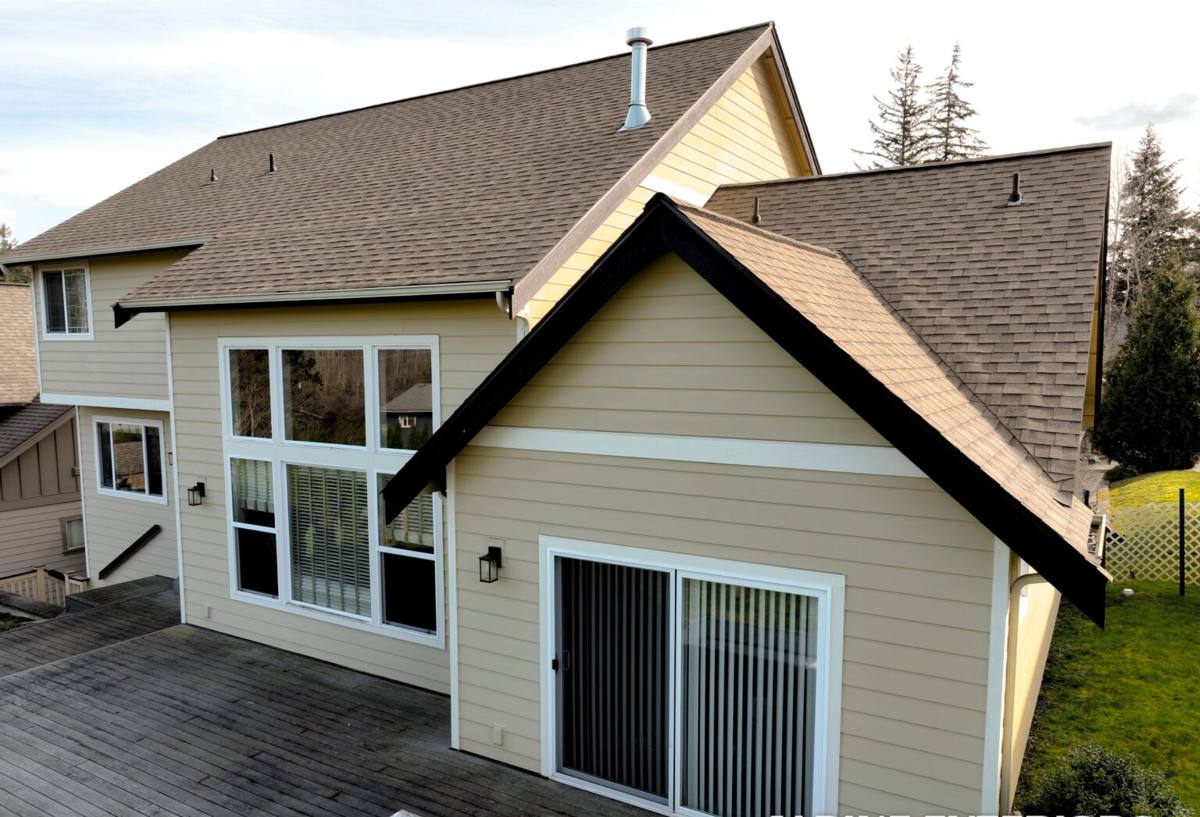
Why We Install Only James Hardie Fiber Cement
We standardized on James Hardie siding company-wide, and waterfront neighborhoods like Flounder Bay are a good example of why. Hardie's fiber cement is non-combustible, dimensionally stable when wet or dry, and doesn't feed moss and algae growth the way wood-based products can. The factory-applied ColorPlus finish is baked on under controlled conditions and formulated to resist UV and moisture-driven fading — which matters more here than in a typical inland yard, because salt air and constant damp cycling are harder on painted surfaces than dry heat ever is.
Hardie also builds siding lines specifically for different exposure levels. For a location like Flounder Bay, we typically spec their HZ10 climate configuration, engineered for wetter, harsher weather zones, rather than the standard configuration built for milder inland conditions. It's a small distinction on paper but it affects how the product is formulated to handle sustained moisture exposure — exactly the condition this neighborhood deals with for months at a stretch.
What This Means Compared to Other Materials
We don't install vinyl, LP SmartSide, cedar, or primed spruce, and we're upfront about why: each of those has a real weak point in a marine-influenced climate. Vinyl can warp and its seams open under repeated wet-dry cycling. Wood-based and engineered wood products need consistent paint maintenance to keep moisture out, and a missed cycle near salt air shows up faster than it would inland. Cedar looks great new but requires ongoing sealing and is a natural food source for the same moss and algae this area already fights. None of these are bad products in every setting — they're just not the right fit for a wall that faces Flounder Bay's specific combination of salt, rain, and shade.
What a Correct Installation Actually Involves
The material is only half the equation. Most siding failures we get called out to inspect — on any brand — trace back to installation shortcuts, not the product itself. For Flounder Bay homes specifically, we pay extra attention to a few details that matter more here than elsewhere in Anacortes:
- Drainage plane and rain screen gap: a continuous water-resistive barrier behind the siding with a ventilated gap, so any moisture that gets past the cladding has somewhere to drain and dry instead of sitting against the sheathing.
- Flashing at every penetration: windows, doors, hose bibs, and vents all need properly lapped flashing so wind-driven rain can't work its way in sideways, which is the dominant rain pattern this close to the water.
- Correct fastener type and placement: corrosion-resistant fasteners driven per Hardie's blind- or face-nailing specs — placement and depth affect both the warranty and how the boards perform over time.
- Ground and roof clearance: Hardie specifies minimum clearances from grade, decks, and roof lines. Skipping these is one of the most common shortcuts we find on inspections, and it's a direct path to moisture wicking into the bottom of the boards.
- Joint and butt seam treatment: factory-primed edges get field-primed or sealed per spec at every cut, since an unsealed cut edge is a moisture entry point regardless of how good the rest of the installation is.
Skip any one of these and the siding can still look fine for a year or two. In a location like Flounder Bay, problems from a shortcut installation tend to show up faster — usually as staining, soft spots near the bottom courses, or paint failure at the seams — because the environment is actively testing every weak point in the assembly.
Our Process for Flounder Bay Homes
1. On-Site Assessment
We walk the exterior and look at exposure by wall — which sides face prevailing wind and rain, where moss is already established, where trim or fascia shows early wear. This tells us which Hardie products, colors, and detailing make sense for that specific house rather than a one-size answer.
2. Tear-Off and Substrate Check
Old siding comes off and we inspect the sheathing underneath for rot or hidden moisture damage before anything new goes up. Catching a soft spot now is far cheaper than finding it after new siding is already installed over it.
3. Water-Resistive Barrier and Rain Screen
We install a continuous drainage plane with a vented rain screen gap, which is standard on every job we do but carries more weight in a wind-driven-rain environment like this one.
4. Installation to Hardie Spec
Fastening, clearances, flashing, and joint treatment are done to manufacturer specification — not just "close enough" — because that's what keeps the transferable warranty intact and what actually performs against salt air and moss over the long run.
5. Final Walkthrough
We review the finished work with the homeowner, point out any maintenance items (gutter clearance, plantings too close to walls, areas to keep an eye on for moss regrowth), and leave documentation for the warranty.
What We Commonly See on Waterfront Anacortes Homes
When we inspect existing siding in and around Flounder Bay, a handful of issues show up repeatedly:
- Moss and algae staining concentrated on shaded north- and west-facing walls, often worse near tree cover or fences that block airflow.
- Caulk failure at butt joints and trim, usually from sun and salt exposure breaking down sealant faster than the manufacturer's stated service life.
- Bottom-course damage where siding was installed too close to grade, a deck, or a lower roofline, letting splash-back and standing moisture sit against the material.
- Faded or chalking paint film on older, field-painted siding, which ColorPlus factory finish is specifically designed to resist.
None of these are unusual problems — they're the predictable result of this specific climate acting on siding over enough years. The fix is rarely "replace with the same thing done the same way." It's addressing the underlying detail (clearance, ventilation, sealant, finish) as part of the new installation.
Choosing Product and Color for This Location
For homes closer to the water, we lean toward Hardie's climate-specific HZ10 configuration and ColorPlus finishes over field-applied paint, since the factory finish holds up better against the fade and chalking that salt air and constant moisture cycling can cause. Color choice matters too — darker colors absorb more heat and can show fade differently than lighter tones over time, and texture (smooth versus cedar-grain) affects how visible moss growth is if it does establish before a cleaning cycle. We walk through these tradeoffs with each homeowner rather than defaulting to a single answer.
Cost Factors for This Area
| Factor | Why It Affects Flounder Bay Jobs Specifically |
|---|---|
| Wall exposure and access | Waterfront lots and tighter setbacks can affect staging, scaffolding, and material handling |
| Substrate condition | Homes near the water more often reveal hidden moisture damage once old siding is removed |
| Product line (HZ5 vs. HZ10) | Climate-specific configurations cost somewhat more but are matched to this exposure level |
| Finish choice | ColorPlus factory finish vs. field-primed-and-painted trim changes both cost and long-term maintenance |
| Detailing scope | Additional flashing, rain screen work, and clearance corrections add labor but reduce future callbacks |
We provide a written estimate that breaks these out so homeowners can see exactly what they're paying for and why, rather than a single lump-sum number.
Why a Crew That Already Works This Neighborhood Matters
Anacortes and Skagit County as a whole have their own permitting requirements, and waterfront-adjacent lots sometimes carry additional considerations around setbacks or drainage that a crew unfamiliar with the area might miss. Beyond paperwork, a crew that has already worked Flounder Bay and similar Fidalgo Island locations has seen firsthand how salt air, wind direction, and shade patterns actually play out on real houses here — not just in a manufacturer's general climate zone map. That local pattern recognition is what shows up in better detailing decisions on your specific lot, not just a correctly installed product in the abstract.
Questions Worth Asking Any Siding Contractor Here
- Which Hardie product line and finish are you specifying for this exposure, and why?
- How will you handle rain screen ventilation and flashing at penetrations?
- What clearance will the bottom course have from grade, decks, and roofs?
- Is the warranty transferable, and what maintenance keeps it valid?
- Can you show recent work on similarly exposed homes in this area?
If your Flounder Bay home's siding is showing moss, fading, caulk failure, or you're just planning ahead for a replacement, we're happy to walk the property with you and talk through what's actually needed here. There's a form below to request a free, no-pressure estimate.