 Anacortes Roofing
 Siding Built for La Conner's Waterfront Climate
La Conner sits right on the Swinomish Channel, tucked between saltwater tidal flats and the farmland of the Skagit Valley. That location gives the community its character, but it also puts a lot of stress on a home's exterior. Salt-laden air moves off the water and settles on siding, trim, and fasteners. Winter storms bring driving rain that hits walls sideways instead of straight down. And the mix of shade, moisture, and mild temperatures that Skagit County sees for much of the year creates ideal conditions for moss and algae to take hold on anything that stays damp too long.
Siding in this part of Skagit County isn't just a cosmetic layer. It's the first line of defense against a climate that combines coastal exposure with the Pacific Northwest's long wet season. When it's installed correctly, with the right material and the right detailing, it holds up for decades. When it's installed by someone unfamiliar with what this specific location throws at a house, problems show up early — usually at the seams, the trim joints, and the bottom few feet of wall closest to the ground.
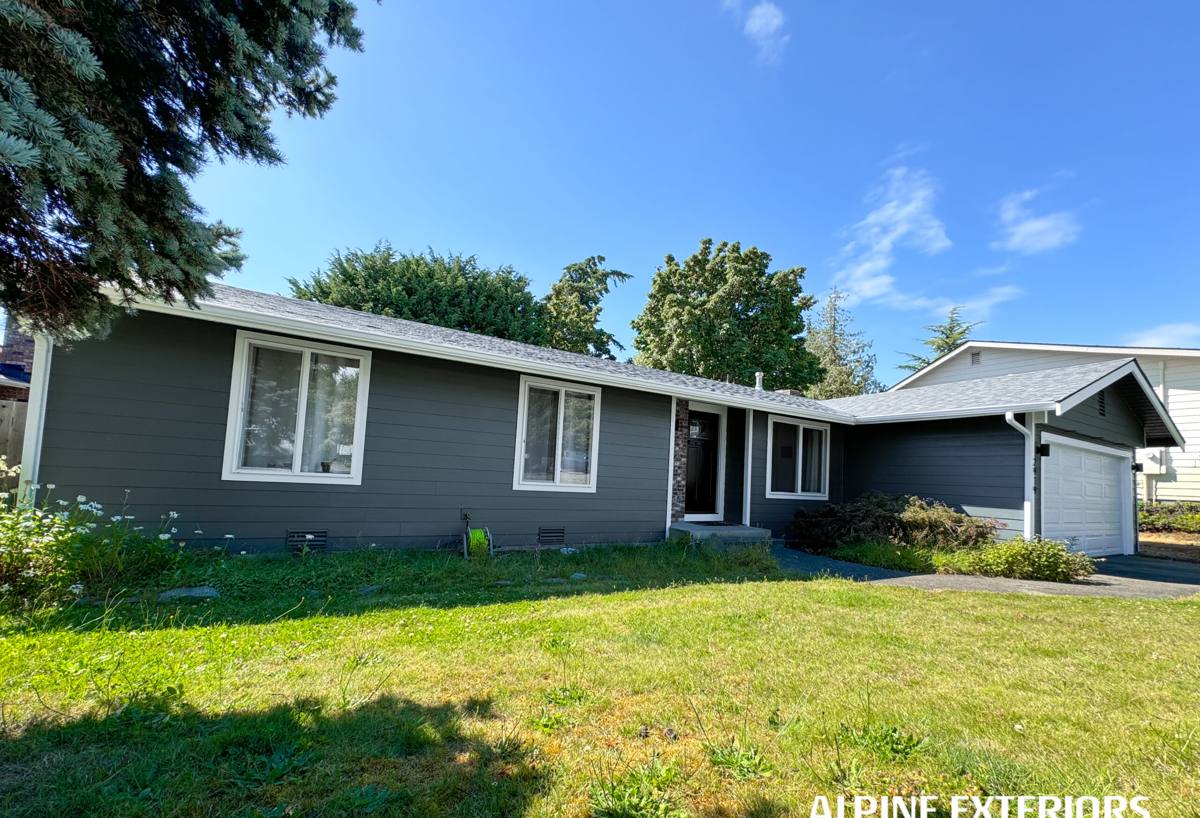
What Salt Air and Driving Rain Actually Do to Siding
It helps to understand the specific mechanisms at work, because they explain why certain materials and installation choices matter more here than they would inland.
Salt Air
Airborne salt is corrosive to metal fasteners, flashing, and hardware. Over years, uncoated or under-rated fasteners can weaken, staining the siding face and eventually compromising the fastening itself. Salt exposure also accelerates the breakdown of lower-quality paint films, which is part of why factory-applied finishes matter more near the water than they do a few miles inland.
Driving Rain
Wind-driven rain off the channel doesn't just run down a wall — it gets pushed sideways and upward into laps, seams, and penetrations. Siding systems that aren't lapped, flashed, and caulked correctly at those points will eventually let water behind the cladding, where it can sit against sheathing and framing.
Moss and Algae Season
Shaded walls, north-facing exposures, and anything near mature trees or dense landscaping stay damp longer here than in drier parts of the state. That extended dampness is exactly what moss and algae need to establish. Porous or absorbent siding materials give organic growth something to grip; harder, factory-finished surfaces are far more resistant.
What a Correct Siding Installation Involves
A siding job that's going to hold up in La Conner isn't just nailing boards to a wall. It's a system, and every layer matters.
- Weather-resistant barrier: A continuous, correctly lapped water-resistive barrier behind the siding, with all penetrations sealed, so any moisture that does get past the cladding has a way to drain out rather than sitting against the sheathing.
- Proper flashing: Window and door flashing, head flashing above openings, and kick-out flashing where rooflines meet walls — all critical in a driving-rain environment, and all places where shortcuts show up as leaks years later.
- Correct fastening: Fastener type, length, and spacing matched to the siding manufacturer's specifications and to this region's wind and moisture exposure, using corrosion-resistant fasteners appropriate for a salt-air environment.
- Ground clearance: Adequate clearance between the bottom of the siding and grade, decks, and roof surfaces, so splash-back and standing moisture don't sit against the material.
- Sealed joints and trim: Butt joints, corners, and trim transitions caulked with a product rated for the movement and moisture conditions here, not just whatever's cheapest.
- Manufacturer-spec installation: Following the siding manufacturer's actual installation instructions for this climate zone — the instructions exist because they were written for conditions like La Conner's, and skipping steps is where most premature failures start.
Why We Install James Hardie Fiber Cement Only
We install James Hardie fiber cement siding exclusively. We don't install vinyl, LP SmartSide, primed spruce or cedar lap, or other fiber cement brands. That's a deliberate standard, not a limitation of what we're capable of installing.
Fiber cement is non-combustible, which matters increasingly across Western Washington as wildfire risk becomes part of the conversation even in wetter counties like Skagit. It doesn't absorb moisture the way wood-based products can, which matters directly in a climate defined by driving rain and long damp stretches. James Hardie's ColorPlus factory finish is baked on under controlled conditions, giving it better resistance to fading, chipping, and the kind of surface breakdown that salt air accelerates on field-painted products. And Hardie manufactures specific HZ (HardieZone) product lines engineered for different climate zones — the Pacific Northwest's combination of moisture and moderate temperatures is exactly the kind of condition those product lines are built around.
We're not going to tell homeowners that other siding materials don't work anywhere — they do, in the right application, installed correctly. But for a waterfront community like La Conner, where salt exposure, wind-driven rain, and moss season all stack on top of each other, we've made the call that fiber cement from a manufacturer that engineers specifically for this climate is what we're willing to put our name behind. Vinyl can warp and fade under sustained sun and temperature swings and doesn't hold paint if a color change is ever wanted. Wood-based products, even primed, need consistent maintenance to keep moisture out once the factory coating is compromised. Those are real trade-offs, not defects — they're just trade-offs we'd rather homeowners not discover the hard way.
How Local Siding Material Options Compare
| Material | Salt Air Resistance | Moisture Behavior | Moss/Algae Resistance | Maintenance Burden |
|---|---|---|---|---|
| James Hardie Fiber Cement | Strong — non-combustible, factory finish | Doesn't absorb moisture like wood | Strong — hard, factory-finished surface | Low — periodic rinse, repaint on a long cycle if ever needed |
| Vinyl | Moderate — can fade with sun/salt over time | Doesn't absorb water, but seams can allow water behind panels | Moderate — smooth but can trap grime in laps | Low, but limited repair/color options if damaged |
| Primed Wood / Cedar | Weaker — coating breaks down faster near salt air | Absorbs moisture if coating fails | Weaker — organic material, needs regular treatment | High — repainting and sealing on a recurring cycle |
| LP SmartSide / Other Fiber Cement | Varies by product and coating system | Varies — check manufacturer moisture testing for this climate | Varies by finish quality | Varies — often moderate |
Our Process for a La Conner Siding Installation
- On-site assessment: We walk the home, checking existing siding condition, trim, flashing, moisture points, and any areas showing early moss, staining, or soft spots — common where shade and channel-side exposure overlap.
- Tear-off and inspection: Once old siding is removed, we inspect the sheathing and framing underneath for hidden moisture damage before anything new goes on. This step catches problems that would otherwise get sealed behind a new wall.
- Weather barrier and flashing installation: We install a continuous water-resistive barrier and flash every window, door, and roof-to-wall transition before the first piece of siding goes up.
- James Hardie installation to manufacturer spec: Panels or lap siding installed with correct fastener type, spacing, and clearance, following James Hardie's published installation requirements for this climate zone.
- Trim, caulking, and detail work: Corners, joints, and penetrations sealed with climate-appropriate materials — the details that determine whether a job holds up through its first few Skagit County winters or starts showing problems early.
- Final walkthrough: We review the finished work with the homeowner and flag any maintenance basics specific to the home's exposure and site.
Why a Crew That Already Works in La Conner Matters
Siding installation isn't identical everywhere, even within the same county. A crew that regularly works close to the Swinomish Channel already knows which walls take the worst of the driving rain, which exposures need extra attention to moss and algae resistance, and how salt-air exposure changes fastener and flashing choices compared to a job further inland in Skagit County. That familiarity shows up in fewer surprises during tear-off, better sequencing around weather windows, and detailing that accounts for this specific waterfront environment rather than a generic install.
Local permitting and inspection expectations are also consistent when a crew has already worked through them nearby — it keeps the project moving instead of stalling on paperwork or rework.
Signs Your La Conner Home May Need New Siding
- Persistent moss or algae growth that returns shortly after cleaning, especially on shaded or channel-facing walls
- Soft spots, bubbling, or visible warping in the siding surface
- Paint that's peeling or chalking faster than expected, particularly on walls with direct salt-air exposure
- Visible gaps, cracking, or separation at seams, corners, and trim joints
- Staining or discoloration around fasteners or trim, which can indicate corrosion or moisture intrusion
- Rising energy bills that may point to compromised insulation or air sealing behind aging siding
What to Ask Before Hiring a Siding Contractor Here
Given how much correct detailing matters in this climate, a few questions separate a contractor who understands the local conditions from one who doesn't:
- Do you install to the siding manufacturer's published specifications for this climate zone, or a generic standard?
- What weather-resistive barrier and flashing approach do you use around windows, doors, and roof-to-wall transitions?
- What fastener type and spacing do you use, and are they rated for a salt-air environment?
- Have you worked on homes near the Swinomish Channel or similar Skagit County waterfront locations before?
- What does your warranty cover, and is it backed by the manufacturer as well as your labor?
If your La Conner home's siding is showing its age, or you're planning ahead for a replacement, we're happy to walk the property, explain what we're seeing, and put together a straightforward, no-pressure estimate. Use the form below to get started.