 Anacortes Roofing
 Why Storm Damage Repair Looks Different in Mount Vernon
Mount Vernon sits inland along the Skagit River, in a valley that channels weather rather than blocking it. Storms rolling off the Salish Sea and Puget Sound don't lose much punch by the time they reach the valley floor — if anything, the terrain can funnel wind and driving rain in ways that catch homeowners off guard. Roofs here don't take the direct salt spray that roofs on Fidalgo Island or the immediate waterfront do, but the same moisture-laden marine air still moves through, and it still leaves roofing materials damp for long stretches at a time.
That dampness is the real story. Skagit County's moss season isn't a two-month nuisance — it's most of the year on a shaded or north-facing slope. Combine that with periodic windstorms that lift shingles, drop branches, and drive rain sideways under flashing, and you get a specific failure pattern that's different from what a drier climate produces. A storm damage repair in Mount Vernon has to account for both the acute event — the wind, the impact, the sudden leak — and the chronic moisture load the roof was already carrying before the storm hit.
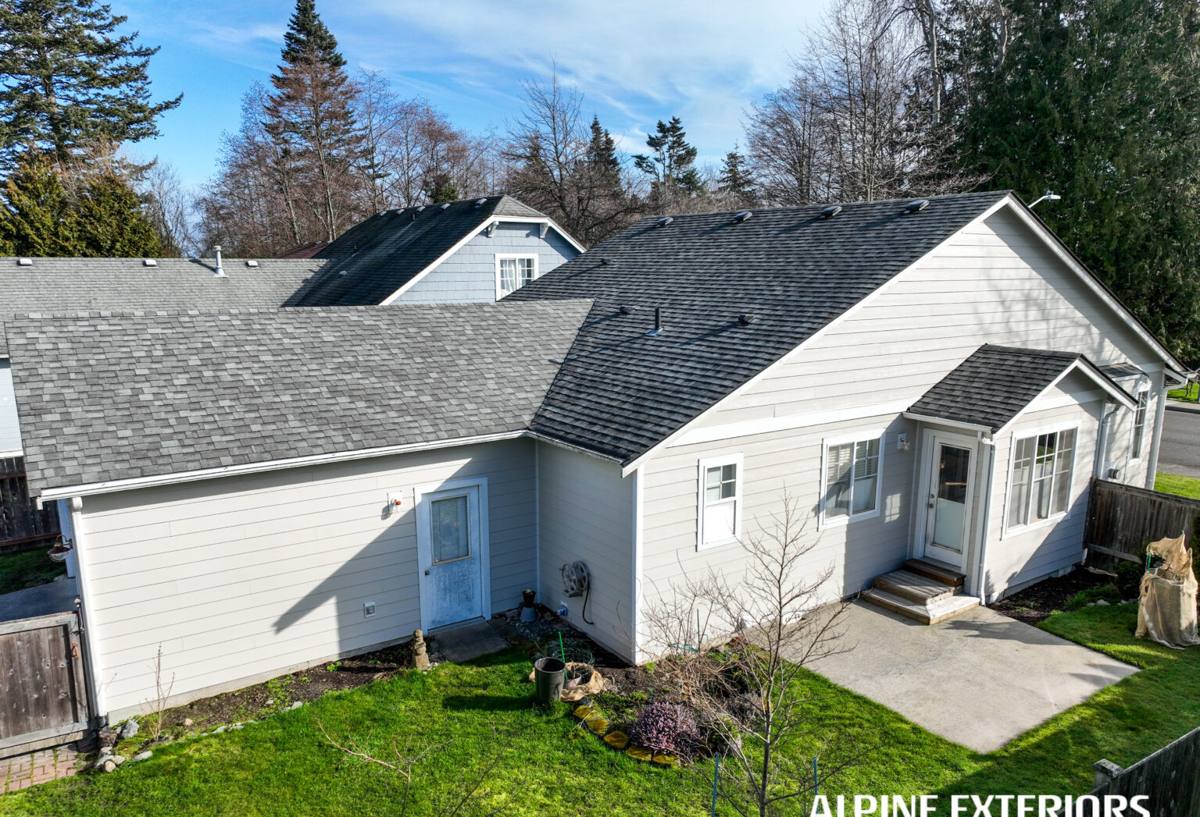
What Storms Actually Do to a Skagit County Roof
Wind
Sustained valley wind doesn't need to be a named storm to do damage. It works shingle tabs loose at the edges and ridgelines first, then works inward. Once a few tabs lift, the next windstorm has something to grab, and the damage compounds fast. Wind damage is often invisible from the ground — it shows up as a leak weeks later, not a missing shingle you can spot from the driveway.
Rain intrusion
Driving rain finds the weak points a calm rain never would: nail heads that have backed out slightly, flashing laps that have opened a fraction of an inch, valleys where debris has built up. Once wind-driven rain gets under the first course of shingles, it can travel a surprising distance along the underlayment before it ever shows as a ceiling stain.
Moss and organic growth
Moss doesn't just look bad — it holds water against the shingle surface, lifts shingle edges as it grows, and breaks down the granule coating that protects the asphalt underneath. A roof with heavy moss going into a windstorm is far more likely to lose shingles than a clean one, because the moss has already loosened the seal.
Debris impact
Falling branches and wind-blown debris cause the damage everyone expects, but the impact often does more than crack a shingle — it can bruise the mat underneath in a way that isn't visible until the shingle starts to fail from that spot months later.
Signs Your Mount Vernon Roof Has Storm Damage
Not every sign is dramatic. Some of the most costly damage looks minor at first glance. After any significant wind or rain event, it's worth checking for:
- Shingles that look lifted, curled, or slightly out of line with their neighbors
- Granules collecting in gutters or at downspout outlets
- New or worsening moss growth along ridges, valleys, or shaded slopes
- Flashing around chimneys, skylights, or vent pipes that looks bent, separated, or rusted
- Ceiling stains, especially ones that appear or grow after a storm rather than gradually
- Sagging or soft spots in the roof deck, visible from the attic side
- Debris buildup in valleys that's holding water against the shingles
Any one of these on its own might be nothing. A few together, especially right after a storm, is worth a proper inspection before the next round of weather.
What a Correct Storm Damage Repair Actually Involves
A quick shingle swap can hide a repair that isn't actually finished. Storm damage that penetrated the surface layer usually affected more than the shingle — and a repair that only addresses what's visible tends to fail again in the next storm. A correct repair typically includes:
A full-slope inspection, not just the reported leak
Wind and rain damage rarely stays confined to one spot. We check the whole slope the damage is on, plus adjoining slopes and penetrations, before writing a scope.
Underlayment and decking assessment
If water made it past the shingles, the underlayment and deck sheathing beneath need to be checked for saturation or rot. Replacing shingles over a compromised deck just delays the next failure.
Flashing repair or replacement
Most storm leaks trace back to flashing — around chimneys, skylights, sidewalls, and valleys — rather than the shingle field itself. Flashing gets evaluated on its own, not assumed to be fine because the shingles nearby look new.
Matched materials where possible
We try to match existing shingle color and profile as closely as the manufacturer's current line allows, so a repair blends rather than standing out as a patch. On older roofs, an exact match sometimes isn't available — we'll tell you that honestly rather than promise a seamless result we can't deliver.
Repair or Replace? What Actually Decides It
Storm damage doesn't automatically mean a full replacement, and it doesn't automatically mean a simple patch either. The right call depends on a few honest factors:
| Factor | Favors Repair | Favors Replacement |
|---|---|---|
| Age of existing roof | Under half of expected lifespan, in otherwise good condition | Nearing or past expected lifespan |
| Extent of damage | Isolated to one slope or a few sections | Spread across multiple slopes or the ridge line |
| Decking condition | Dry, solid sheathing under the damaged area | Soft, delaminated, or water-stained decking |
| Moss and granule loss history | Minimal prior wear, good maintenance history | Heavy moss and granule loss across large areas already |
| Material availability | Close color/profile match available | Discontinued material, mismatch would be very visible |
We walk through these factors with you on-site rather than defaulting to whichever answer is more profitable. Plenty of storm calls genuinely are a straightforward repair, and we'll say so.
Our Storm Damage Repair Process
- Inspection and documentation. We get on the roof, photograph the damage and its likely cause, and check adjoining areas for related issues.
- Temporary protection if needed. If there's an active leak or exposed decking, we address that first so the interior of your home isn't taking on more water while repairs are scheduled.
- Written scope and honest options. You get a clear description of what's damaged, what caused it, and what repair or replacement options make sense — with reasoning, not just a price.
- The repair itself. Matched materials, correct flashing detail, and proper fastening — done to the same standard as new work, not a shortcut because it's "just a repair."
- Site cleanup. Old materials, nails, and debris removed from the roof and the ground around your home.
- Follow-up. We stand behind the workmanship and will come back if something related to that repair doesn't hold up.
Working With Your Insurance Claim
Many storm repairs in Mount Vernon go through a homeowner's insurance claim, and how that process goes often comes down to documentation. We provide clear photos and a written description of the damage that distinguishes storm-caused damage from ordinary wear, moss buildup, or age-related wear that predates the storm. Insurers generally cover the former and not the latter, and an honest, well-documented scope helps your claim move faster and avoids disputes later. We won't inflate a scope to pad a claim — our job is to give you an accurate picture so you and your adjuster can make a fair decision.
Why a Crew That Already Works Mount Vernon Matters
Storm damage repair rewards familiarity. A crew that regularly works roofs in Mount Vernon and the surrounding Skagit County area already knows which shingle lines and colors are common on homes built in the area's typical eras, which cuts down on mismatched patches. We're also familiar with the local permitting process for larger repairs, and we know how fast weather can turn in the valley — which matters when a tarp needs to go on before the next front arrives, not two days later.
Just as important is response time after a storm. When wind events hit the region, demand for roof repair spikes all at once. A local crew that isn't dispatching from far outside the area can generally get to an active leak sooner, which limits interior damage and keeps a repair from turning into a much bigger job.
Get a Straightforward Look at Your Roof
If a recent storm has you wondering about your roof, we're happy to take a look and give you a straight answer — repair, replace, or nothing urgent at all. Fill out the form below for a free, no-pressure estimate.