 Anacortes Roofing
 Deck Repair, Built for How Sedro-Woolley Actually Weathers
Sedro-Woolley sits in the Skagit River valley, tucked between farmland and the foothills of the Cascades, a little inland from the saltwater that shapes so much of the rest of Skagit County. That inland position doesn't mean your deck gets off easy. Surrounded by hills and heavy tree cover, the valley traps moisture instead of letting it move through the way it does closer to open water. Fog sits longer in the morning. Rain lingers on wood surfaces instead of drying off in a stiff breeze. And the salt-laden air that rolls in off the Sound still reaches far enough to accelerate corrosion on fasteners, hinges, and any exposed metal hardware on outdoor structures throughout the county, decks included.
Add in the region's long, wet stretch of fall through spring, and you've got a near-ideal setup for moss, algae, and slow wood decay to take hold on any deck that isn't built or maintained with that in mind. We've repaired decks all over this area long enough to know exactly where the damage starts and how to fix it so it stays fixed, not just patched until next season.
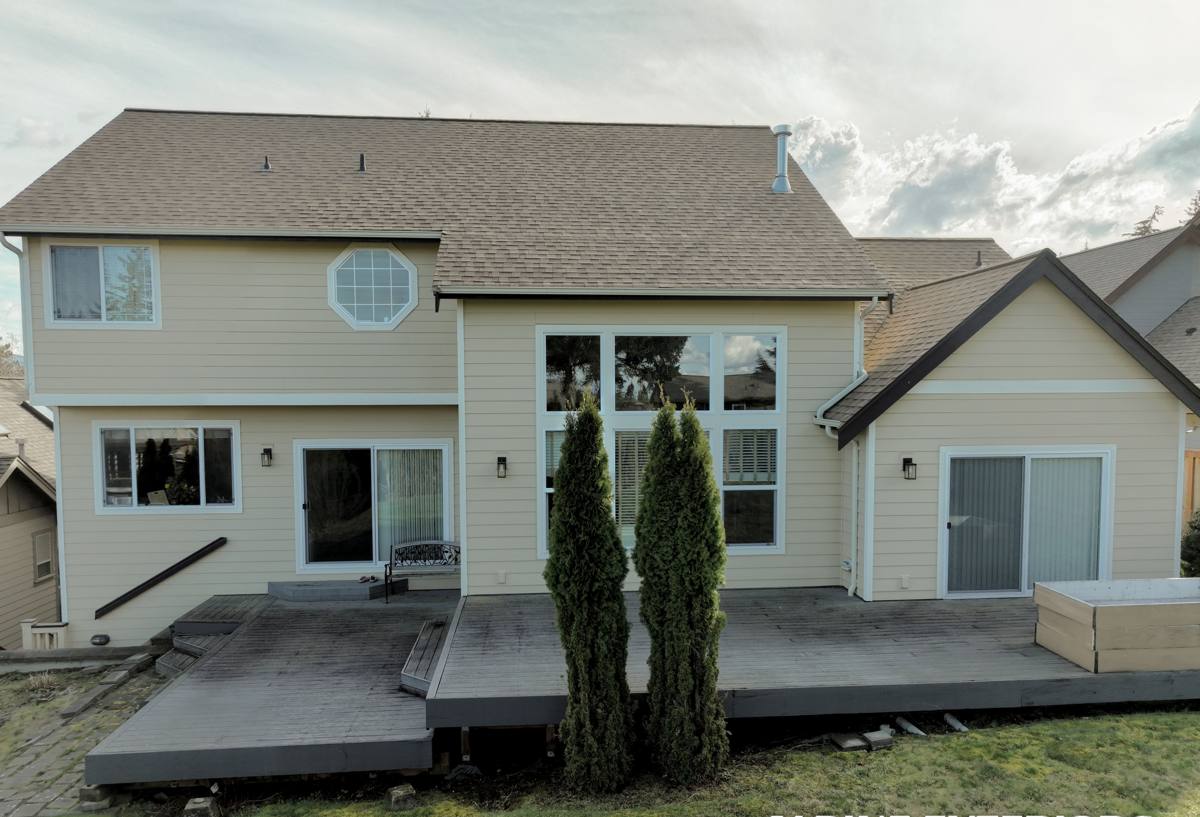
Why Decks Fail Faster Here Than in Drier Climates
Driving rain finds the gaps
Wind-driven rain in this region doesn't just fall straight down — it gets pushed sideways under railings, into ledger board connections, and behind fascia trim. Over time that means water sitting in places it was never designed to sit, particularly where the deck ties into the house.
Moss season runs long
In a lot of the country, moss is a summer nuisance. Here, with our tree cover and valley humidity, it's closer to a year-round tenant. Moss and algae hold moisture directly against the decking surface, which softens wood fibers, degrades composite surface layers faster than the manufacturer's warranty accounts for, and makes boards dangerously slick.
Metal hardware corrodes quietly
Fasteners, joist hangers, and post bases are the parts of a deck nobody looks at until something gives way. Salt-influenced air combined with near-constant dampness speeds up corrosion on hardware that wasn't rated for it, and that failure happens underneath the decking where you can't see it coming.
Signs Your Deck Needs Repair, Not Just a Cleaning
A pressure wash or a coat of sealant can hide a lot of problems for a season, but it won't fix them. Here's what tells us a deck needs actual repair work:
- Boards that feel soft, spongy, or springy underfoot, especially near the house or in shaded corners
- Visible gaps or movement where the deck ledger attaches to the house framing
- Railings or posts that wobble or flex when pushed
- Stair stringers that feel uneven or bounce under weight
- Rust streaks below fastener heads or joist hangers
- Persistent moss or dark staining that comes right back within weeks of cleaning
- Gaps opening up between boards, or boards cupping and warping
- A musty smell coming from underneath the deck structure
Any one of these on its own might be minor. A few of them together usually mean moisture has been getting into the structure for a while, not just the surface.
What a Correct Deck Repair Actually Involves
Deck repair gets treated as a cosmetic job more often than it should be. Swapping out a few gray, split boards for new ones looks like a fix, but if the framing underneath is compromised, you've just put fresh wood on top of a problem that's still there.
A repair done right starts underneath, not on the surface:
- Ledger board and flashing check — this is where the deck attaches to your house, and it's the single most common point of hidden rot in this climate. Flashing that's cracked, missing, or improperly lapped lets water track straight into the house rim joist.
- Joist and beam inspection — we probe framing members with an awl, not just a visual look, since surface paint or stain can hide soft wood underneath.
- Post and footing condition — posts sitting in or near standing water, or footings that have shifted, need to be addressed before any surface work matters.
- Fastener and hardware condition — corroded nails, screws, or joist hangers get replaced with hardware rated for this environment, not just whatever matches on the shelf.
- Surface decking and railings — this is the visible layer, and it's the last thing we address, once we know what's underneath it is sound.
Skipping straight to that last step is how homeowners end up paying for the same repair twice.
Repair or Replace: What Actually Decides It
Not every deck with problems needs to be torn out. But some do, and the honest answer depends on where the damage is, not how the deck looks from the yard.
| Factor | Repair Usually Makes Sense | Replacement Usually Makes Sense |
|---|---|---|
| Framing (joists, beams, ledger) | Isolated soft spots, otherwise sound structure | Widespread rot, or framing undersized for current code |
| Decking surface | Scattered damaged boards, rest still solid | Most boards cupped, splitting, or soft throughout |
| Posts and footings | Footings sound, posts show surface wear only | Footings undersized, shifted, or below grade requirements |
| Age of structure | Under 15-20 years, built to a reasonable standard | Original construction unpermitted or clearly under-built |
| Owner's plans | Staying in the current footprint and layout | Wanting a larger footprint, different material, or layout change |
We'll tell you plainly which side of that table your deck falls on. If a repair will genuinely hold up, that's what we recommend — a full rebuild isn't the right answer just because it's the bigger job.
Our Deck Repair Process
- On-site inspection. We walk the deck, get underneath it where possible, and probe the framing, ledger, and posts rather than just looking at the surface.
- Straight assessment. You get a clear picture of what's structural, what's cosmetic, and what can wait, along with honest reasoning for each.
- Written scope and estimate. No vague line items — you'll know what's being replaced, repaired, or reinforced before work starts.
- Repair work. We address structure first, then hardware and flashing, then surface materials, in that order.
- Final check. Before we call it done, we walk the deck again to confirm it's solid, level, and properly fastened.
Materials and Hardware We Rely On
Given how much moisture this valley holds onto through the fall and winter, material choice matters more here than it would in a drier region.
For framing repairs, we use lumber rated for ground contact or exterior exposure where it's called for, not standard-grade lumber that happens to be cheaper. For fasteners and hardware, we use hot-dip galvanized or stainless steel components sized for the load they're carrying — the extra cost up front is small compared to what it costs to chase down hidden corrosion damage in a few years. For decking surfaces, we'll walk you through the honest trade-offs between wood and composite: wood costs less initially but needs regular refinishing and is more vulnerable to moss and rot if maintenance slips; composite costs more up front but handles this climate's moisture and moss cycle with far less upkeep. Neither is automatically "better" — it depends on your budget and how much yearly maintenance you want to take on.
Keeping a Repaired Deck From Needing Repair Again
Once a deck is structurally sound, the biggest threat to it going forward is neglect during our wet months. A few habits go a long way:
- Sweep leaves and debris off the deck surface regularly through fall — trapped organic matter holds moisture against the wood and feeds moss growth
- Clean moss and algae off the surface at least once a year, ideally before winter sets in
- Check that gutters and downspouts near the deck are directing water away, not onto it
- Reseal or restain wood decking on the schedule the product actually calls for, not "whenever it looks bad"
- Take a look underneath the deck once a year for early signs of moisture or pest activity
Why a Crew That Already Works Sedro-Woolley Matters
Deck repair here isn't the same job as deck repair in a dry inland climate, and it shows in the details — how flashing gets lapped against a ledger board, which fastener grade actually holds up through a Skagit County winter, and how long moss will keep coming back if the underlying moisture problem isn't dealt with. A crew that works this area regularly has already seen how local decks fail and knows what to check first instead of guessing.
We're also familiar with the permitting expectations Skagit County and the City of Sedro-Woolley apply to deck work, particularly for structural repairs involving framing, footings, or anything that changes the deck's load path. That's not a detail to skip — it protects you if you ever sell the home or need insurance to recognize the work as done correctly.
If you're comparing quotes, ask any contractor directly how they'd handle moisture at the ledger board and what hardware grade they use for fasteners in this climate. The answer tells you a lot about whether they've actually worked decks in this region or are treating it like any other job.
Get a Straight Answer on Your Deck
If your deck has soft spots, a wobble that wasn't there before, or moss that keeps coming back no matter how often you clean it, it's worth getting an honest look before another wet season sets in. We'll walk the deck, tell you plainly what we find, and give you options — repair or replace — with no pressure either way. Reach out below for a free estimate.