 Anacortes Roofing
 Siding Built for Ship Harbor's Waterfront Exposure
Homes in the Ship Harbor area sit close enough to the water that the siding on them is doing a harder job than siding on a house a few miles inland. Salt-laden air moves off the water and settles on exterior walls day after day. Wind-driven rain comes in sideways during winter storms instead of falling straight down. And the tree cover and shaded north sides that make this part of Fidalgo Island so pleasant to live in also keep moisture sitting against exterior walls longer than it would in a more open, sun-exposed location. Any siding installed here has to be chosen and installed with those three realities in mind, not treated like a generic product going up on a generic wall.
We install siding across Anacortes and the rest of Skagit County, and Ship Harbor is one of the areas where the gap between "siding that was installed" and "siding that was installed correctly for this specific site" shows up fastest — often within the first two or three wet seasons.
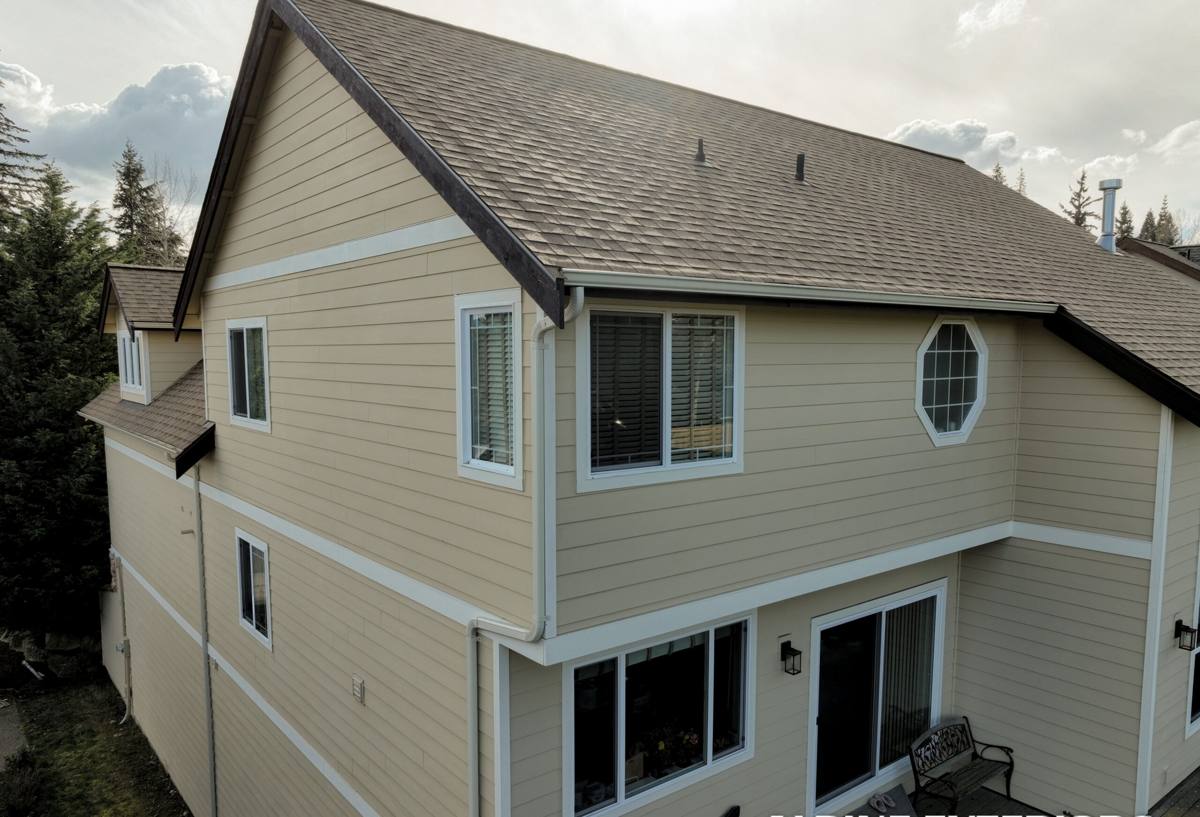
What Salt Air, Rain, and Moss Season Actually Do to Siding
Salt Air
Airborne salt is corrosive to exposed metal fasteners, flashing, and trim, and it can accelerate the breakdown of lower-grade coatings and caulks over time. It doesn't damage siding overnight — it works slowly, which is exactly why so many homeowners don't connect ten years of gradual fading, chalking, or fastener staining back to where they live.
Driving Rain
Wind off the water pushes rain into laps, seams, and butt joints that would stay dry in a calmer inland setting. That means the water-resistive barrier, flashing details, and caulking behind the siding matter more here than the siding material itself. A great product installed with sloppy flashing will still let water in.
Moss and Shade
Anacortes' long, mild, wet stretch of the year — combined with mature tree cover common around Ship Harbor properties — keeps north- and west-facing walls damp for extended periods. That's ideal growing conditions for moss and mildew on any siding surface that holds moisture rather than shedding it, and it's especially hard on materials that swell, delaminate, or absorb water at cut edges and seams.
Why We Install Only James Hardie Fiber Cement Siding
We made a deliberate decision to install one siding system — James Hardie fiber cement — instead of offering a menu of products at different price points. That's not a marketing position; it's a response to what we've seen happen to other materials in exactly this kind of coastal, wet, shaded environment.
Vinyl siding is inexpensive and low-maintenance in mild, dry climates, but it can become brittle and crack in freeze-thaw swings, and it relies almost entirely on caulking and overlap for weather resistance rather than the material itself resisting moisture. LP SmartSide, primed spruce, and cedar are wood-based products — even engineered ones — and wood-based siding's long-term performance depends heavily on edges, cuts, and fastener penetrations staying sealed. In a salt-air, high-moisture environment, that's a maintenance burden we don't think is fair to hand a homeowner without saying so plainly.
James Hardie fiber cement is non-combustible, doesn't swell or rot the way wood-based products can, and holds its factory-applied ColorPlus finish far longer than field-applied paint holds up on other materials — which matters a lot when repainting means scaffolding and a full house, not a touch-up. Hardie also engineers specific product lines (its HZ5 and HZ10 zone formulations) for different climate exposures, which is directly relevant to a site like Ship Harbor.
What a Correct Siding Installation Involves
The siding itself is only part of the system. In an exposure like Ship Harbor's, the details underneath and around it are what actually keep water out.
Tear-Off and Sheathing Inspection
Old siding comes off down to the sheathing so we can see what's actually there — soft spots, hidden rot, or prior water intrusion don't show up until the wall is opened up. Any damaged sheathing gets replaced before anything new goes on; covering a problem is worse than finding one.
Weather-Resistive Barrier
A continuous, properly lapped weather-resistive barrier goes over the sheathing, shingle-style, so water always drains down and out rather than behind the barrier.
Flashing at Every Penetration
Windows, doors, hose bibs, vents, and roof-to-wall transitions all need dedicated flashing, integrated with the barrier in the correct order. This is where wind-driven rain finds its way in if it's rushed or skipped, and it's the single most common source of long-term siding failures we see on inspections — regardless of the siding brand involved.
Panel or Plank Installation to Spec
James Hardie publishes specific fastening patterns, gap requirements, and clearances (including ground clearance and roof-line clearance) for a reason — following them is what keeps the manufacturer's warranty valid and keeps the assembly performing as engineered. That includes proper clearance from grade and from roofing, which matters for a wooded, damp lot the way it might not on an open, sunny one.
Caulking and Finish Details
Factory-finished ColorPlus panels need far less field caulking than field-painted products, but the caulking that is required — at trim joints and penetrations — needs to be a compatible, quality sealant, not whatever tube is on the truck.
Our Process, Start to Finish
- Free on-site estimate — we walk the exterior, note the exposure on each wall (sun, shade, wind direction), and check for existing moisture damage.
- Written scope and product selection — plank or panel style, color, and trim, matched to your home and the site's exposure.
- Tear-off and sheathing check — old material removed, substrate inspected and repaired as needed.
- Barrier, flashing, and trim installation — the part of the job that determines whether water stays out for the next 30-plus years.
- Hardie siding installation — installed to manufacturer fastening and clearance specifications.
- Final walkthrough — we go over the finished work with you before calling the job done.
Comparing Siding Materials for a Site Like Ship Harbor
| Material | Behavior in Salt Air / High Moisture | Maintenance Over Time |
|---|---|---|
| Vinyl | Can become brittle with age; relies on overlap and caulk for weather resistance | Low, but limited repair options if cracked or faded |
| Wood / Primed Spruce / Cedar | Absorbs moisture at cuts and joints; vulnerable to rot in shaded, damp spots | Ongoing painting and sealing required |
| LP SmartSide (engineered wood) | Improved over solid wood, but still wood-based and dependent on sealed edges | Periodic inspection and repainting |
| James Hardie Fiber Cement | Non-combustible, doesn't rot or swell; factory finish resists salt-air fading | Occasional washing; no repainting cycle for the life of the ColorPlus warranty |
What Drives the Cost of a Ship Harbor Siding Project
| Factor | Why It Matters Here |
|---|---|
| Wall exposure and access | Waterfront-adjacent lots with slopes or limited access can affect staging and scaffolding needs |
| Sheathing condition | Hidden moisture damage found during tear-off adds repair work before new siding can go on |
| Trim and detail complexity | More corners, windows, and rooflines mean more flashing work, which is labor, not material, cost |
| Product line and profile | Plank vs. panel, and standard vs. premium ColorPlus colors, shift material cost |
We give firm, written numbers after seeing the house in person — not a phone estimate — because so much of the real cost on a job like this is in the condition of what's underneath the old siding, which you can't know until it's off the wall.
Why Hire a Crew That Already Works This Area
Siding installation isn't just a set of nailing instructions — it's a set of judgment calls about how much clearance to leave, which walls need extra flashing attention, and where moss and moisture are likely to become a problem five years down the road. A crew that regularly works properties in the Ship Harbor area and around Anacortes has already seen how salt air and shade play out on homes like yours, instead of learning it on your house for the first time. That familiarity shows up in small decisions — flashing detail at a shaded window, fastener spacing on a wall that takes the brunt of winter storms — that don't appear on an estimate sheet but matter enormously ten years later.
Signs Your Current Siding May Already Be Telling You Something
- Green or black staining that returns shortly after washing, especially on shaded or north-facing walls
- Caulk that's cracked, shrunk, or pulled away from trim and window edges
- Soft or spongy spots when you press on siding near the bottom courses or around penetrations
- Paint that's peeling or bubbling rather than just fading evenly
- Visible warping, cupping, or separation at panel seams and butt joints
- Interior signs like peeling paint or musty smells on exterior-facing walls
None of these guarantee a full replacement is needed, but they're worth having looked at before they turn into sheathing damage.
Get a Straightforward Look at Your Siding
If you're weighing a siding replacement on a Ship Harbor property, we're glad to come take a look, walk the exposure with you, and give you an honest read on what the house actually needs — no pressure, no hard sell. Use the form below to request a free estimate.