 Anacortes Roofing
 Old Town Anacortes Puts Extra Demands on Siding
Old Town is one of the oldest residential pockets in Anacortes, and it shows in the housing stock: older platform-framed homes, a mix of additions and remodels layered over decades, and siding that has usually been recoated, patched, or replaced at least once already. That history matters when it's time to reside a house here. Older wall assemblies weren't built with today's moisture-barrier standards, and previous siding jobs weren't always installed to current best practice. A siding replacement in this neighborhood isn't just a materials swap — it's a chance to correct decades of small building-envelope compromises at the same time.
Add in the neighborhood's proximity to the water and its older tree canopy, and you get a combination that's tougher on siding than a newer subdivision a few miles inland. Salt-laden air off the channel, driving rain that comes in sideways during winter storms, and a long, damp moss season all work on exterior materials year-round, not just during a few bad weeks.
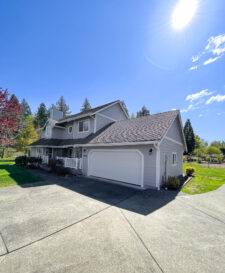
What Skagit County's Marine Climate Does to Siding
Anacortes sits in a marine climate with mild temperatures but a lot of moisture exposure. Three factors matter most for siding on an Old Town home:
- Salt air: being close to Puget Sound and the Guemes Channel means airborne salt settles on exterior surfaces, accelerating corrosion of fasteners and trim and breaking down some paints and coatings faster than in a dry climate.
- Driving rain: wind-driven rain doesn't just fall on siding, it gets pushed into laps, seams, and butt joints. Any gap in flashing or caulking becomes a path for water to reach the sheathing behind the siding.
- Moss and algae season: the long wet stretch from fall through spring keeps north- and shade-facing walls damp for extended periods, which is exactly the environment moss, algae, and mildew need to establish themselves on porous or textured siding.
None of this is unique to Old Town, but older homes here tend to have more shade from mature trees, tighter lot spacing, and more wall area that stays damp longer between sun exposures — all of which compound the effect.
Signs an Old Town Home Needs Siding Replacement, Not Just Repair
Not every siding problem calls for a full tear-off. But there's a point where patching stops making sense and full replacement becomes the more honest recommendation. Watch for:
- Soft or spongy spots when you press on the siding, especially near the bottom courses, window sills, or corner trim
- Persistent black or green staining that returns within weeks of cleaning, even on surfaces that get some sun
- Visible cupping, warping, or delamination across multiple boards rather than an isolated spot
- Paint that won't hold — bubbling, peeling, or alligatoring within a couple of years of a repaint
- Gaps that have opened at butt joints or around trim, letting daylight or drafts through
- Interior signs — musty smell, staining on interior wall surfaces, or bubbling drywall on an exterior wall
When two or three of these show up together, it's usually a sign that moisture has been getting behind the siding for a while, not just sitting on top of it. That's a structural conversation, not a cosmetic one.
How Different Siding Materials Hold Up Locally
Homeowners in Old Town often ask us to compare options rather than just quote one material. Here's an honest look at how the common choices perform under Anacortes conditions:
| Material | Salt air / moisture behavior | Moss & algae resistance | Long-term maintenance |
|---|---|---|---|
| Vinyl siding | Doesn't corrode, but can warp or crack in temperature swings; seams are a water entry risk | Grows algae readily, especially in shade; hard to fully clean without damaging the surface | Low upfront upkeep but limited lifespan and can't be refinished when it fades |
| Cedar siding | Handles moisture well when maintained, but demands consistent sealing/staining to prevent rot | Susceptible to moss and mildew without regular treatment | High — refinishing every few years is the norm in this climate |
| Primed spruce/wood composites | Vulnerable at cut edges and fastener points if the primer coat is compromised | Similar exposure risk to cedar if coatings aren't maintained | Moderate to high; recoating is required to prevent moisture entry |
| James Hardie fiber cement | Non-combustible, engineered for moisture and doesn't rot; factory-applied ColorPlus finish resists the coastal environment | Smooth ColorPlus finishes shed moss and algae buildup far more easily than wood-textured products | Low — no re-staining, and the factory finish is warrantied against fading and peeling |
This isn't a knock on cedar or vinyl as products — they have real strengths and plenty of homes wear them well elsewhere. It's specifically about what holds up with minimal fuss in a salt-air, high-moisture, moss-prone neighborhood like Old Town.
Why We Install Only James Hardie Fiber Cement
We made a deliberate call to standardize on James Hardie and not offer LP SmartSide, vinyl, Cemplank, Allura, primed spruce, or cedar. That's not because those products can't be installed correctly — it's because, after years of working on homes in exactly this climate, Hardie's combination of moisture performance, factory finish, and warranty structure gives homeowners the least to worry about over the long run.
Fiber cement is engineered specifically for climates like this one. Hardie's HZ5 product line is formulated for wetter, harsher climates, which fits Skagit County's marine exposure better than a one-size-fits-all product. The ColorPlus factory finish is baked on under controlled conditions rather than field-applied, which means better adhesion and a longer, warrantied service life against fading, chipping, and peeling than most site-painted or site-stained materials achieve. It's also non-combustible, which matters more each year as wildfire smoke and ember exposure become a bigger part of the conversation even in western Washington.
We're not going to tell you cedar looks bad or that vinyl is junk — that's not honest, and it's not the point. The point is that we've chosen to only put our name behind installations we're confident will still look and perform well fifteen years from now on a house exposed to salt air, driving rain, and a long moss season. For us, that's Hardie.
What a Correct Siding Replacement Actually Involves
A siding replacement is only as good as what's underneath it. On an older Old Town home, the tear-off is where the real information shows up — and where a rushed job usually goes wrong. A correct process looks like this:
- Full tear-off, not overlay. Installing new siding over old is a shortcut that traps moisture and hides problems. We remove the existing siding down to the sheathing.
- Sheathing inspection. On older homes, this is where soft spots, past water damage, or outdated wall assemblies get found and addressed before anything new goes up.
- Weather-resistive barrier. A correctly lapped and taped house wrap or building paper, installed to shed water down and out rather than trap it, is the actual first line of defense — the siding is the second.
- Flashing at every penetration. Windows, doors, vents, hose bibs, and light fixtures all need proper flashing integrated with the weather barrier, not just caulk over a gap.
- Correct fastening and clearances. Hardie has specific fastener, nailing pattern, and ground-clearance requirements. Skipping these is one of the most common ways a fiber cement job fails prematurely — and it's usually an installation issue, not a product issue.
- Trim and joint treatment. Butt joints, corners, and trim transitions are where water intrusion typically starts if they're not detailed correctly.
- Final finish inspection. Checking reveal consistency, caulking, and touch-up before calling the job done.
Every one of those steps matters more in a climate that's pushing rain sideways into your walls for several months a year. Skipping or rushing any of them is how a siding job that looks fine on day one starts failing in year three.
Our Process for an Old Town Project Specifically
Because so many Old Town homes have layers of prior work, we treat the walk-through and tear-off phase as the most important part of the job, not a formality before installation starts. That typically means:
- An exterior walk-through that looks at grading, gutter performance, and shade patterns around the house — all of which affect how much moisture exposure the new siding will see
- Checking for signs of prior water intrusion around windows, at the roofline, and near ground level before we ever quote the job
- Planning around mature landscaping and tight lot lines common in the neighborhood, so material staging and tear-off don't damage what's already there
- Confirming whether any permit or design review applies to the property before work begins, since older neighborhoods sometimes carry additional requirements
- Sequencing work to keep the house weather-tight overnight and during storms — we don't leave open sheathing exposed to an incoming rain system
What Siding Replacement Typically Costs — and What Drives the Price
We don't quote firm numbers without seeing the house, but the factors that move the price on an Old Town project are consistent:
| Cost factor | Why it matters |
|---|---|
| Condition of the sheathing | Rot or water damage found during tear-off adds repair scope before new siding can go on |
| Home size and wall complexity | More corners, dormers, and trim details mean more labor and material cuts |
| Siding profile chosen | Lap width, shake-style panels, and trim details all price differently within the Hardie product line |
| Access and site constraints | Tight lots, mature landscaping, and limited staging space common in older neighborhoods can add labor time |
| Window and trim work bundled in | Replacing flashing, trim, or exterior fixtures at the same time is more efficient than doing it later separately |
In general, addressing everything in one coordinated project — tear-off, sheathing repair, weather barrier, and new siding — costs less over the life of the house than doing a cheap reside now and dealing with hidden moisture damage in a few years.
Questions Worth Asking Any Contractor Before You Sign
- Will you do a full tear-off, or is this an overlay?
- What happens if you find damaged sheathing — is that a change order or is it priced in?
- What weather-resistive barrier and flashing details will you use?
- Are your installers factory-trained on the specific siding product you're installing?
- What does the warranty actually cover — material, finish, and labor — and for how long?
- How will you protect landscaping and neighboring property during tear-off?
Why It Matters to Hire a Crew That Already Works Old Town
A crew that regularly works this neighborhood already knows what to expect before the tear-off starts — the age range of the framing, the kinds of prior repairs that show up, the tight site conditions, and how the local moisture and moss patterns behave on shaded, older lots. That's not something you get from a contractor who mostly works newer subdivisions and treats every older home as a surprise. Local, current experience means fewer change orders, fewer surprises mid-project, and a better match between the siding system we recommend and what your specific house actually needs.
If you're weighing a siding replacement for a home in Old Town Anacortes, we're happy to take a look and give you a straightforward assessment — what we'd expect to find, what it would take to do right, and an honest estimate. There's no pressure and no obligation; just fill out the form below to get started.