 Anacortes Roofing
 Roof Repair for Burlington, Built Around Skagit County Weather
Burlington sits in the Skagit Valley, close enough to the water that the same marine weather systems moving off Rosario Strait and the Salish Sea reach it too — long stretches of driving rain, damp air that never fully dries out roof surfaces, and a moss season that can run most of the year. A roof here doesn't fail because of one dramatic storm. It fails slowly, from small entry points that stay wet longer than they should, under moss mats that hold moisture against shingles, or at flashing details that were never quite sealed right the first time.
Roof repair in this area is a different job than roof repair in a dry climate. The materials, the sequencing, and the details around flashing and ventilation all have to account for a roof that spends a large part of the year wet or drying out. We work this pattern across Skagit County, and Burlington roofs see the same issues as the rest of our service area — just with local variation depending on tree cover, roof pitch, and how exposed the home is to wind-driven rain.
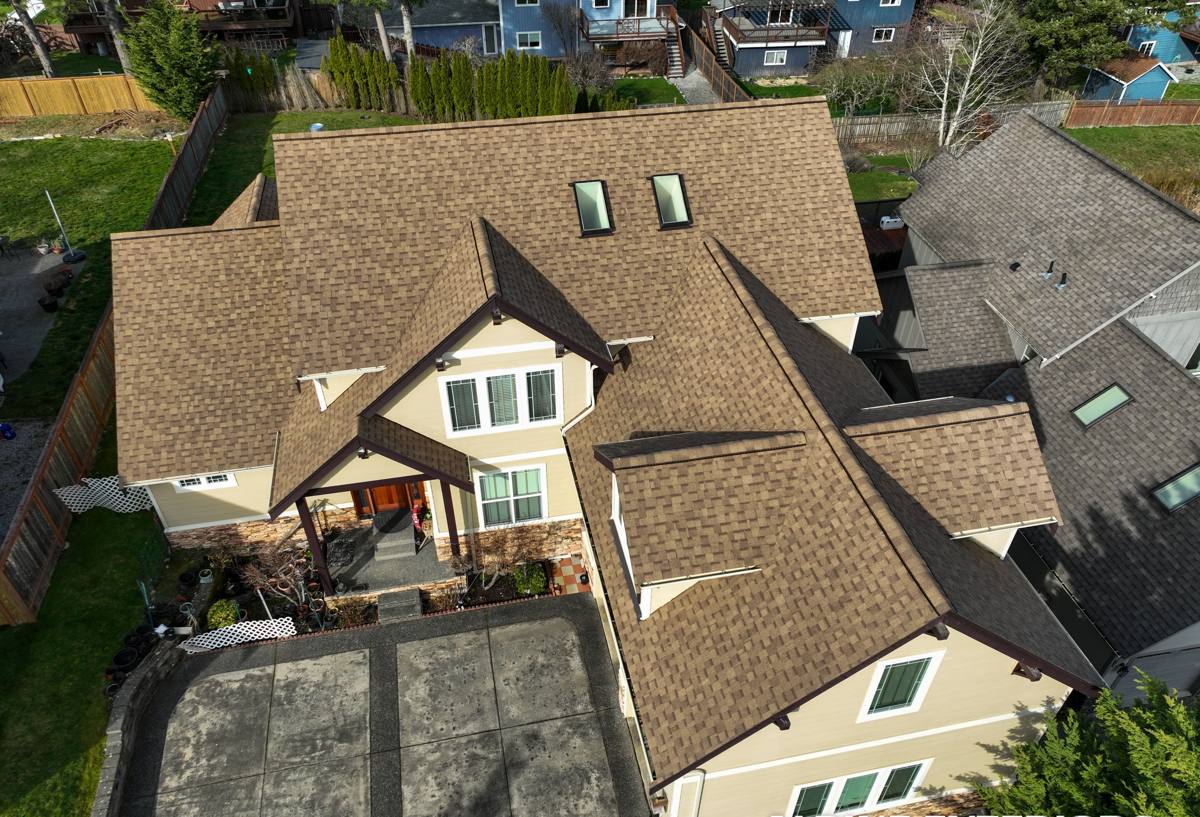
Signs a Burlington Roof Needs Repair, Not Full Replacement
Most roofs don't need to be torn off. They need specific, localized work done correctly. Here's what typically points to a repair rather than a replacement:
- A ceiling stain that appears after heavy rain but doesn't grow between storms — usually a localized flashing or penetration leak, not a failing roof field
- Missing or lifted shingles in one section, especially near a ridge, valley, or roof-to-wall transition
- Visible moss growth concentrated in shaded areas, with the rest of the roof still in decent shape
- Granule loss and wear that's isolated to one slope, often the one facing prevailing wind and rain
- A roof under 15-20 years old with an otherwise sound structure and no widespread decking damage
Replacement becomes the honest recommendation when the decking underneath is soft or delaminated in multiple areas, when shingles are brittle and cracking across the whole roof rather than in one spot, or when the roof has been patched repeatedly over the years without the underlying cause ever being fixed. We'll tell you plainly which category your roof falls into — there's no benefit to us talking a homeowner into a repair that won't hold, or a replacement that isn't necessary yet.
What a Correct Roof Repair Actually Involves
Finding the Real Source, Not Just the Symptom
Water travels. A stain on a bedroom ceiling might trace back to a roof penetration several feet away, following a rafter or the underside of the decking before it shows up indoors. A repair that only patches the spot where the stain appears, without tracing the actual entry point, tends to fail again within a season or two. Correct repair work starts with finding where water is actually getting in — checking flashing at chimneys, vents, and skylights, checking valley metal, checking the transition where a roof meets a wall, and checking shingle condition on the section in question.
Matching Materials and Technique
Once the source is identified, the fix has to match the existing roofing correctly — same or compatible shingle profile, proper nailing pattern, correct flashing metal and shape, and underlayment that seals against wind-driven rain rather than just shedding water downhill. In a wet climate, sealant is a backup, not the primary defense. A repair that relies mainly on caulk or roofing cement to hold water out is a short-term fix that will need to be redone.
Checking What's Underneath
Any time we open up a repair area, we check the decking underneath for soft spots, delamination, or rot before closing it back up. Covering damaged decking with new shingles just hides a problem that will resurface, usually as a bigger repair later. If decking needs to be replaced, that gets scoped and quoted honestly as part of the repair — not glossed over.
Our Repair Process
- Initial contact and scheduling — you describe what you're seeing (a stain, missing shingles, visible damage), and we schedule an inspection.
- Roof inspection — we walk the roof and check the attic or interior where accessible, tracing suspected leaks to their actual source rather than guessing from the ground.
- Written scope and estimate — you get a clear explanation of what's wrong, what the repair involves, and a price range before any work starts.
- Repair work — materials matched to your existing roof, flashing and underlayment done to hold up under repeated wet weather, not just pass a dry-day inspection.
- Cleanup and walkthrough — debris and old materials removed, and we walk you through what was done and what to watch for going forward.
We don't upsell a full replacement during a repair call unless the roof genuinely needs it, and if it does, we'll explain exactly why — decking condition, extent of damage, or age relative to remaining serviceable life.
Common Roof Repair Issues Around Burlington
These are the repair categories we see most often in this part of Skagit County, along with what typically causes them and how they're addressed:
| Issue | Typical Cause | Repair Approach |
|---|---|---|
| Ceiling stain after rain | Failed flashing at a penetration or roof-to-wall joint | Trace source, replace flashing, confirm underlayment seal |
| Moss-related shingle damage | Moisture trapped under moss mats in shaded areas | Careful moss removal, damaged shingle replacement, treatment to slow regrowth |
| Valley leak | Worn or improperly lapped valley metal/shingles | Rebuild valley with correct metal and shingle overlap |
| Wind-lifted shingles | Nailing pattern or sealant strip failure from repeated storms | Re-secure or replace affected shingles, check adjacent field |
| Soft decking near a repair area | Long-term moisture intrusion before the leak was caught | Cut back to sound decking, replace, then re-roof the section |
Cost for any of these varies with how much of the roof is affected, roof pitch and access, and whether decking replacement is involved — a single flashing repair is a modest job, while a repair involving several sheets of decking and a rebuilt valley is a larger one. We give an actual number after inspection rather than a guess over the phone.
Moss, Debris, and Preventive Maintenance
Moss season in Skagit County isn't a minor cosmetic issue — moss holds moisture directly against the shingle surface for months at a time, which accelerates granule loss and can work its way under shingle edges. Roofs with heavy tree cover or north-facing slopes that don't get much sun exposure are the most affected. A repair on a moss-damaged roof isn't complete if the moss itself isn't addressed, because it will simply cause the same damage again in the same spot.
Between repairs, a short seasonal maintenance routine catches small problems before they become leaks:
- Clear gutters and downspouts before the fall rains start, so water isn't backing up under the roof edge
- Remove moss and debris buildup, especially in valleys and shaded slopes, rather than letting it accumulate over multiple seasons
- Check flashing around chimneys, vents, and skylights visually once a year for lifted edges or cracked sealant
- Trim back tree branches that keep sections of the roof shaded and damp longer than the rest
- Have any new stain or drip investigated right away rather than waiting to see if it happens again
None of this replaces a proper inspection, but it meaningfully extends the life of a repair and reduces how often bigger repairs are needed.
Repair vs. Replacement: How We Help You Decide
The honest answer depends on three things: how much of the roof is affected, the condition of the decking underneath, and how many years of service life are realistically left in the existing roofing material. A 10-year-old roof with one bad flashing detail is a repair. A 22-year-old roof with granule loss across every slope and soft decking in multiple spots is heading toward replacement regardless of how the current leak gets patched. Most roofs fall somewhere in between, and that's where a straightforward inspection and a clear explanation matter more than a sales pitch either direction.
We'll always give you the repair option first if it's a sound one. If a repair would just be a temporary fix on a roof that's clearly near the end of its service life, we'll say so and explain the reasoning, so you can decide with real information rather than guesswork.
Materials and Workmanship Standards
For repair work, we match materials to what's already on the roof where possible, and we don't cut corners on the details that matter most in this climate — proper flashing metal and shape, correct underlayment at vulnerable points like valleys and roof-to-wall transitions, and nailing patterns that hold up under sustained wind-driven rain rather than just a dry-weather inspection. We use sealant as a supplement to correct flashing and shingle technique, not as a substitute for it. That standard doesn't change based on job size — a single flashing repair gets the same attention to detail as a larger one.
Why a Crew That Already Works Burlington Matters
Roof problems in the Skagit Valley have patterns — which slopes hold moss longest, which flashing details tend to fail first on homes of a certain age, how much wind-driven rain a given roof orientation actually takes on. A crew that already works this area has seen those patterns repeatedly and knows what to check first instead of working through a generic troubleshooting list. That translates into a faster, more accurate diagnosis and a repair that's built for the weather Burlington actually gets, not a one-size-fits-all fix.
Being local also means being available when a leak needs a look before it turns into interior damage, and being around afterward if a question comes up about how the repair is holding. We're an Anacortes-based crew serving Burlington and the surrounding Skagit County area, and we stand behind the repair work we do here.
If you're dealing with a leak, missing shingles, or a moss problem that's gotten out of hand, we're glad to take a look. Fill out the form below for a free, no-pressure estimate — we'll inspect the roof, explain what we find in plain terms, and give you a clear price before any work begins.