 Anacortes Roofing
 Burlington's Climate Is Tougher on Siding Than It Looks
Burlington sits in the Skagit Valley, close enough to Puget Sound and Padilla Bay to catch salt-laden air on a regular basis, and low enough in the valley that fog, standing humidity, and driving rain linger longer than they do on higher ground. Add in the region's long, dim moss season — stretching from fall through spring most years — and you have a set of conditions that will find every weak point in a home's exterior cladding. Salt air accelerates corrosion on fasteners and trim. Driving rain, especially in wind-driven storms off the Sound, pushes water sideways into seams and laps that were never designed to shed water horizontally. And moss, algae, and mildew don't just look bad — they hold moisture against the siding surface for weeks at a time, which is exactly the condition that rots wood-based products and delaminates weaker composites.
None of this is unique to any one house in Burlington. It's a valley-wide, county-wide reality for anyone in Skagit County within a few miles of tidal water or low-lying farmland. What it means practically is that siding here needs to be chosen and installed with moisture management as the top priority, not an afterthought.
What Actually Fails on Burlington Homes
Moisture at the Laps and Seams
Horizontal lap siding sheds water down and out — but only if the laps are cut, spaced, and fastened correctly, and only if the material underneath the laps can tolerate occasional wetting without swelling or softening. On many older Burlington homes, we find siding that was installed tight against trim with no drainage gap, which traps water exactly where it does the most damage.
Fastener and Trim Corrosion
Salt air is hard on any exposed metal. Nail heads, trim flashing, and corner fasteners that weren't rated for coastal exposure show rust streaking and loosening well before the siding field itself fails. Once fasteners let go, the whole system loses its wind and water resistance.
Moss and Algae Buildup
North-facing walls and anything shaded by mature trees — common throughout Burlington's older residential streets — stay damp far longer after a storm than south-facing walls. That extended dampness is what lets moss and algae take hold, and on porous or wood-based siding, sustained moss growth eventually works its way into surface cracks and accelerates rot from the outside in.
What a Correct Siding Replacement Actually Involves
Replacing siding well isn't just pulling off old boards and nailing up new ones. A correct job addresses everything the old siding was hiding, not just the surface you can see.
- Full tear-off to bare sheathing, not an overlay on top of existing siding
- Inspection of sheathing for rot, soft spots, or prior water intrusion, with repairs before anything new goes up
- Installation of a code-compliant weather-resistive barrier, lapped correctly to shed water downward
- Correct flashing at every window, door, and penetration — this is where most water intrusion actually starts
- Proper drainage gap behind the siding so any moisture that does get behind the cladding can escape
- Fasteners rated for the exposure, driven to the manufacturer's specified depth and spacing
- Factory-finished siding installed per the manufacturer's climate zone requirements, not generic instructions
Skip any one of these steps and you haven't fixed the underlying problem — you've just put a new face on it and reset the clock on the same failure.
Why We Install Only James Hardie Fiber Cement Siding
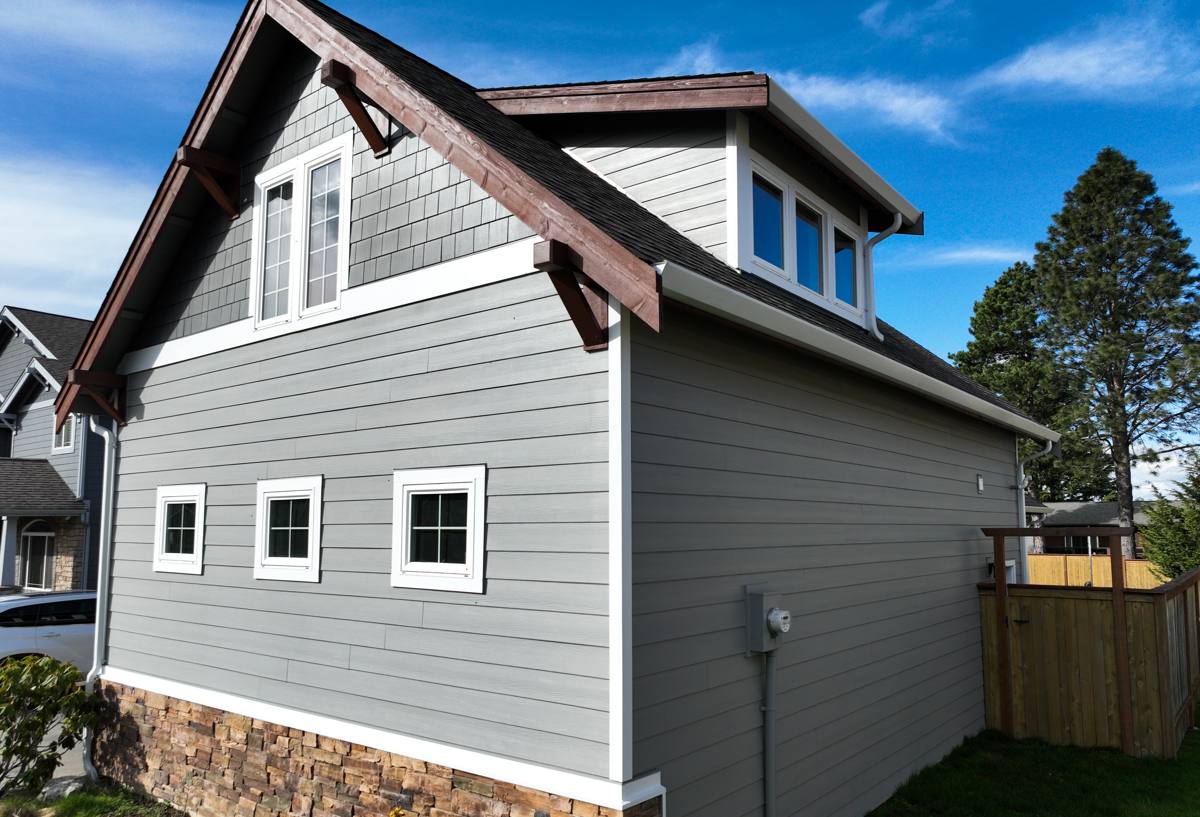
We standardized on James Hardie fiber cement siding for every home we side, including in Burlington, and we don't install vinyl, LP SmartSide, Cemplank, Allura, primed spruce, or cedar. That's not a marketing position — it's a decision built around what actually holds up under sustained coastal moisture and a long moss season.
Fiber cement is non-combustible and dimensionally stable, meaning it doesn't expand, contract, warp, or absorb water the way wood-based and some engineered wood products can. James Hardie's HZ5 product line is specifically engineered for climates with sustained moisture exposure — which describes the Skagit Valley well — and its ColorPlus factory finish is baked on under controlled conditions, giving more even, longer-lasting color adhesion than field-applied paint typically achieves. Hardie also backs its products with a strong, transferable limited warranty, which matters more in a climate that's actively testing every seam and fastener year-round.
We're not saying every alternative product is unusable everywhere. We're saying that for the specific conditions Burlington homes face — salt air, driving rain, extended damp seasons — we've chosen to build our business around the one product system we're confident holds up without the maintenance burden or moisture risk we've seen elsewhere. That's a professional standard, not a knock on every other brand.
Comparing Siding Approaches for This Climate
| Factor | James Hardie Fiber Cement | Vinyl | Untreated Wood / Cedar |
|---|---|---|---|
| Moisture resistance | Engineered for sustained damp climates (HZ5 line) | Resists rot but can warp and gap over time | Absorbs moisture; prone to rot without diligent upkeep |
| Finish durability | Factory-baked ColorPlus finish | Color molded in but can fade and chalk | Requires repainting/staining on a recurring cycle |
| Fire resistance | Non-combustible | Combustible, can melt or deform under heat | Combustible |
| Moss/algae resistance | Dense surface resists penetration | Surface resists penetration but seams trap debris | Porous surface, moss can root into grain over time |
| Warranty structure | Strong, transferable limited warranty | Varies widely by manufacturer | Typically none beyond installer workmanship |
Our Siding Replacement Process
1. On-Site Assessment
We walk the exterior with you, note problem areas — especially shaded or north-facing walls where moss and moisture linger longest — and check trim, flashing, and any visible soft spots.
2. Tear-Off and Sheathing Inspection
Old siding comes off down to the sheathing. Any rot or water damage gets addressed before anything new goes on — we don't cover up a problem we've already found.
3. Weather Barrier and Flashing
We install a properly lapped weather-resistive barrier and correct flashing details at every window, door, and penetration point, since this is where the majority of water intrusion actually originates.
4. James Hardie Installation
Siding goes up to manufacturer spec — correct fastener type, spacing, and drainage gap — using the HZ5 product line suited to this region's moisture exposure.
5. Final Walkthrough
We review the finished work with you, covering what to expect from the ColorPlus finish and basic care going forward.
Signs Your Burlington Home May Need Siding Replacement
- Visible moss, algae, or persistent green staining that returns shortly after cleaning
- Soft or spongy spots when you press on the siding, especially near the bottom courses
- Cracking, buckling, or gaps opening up at the laps
- Peeling or bubbling paint that keeps recurring in the same spots
- Rust streaking around nail heads or trim
- Rising energy bills that suggest the wall assembly is no longer insulating or sealing properly
- Visible rot or discoloration on trim boards, especially around windows and corners
What Drives the Cost of a Siding Replacement
| Cost Factor | Why It Matters |
|---|---|
| Home size and wall complexity | More corners, gables, and dormers mean more cutting, flashing, and labor |
| Sheathing condition | Rot or water damage found during tear-off requires repair before new siding goes up |
| Siding profile and texture | Lap width, shingle-style, and panel options carry different material and labor costs |
| Trim and accessory work | Fascia, corner boards, and window trim often need replacing alongside the siding |
| Access and site conditions | Steep grades, tight lot lines, or landscaping can affect staging and labor time |
We give straightforward, itemized estimates so you know what's driving the number — not a flat per-square-foot quote that hides what you're actually paying for.
Why Hiring a Crew That Already Works in Burlington Matters
A crew that regularly works throughout Skagit County already understands how this valley's moisture and salt exposure behave differently than they would ten or twenty miles inland or up in the hills. That's not a small thing — it affects which side of a house needs extra flashing attention, how much of a drainage gap to build in, and which product line actually holds up here. It also means faster response if something needs a follow-up look, and a crew that isn't learning the region's quirks on your home for the first time.
If you're weighing a siding replacement in Burlington, we're happy to take a look and walk you through what we're seeing — no pressure, no obligation. A free estimate is the easiest way to find out what your home actually needs and what it would take to get it done right.