 Anacortes Roofing
 Windows Built for Conway's Delta Climate
Conway sits on low, flat land in the Skagit River delta, close enough to Skagit Bay that salt air is part of daily life whether you notice it or not. That air moves through window frames, settles into hardware, and works on anything that isn't sealed or finished correctly. Add in the wind-driven rain that comes through open farmland with nothing to slow it down, plus the long stretch of gray, damp months that keep moss and algae growing on north-facing surfaces for half the year, and you have a window environment that's noticeably harder on a house than what you'd find twenty miles inland.
This isn't a generic "coastal Pacific Northwest" problem we're describing in the abstract. It's the specific combination Conway homes deal with: low elevation, open exposure across fields, proximity to tidal water, and the humidity that comes with all of it. Windows here need to shed water aggressively, resist corrosion in hardware and fasteners, and hold a tight seal through repeated wet-dry cycles without the frame swelling, the finish failing, or moisture finding its way into the wall cavity.
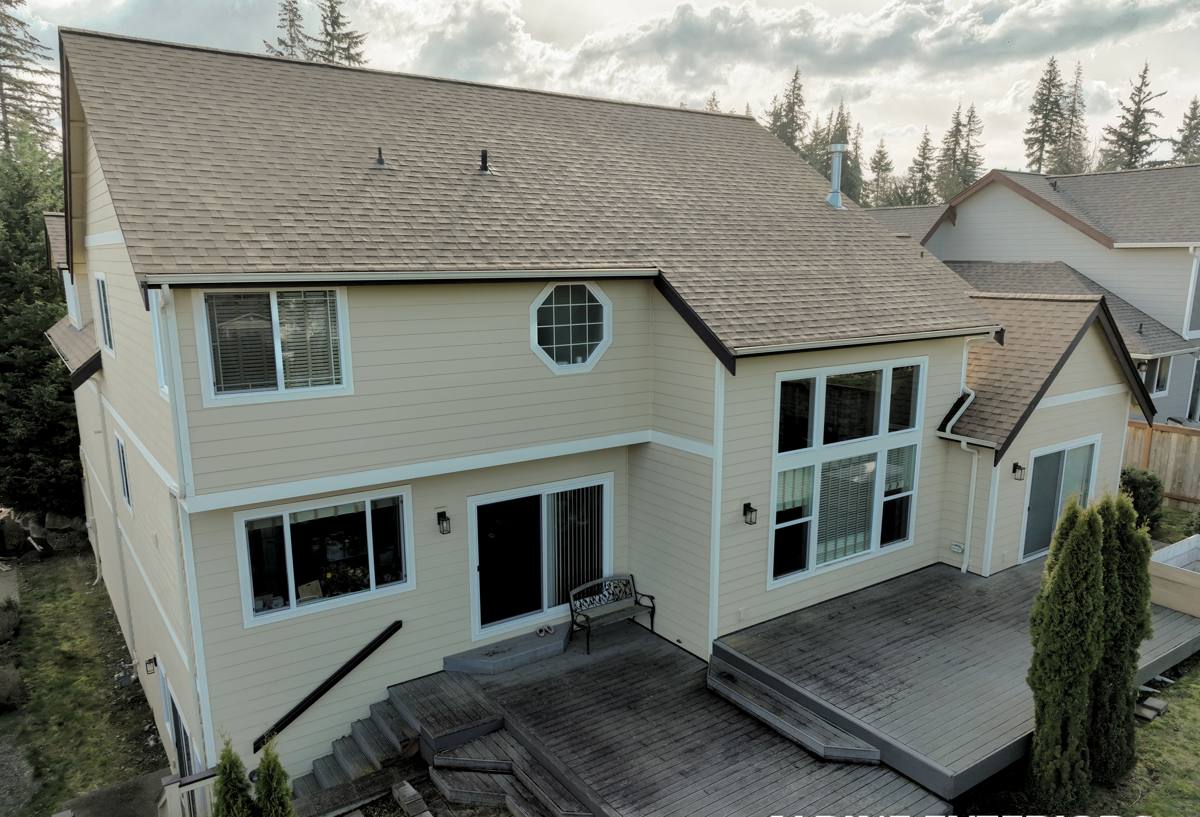
What Happens When Windows Aren't Right for This Area
Most window problems we get called out for in this part of Skagit County didn't start as window problems — they started as installation shortcuts that took a few years to show up. Here's what we see most often on Conway homes:
- Condensation between panes — a sign the seal has failed and the insulating gas or air pocket is gone, usually accelerated by constant humidity.
- Soft or discolored trim and sills — water getting behind the window through a gap in flashing or caulking that was never structurally sound to begin with.
- Frames that stick or won't latch tight — wood or lower-grade vinyl expanding and contracting with moisture until the frame is no longer square.
- Black staining or moss growth around the frame edges — a sign water is sitting against the window rather than draining away from it.
- Drafts that get worse every winter — weatherstripping and seals breaking down faster than they should because of constant exposure to wind-driven moisture.
None of these are just cosmetic. Once water gets past the exterior surface of a window, it's inside the wall assembly, and that's a slower, more expensive problem than the window itself.
What a Correct Installation Actually Involves
The window unit itself matters, but in a climate like this, installation quality is what actually determines whether that window lasts 10 years or 30. A correct job includes:
Proper Flashing and Sill Pan Work
Every opening gets flashed so that any water that does get past the exterior cladding is directed back out, not down into the framing. A sill pan under the window unit is non-negotiable in an area that sees this much wind-driven rain — it's the difference between water draining harmlessly and water pooling against untreated wood.
Weather-Resistive Barrier Integration
The window has to be integrated into the house's existing water and air barrier correctly, with proper shingle-lap sequencing (each layer overlapping the one below it, top to bottom) so water always has a path down and out, never in.
Correct Shimming and Fastening
A window that isn't shimmed level and plumb will bind, sag, or lose its seal integrity over time, even if the unit itself is high quality. Fasteners need to be corrosion-resistant given the salt content in the air here — standard hardware corrodes faster this close to the water.
Interior and Exterior Sealing
Low-expansion foam or backer rod and sealant around the frame, plus a properly caulked and finished exterior perimeter, closes off the air and moisture paths that cause the drafts and stains described above.
Choosing the Right Window for a Conway Property
There's no single "best" window material — the right choice depends on the home's exposure, budget, and how much upkeep the owner wants to take on. Here's how the common options actually perform in this climate:
| Frame Material | Moisture Resistance | Maintenance | Best Fit |
|---|---|---|---|
| Vinyl | Very good — won't rot, low corrosion risk | Low | Most Conway homes; strong value in a wet climate |
| Fiberglass | Excellent — very stable in swings of moisture and temperature | Low | Higher-exposure walls, long-term durability priority |
| Wood (unclad) | Poor without diligent upkeep | High | Interior-facing or protected openings only, given this rain exposure |
| Wood-clad (vinyl/aluminum exterior) | Good on the exterior face, but claddings can fail at seams if not detailed carefully | Moderate | Homes wanting a wood interior look with better weather protection |
| Aluminum | Conducts cold and can condense heavily; corrosion risk in salt air unless properly coated | Moderate | Rarely our first recommendation this close to the water |
Our default recommendation for most Conway homes is vinyl or fiberglass with a good multi-chamber frame design and a durable low-E, argon-filled dual-pane unit. Triple-pane is available and does add a modest efficiency and sound benefit, but the bigger performance gain in this climate almost always comes from correct installation and sealing rather than glass package alone.
Glass and Coating Considerations
Beyond frame material, the glass package matters for a marine climate:
- Low-E coatings reduce heat loss in winter and glare/heat gain in summer without changing how clear the glass looks.
- Argon or krypton gas fill between panes improves insulation value, though it does slowly diffuse out over decades — a reason seal quality matters as much as the fill itself.
- Warm-edge spacer systems (rather than older aluminum spacers) reduce condensation risk at the edge of the glass, which is where we see the earliest signs of seal failure on older installs.
Our Process, Start to Finish
- On-site assessment — we look at each opening's exposure, current condition, and any signs of existing water intrusion before recommending anything.
- Measurement and product selection — exact sizing for either full-frame replacement or insert (pocket) replacement, and a walkthrough of material options based on that specific wall's exposure.
- Old window removal — careful removal that lets us inspect the framing underneath for hidden rot or past water damage before anything new goes in.
- Framing repair if needed — any soft or damaged wood gets addressed before a new window is installed, not covered over.
- Flashing and sill pan installation — the water management layer described above, done before the window unit is set.
- Window installation, leveling, and shimming — set plumb, level, and square, fastened with corrosion-resistant hardware.
- Sealing, insulating, and trim work — interior and exterior finish work that completes the weather seal and restores the home's appearance.
- Final walkthrough — operation check on every window (smooth open/close, tight latch, no draft) before we consider the job done.
Cost Factors Homeowners Should Actually Weigh
Every quote is different because every house is different, but these are the variables that most affect what a Conway window project costs:
| Factor | Why It Matters |
|---|---|
| Full-frame vs. insert replacement | Full-frame costs more but is often necessary when there's existing rot or the frame is out of square |
| Frame material | Vinyl is typically the most budget-friendly; fiberglass and wood-clad cost more upfront but may reduce long-term maintenance |
| Number and size of openings | Larger openings and specialty shapes (bay, picture, custom) take more labor and material |
| Existing damage | Hidden rot or old water intrusion found during removal adds repair scope before the new window goes in |
| Glass package | Upgraded low-E coatings, gas fills, or triple-pane glass add cost but also add performance |
| Access and site conditions | Second-story or hard-to-reach openings take more time and equipment |
We'd rather walk a homeowner through these factors honestly during the estimate than give a number that doesn't hold up once we're actually into the wall.
Energy Efficiency and Moisture Control Working Together
In a lot of climates, window replacement is sold mostly on energy savings. Here, energy efficiency and moisture control are really the same conversation. A window that's sealed correctly against wind-driven rain is also a window that isn't leaking conditioned air. A frame that isn't absorbing moisture isn't swelling out of square and breaking its own seal. When we size and install a window for a Conway home, we're solving for both at once — lower utility bills are a real benefit, but the bigger win over the life of the window is not dealing with hidden water damage five or ten years down the road.
Signs It's Time to Look at Replacement
- Visible fogging or moisture between panes on a double- or triple-pane window
- Frames that have started to soften, discolor, or show gaps at the corners
- Windows that are noticeably harder to open, close, or lock than they used to be
- A draft you can feel near the frame on a windy day
- Persistent moss, algae, or black streaking around the exterior frame edges
- Rising heating bills without any other obvious cause
Any one of these on its own might just need a repair. Several at once, especially on the wind-exposed side of the house, usually means the windows have reached the end of what caulk and weatherstripping can fix.
Why a Crew That Already Works in Conway Matters
Window installation looks similar on paper everywhere, but the details that keep a window performing for decades are local. Knowing how hard the wind comes off open fields and tidal flats in this part of Skagit County, how long moss and moisture sit on north- and west-facing walls here, and how salt air affects hardware choices isn't something you learn from a manual — it's something you learn from doing this work on homes in this exact area, season after season. A crew that's already worked in Conway isn't guessing at flashing details or fastener grades; they're applying what's already held up here.
That local experience also means a more honest estimate. We're not recommending a premium product where it isn't needed, and we're not recommending a budget option where the exposure calls for something sturdier. We're matching the window to the wall it's going into.
Get a Straightforward Estimate
If your windows are showing any of the signs above, or you're planning ahead for a remodel, we're happy to come take a look and give you an honest read on what your home actually needs. There's no pressure and no obligation — just a straight answer about your options. Use the form below to request a free estimate.