 Anacortes Roofing
 Why Similk Beach Decks Wear Out Faster Than Inland Ones
A deck on Similk Beach lives a harder life than one ten miles inland in the Skagit Valley. The combination of salt-laden air off Similk Bay, near-constant winter rain moving through Fidalgo Island, and long stretches of shade and moss growth adds up to a specific set of failure points we see over and over on repair calls in this neighborhood. Understanding what's actually attacking your deck is the first step to fixing it correctly instead of just patching the symptom.
Salt Air and Metal Fasteners
Airborne salt doesn't just affect boats and siding. It accelerates corrosion on any fastener, bracket, or connector that isn't rated for a marine or coastal environment. Nails and screws that would last decades in a dry inland yard can start rusting, staining the wood around them, and losing their grip strength within a handful of years this close to the water. Once a fastener corrodes, the joint it's holding weakens even if the wood around it still looks fine.
Moss, Shade, and Trapped Moisture
Skagit County's long, wet fall and winter give moss and algae plenty of time to establish on any deck surface that doesn't dry out quickly — north-facing decks, areas under overhangs, and boards shaded by mature trees are especially prone. Moss holds moisture directly against the wood fibers, which is exactly the condition that lets rot fungi take hold. A mossy deck isn't just a slip hazard; it's often a sign that moisture has already been sitting in the wood longer than it should.
Driving Rain and Ledger Board Rot
Wind-driven rain off the water can push water sideways into places a vertical rain gauge would never predict — behind rim joists, under poorly flashed ledger boards, and into end-grain cuts that were never sealed. The ledger board, which bolts the deck to the house, is one of the most safety-critical parts of the whole structure. When it's not flashed correctly, water gets trapped between the ledger and the house framing, and the rot often isn't visible until the damage is significant.
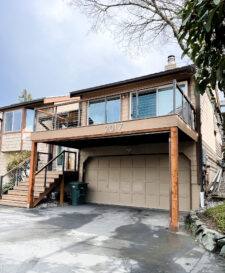
Signs Your Deck Needs Repair, Not Just Cleaning
Some deck problems are cosmetic and some are structural, and it's not always obvious which is which from the surface. If you notice any of the following, it's worth having someone look underneath the deck, not just power-wash the top.
- Soft or spongy spots when you press on decking boards, especially near the house or stair stringers
- Rust streaks bleeding out from screw heads or joist hangers
- Gaps opening up between the ledger board and the house siding
- Railings or posts that flex or wobble when pushed
- Persistent moss or dark staining in the same spots every year, even after cleaning
- Stair stringers that feel bouncy or uneven underfoot
- Visible daylight or gaps at joist hanger connections
- A musty smell coming from underneath the deck
What a Correct Deck Repair Actually Involves
Structural Components First
Before anything cosmetic gets touched, a proper repair starts underneath — checking ledger board attachment and flashing, joist condition, beam and post connections, and footings. This is the part homeowners never see, but it's the part that determines whether the deck is actually safe to stand on. Patching visible boards while ignoring a rotted joist or a corroded ledger connection just hides the real problem.
Decking and Railing
Once the structure is confirmed sound (or repaired to be sound), we address the decking surface and railing system — replacing rotted or cracked boards, resetting loose balusters, and rebuilding stair components that no longer meet code height or spacing. Railings get special attention here, since a loose or undersized guardrail is a fall hazard, not just a cosmetic issue.
Fasteners and Hardware Matter More Here
Given the salt air, we default to stainless steel or heavy hot-dip galvanized fasteners and connectors on Similk Beach jobs rather than standard coated deck screws. It costs a bit more up front, but mismatched or under-rated hardware is one of the most common reasons a deck repair fails again within a few years in a coastal setting.
Repair vs. Replace: How We Decide
Not every deck problem calls for a full rebuild, and not every deck is worth patching. We base the recommendation on what we find in the structure, not on what's easiest to sell.
| Condition Found | Typical Approach | Why |
|---|---|---|
| Isolated rotted boards, sound framing underneath | Targeted board replacement | Framing is doing its job; surface wear is a maintenance-level fix |
| Corroded fasteners, framing otherwise solid | Hardware upgrade to stainless/galvanized | Stops the rust cycle before it spreads to the wood |
| Rotted ledger board or flashing failure | Ledger rebuild with proper flashing | Safety-critical connection point; can't be patched around |
| Widespread rot across multiple joists or beams | Partial or full structural rebuild | Repeated patching won't restore load capacity |
| Deck is decades old with cumulative wear | Full replacement discussion | At some point repair costs approach rebuild costs with less long-term value |
We'll walk you through exactly which category your deck falls into and why, in plain terms, before any work starts.
Decking Material Options for Coastal Conditions
If boards need to be replaced, the material choice matters more here than it would inland. Each option has real trade-offs, and we'll be upfront about them rather than push whatever is easiest to install.
| Material | Coastal Performance | Maintenance |
|---|---|---|
| Pressure-treated lumber | Good if sealed and fastened correctly; needs consistent upkeep | Annual cleaning and periodic sealing |
| Cedar | Naturally rot-resistant, but softer and more sensitive to installation quality | Regular sealing to maintain that resistance |
| Composite decking | Handles moisture and salt air well; won't rot | Low, but not zero — surface cleaning to prevent mold and mildew buildup |
We install and repair all three, and we'll tell you honestly which one fits your budget, your deck's exposure, and how much upkeep you actually want to do. Composite isn't automatically the right answer for every homeowner — it costs more up front, and the substructure underneath still needs to be built correctly regardless of what's on top.
Permits, Codes, and Guardrail Safety
Deck repair work in Skagit County and within Anacortes city limits can trigger permit requirements depending on the scope — particularly if structural framing, footings, or guardrail height and spacing are involved. Guardrail and baluster spacing requirements exist because they prevent falls, not because inspectors enjoy paperwork. When we scope a repair, we'll tell you if it's the kind of job that needs a permit and handle that conversation with you rather than quietly skipping it. Cutting corners on permitting for structural work is exactly how homeowners end up with problems at resale.
Our Deck Repair Process
- On-site inspection. We get underneath the deck, not just walk the surface — checking framing, ledger attachment, fasteners, and footings.
- Honest diagnosis. We show you what we found and explain what's cosmetic versus structural, in terms that make sense.
- Written scope and options. You get a clear plan — repair, partial rebuild, or full replacement — with the reasoning behind the recommendation.
- Permit handling when required. If the scope needs a permit, we manage that process.
- Repair work. Structural fixes first, then decking, railing, and stairs, using fasteners and materials rated for this environment.
- Final walkthrough. We check the finished work with you before we consider the job done.
Why Hire a Crew That Already Works Similk Beach
A contractor who mostly works inland projects can still do competent framing, but they may not default to marine-grade hardware, may not think to check ledger flashing as closely, and may not recognize how fast moss reestablishes on a shaded, salt-exposed deck in this specific microclimate. Crews who regularly work Similk Beach and the surrounding Anacortes waterfront know which failure points show up here again and again, because they've seen them repeatedly — not because a manual told them to look. That local pattern recognition is often the difference between a repair that lasts and one you're calling someone back for in three years.
Maintenance Tips to Extend Your Repair
A correctly done repair still needs some upkeep to get its full lifespan in this climate. A few habits go a long way:
- Sweep debris and standing moss off the deck surface before it has all winter to sit and hold moisture
- Keep gutters and downspouts near the deck clear so runoff isn't dumping extra water onto it
- Check the underside once a year for new staining, soft spots, or fastener rust
- Reseal wood decking on the schedule appropriate to that product, not just when it looks faded
- Trim back vegetation that's keeping sections of the deck shaded and slow to dry
If your deck in Similk Beach is showing rust stains, soft boards, persistent moss, or a railing that doesn't feel as solid as it used to, we're happy to take a look and give you a straight answer about what it actually needs. Use the form below to request a free, no-pressure estimate.