 Anacortes Roofing
 Why Decks in Skyline Wear Out Faster Than You'd Expect
Skyline sits close enough to the water that homes here take a different kind of weathering than decks built further inland in Skagit County. The salt-laden air that rolls off the surrounding waterways settles into fasteners, framing hardware, and even the grain of wood decking, accelerating corrosion in ways that aren't always visible until a board or bracket fails. Add in Anacortes' long stretch of driving rain each fall and winter, plus a moss season that can run from October well into spring, and you have a set of conditions that ages an outdoor structure faster than the manufacturer's warranty paperwork usually accounts for.
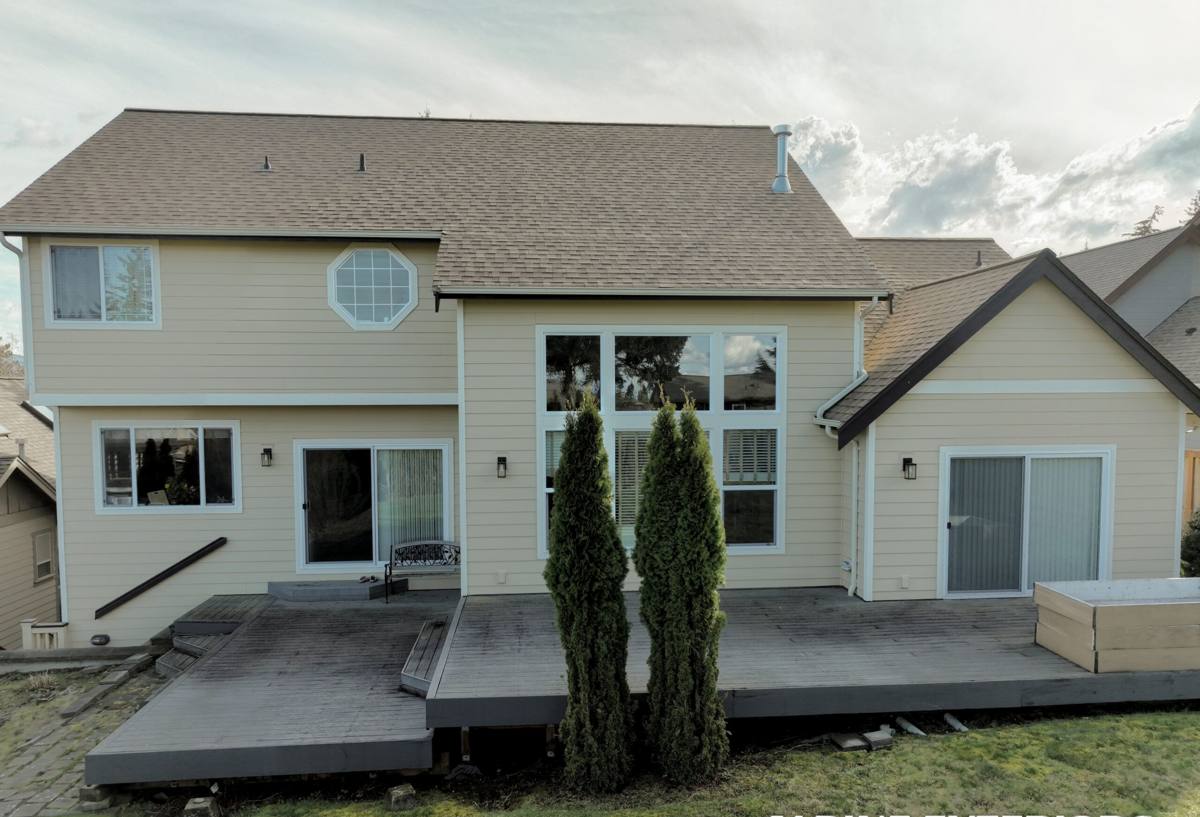
A deck that was built to a generic national spec, without those local factors in mind, tends to show its age in specific ways: soft spots near the ledger board, corroded joist hangers, slick moss buildup on shaded boards, and finish failure on the south and west-facing rails where sun and salt spray both hit hardest. None of that means the original builder did bad work necessarily — it often just means the deck wasn't detailed for this exact microclimate.
Signs a Skyline Deck Needs Replacement, Not Just Repair
Not every tired-looking deck needs to come out entirely. But there's a point where patching individual boards or re-securing a railing is just delaying a bigger, more expensive failure. Here's what tells us a deck has crossed that line:
- Soft, spongy, or discolored decking near the house, especially close to the ledger board attachment
- Rust streaking from screws, joist hangers, or post bases — a sign the galvanizing has broken down
- Visible gaps or movement where the ledger meets the house framing
- Persistent moss or algae growth that regrows within weeks of cleaning, indicating the wood substrate is holding moisture
- Posts that feel loose or that show rot at the base where they meet a footing or concrete pier
- Railings that flex noticeably under normal hand pressure
- A deck more than 20-25 years old that has never been fully re-flashed or had its ledger connection inspected
If you're only seeing one or two of these on an otherwise sound structure, repair may still make sense. When several show up together, it usually means the framing itself has been absorbing moisture for years, and that's a replacement conversation.
What a Correct Deck Replacement Actually Involves
A deck replacement is more than pulling old boards and screwing down new ones. In a marine climate like Anacortes', the parts you don't see after the job is done are the parts that determine whether the new deck lasts 10 years or 30.
Substructure and Footings
We check footing depth and condition against current code requirements before anything else goes back together. Undersized or frost-heaved footings are a common issue on older Skagit County decks, and it's far cheaper to correct that during a full replacement than to discover it later as a structural problem.
Ledger Board and Flashing
The ledger — the board that attaches the deck to the house — is the single most common failure point we see locally, because it's where wood, metal fasteners, and constant moisture all meet in one spot. Proper flashing (a water-resistant barrier that directs rain away from the house-to-deck connection) is non-negotiable on a replacement. This is also where corrosion-resistant fasteners matter most, since this connection carries structural load and sits in the wettest, least-ventilated part of the whole deck.
Decking Material Selection
What goes on top matters for looks, but the framing underneath is what determines whether the deck stays safe. We talk through material trade-offs with every homeowner rather than defaulting to whatever's cheapest to install.
Fasteners and Hardware
In a salt-air environment, hardware grade isn't a place to cut corners. We use stainless steel or high-grade coated fasteners and connectors rated for corrosive exposure, not standard interior-grade hardware, because the cost difference over the life of the deck is small compared to what it costs to repair corrosion damage later.
Decking Material Comparison for Anacortes' Marine Climate
Every material has real trade-offs here — none of them are wrong choices, but each comes with a different maintenance and moisture profile worth understanding before you decide.
| Material | Moisture & Salt Air Behavior | Maintenance | Typical Lifespan |
|---|---|---|---|
| Pressure-treated wood | Absorbs moisture readily; needs sealing to resist salt air and rain intrusion | Annual cleaning and re-sealing recommended | 10-15 years before major work needed |
| Cedar | Naturally rot-resistant but still needs finish maintenance in coastal air | Periodic staining/sealing to preserve color and resistance | 15-20 years with upkeep |
| Capped composite | Resists moisture absorption well; shell protects core from salt exposure | Occasional washing; no sealing or staining | 25-30 years, per most manufacturer warranties |
| PVC/capstock decking | Fully synthetic; essentially unaffected by salt air or standing moisture | Washing only | 25-30+ years, per most manufacturer warranties |
We install all of the above depending on budget and homeowner preference. Where we steer clients away from certain lower-grade composite products, it's a maintenance and moisture-performance conversation — some early-generation composites without a full cap shell can absorb moisture at cut edges over time, which matters more here than in a dry climate. That's a product-category trade-off, not a knock on any single brand.
Our Deck Replacement Process
- On-site assessment — we inspect the existing deck, footings, ledger connection, and framing to determine what's driving the wear and whether full replacement is actually needed.
- Written estimate — a clear scope of work and cost range before any demolition starts, no surprise change orders for known conditions.
- Permit handling — we pull the required permit through the applicable local jurisdiction and coordinate any required inspections.
- Demolition and disposal — old decking, framing, and hardware removed and hauled off, with the site protected during teardown.
- Framing and flashing — footings verified or upgraded, ledger reattached and flashed correctly, joists and beams set to current code spacing.
- Decking installation — your chosen material installed with corrosion-rated fasteners, proper board spacing for drainage, and attention to airflow underneath.
- Railings and final details — railing systems, stairs, and any post caps or lighting installed and secured.
- Final walkthrough — we go over the finished deck with you, including basic care guidance for our climate.
Permits and Local Considerations
Most deck replacements in and around Anacortes require a building permit, particularly when footings, framing, or railing height are involved — which is nearly always the case in a full replacement rather than a cosmetic board swap. Skyline properties often sit on sloped lots with views toward the water, which can bring setback and, in some cases, height or view-corridor considerations into play depending on the specific parcel. We handle the permit application and coordinate inspections as part of the job, so you're not the one tracking down paperwork or scheduling city inspectors.
If your property is part of an HOA or has covenant restrictions common in some Skyline developments, it's worth checking those requirements before final material and color selections — we're happy to build that into the planning conversation.
Keeping a New Deck Ahead of Moss and Salt Air
A well-built deck still needs some seasonal attention in this climate. The goal is to stay ahead of moss and moisture rather than deal with it after it's taken hold:
- Sweep debris and standing leaves off the deck surface regularly through fall, when moss growth accelerates
- Rinse salt residue off the surface periodically, especially after storms with onshore wind
- Keep gutters and downspouts near the deck clear so runoff isn't draining directly onto or under it
- Check railing and stair connections once a year for looseness, especially after the wettest months
- For wood decking, plan on re-sealing on the schedule the product calls for — skipping a cycle in this climate shows up faster than it would inland
- For composite or PVC decking, a simple wash with mild soap and water a couple of times a year keeps the surface from developing a moss film in shaded areas
What Affects the Cost of a Deck Replacement
We don't quote a number without seeing the site, but these are the main factors that move a project up or down in cost:
| Factor | Why It Matters |
|---|---|
| Deck size and footprint | More square footage means more material, more labor, and more footings |
| Height and grade of the lot | Sloped Skyline lots often need taller posts, additional bracing, or stairs |
| Decking material chosen | Wood, capped composite, and PVC carry different material costs and install labor |
| Condition of existing footings | Reusable footings save cost; undersized or failed footings add scope |
| Railing style and hardware | Cable, glass, and custom railing systems cost more than standard baluster rail |
| Permit and inspection requirements | Scope confirmed by the local jurisdiction can add required structural elements |
Generally, a straightforward, code-compliant deck replacement is a moderate five-figure investment for most Skyline-sized homes, with the final number swinging based on the factors above. We'll walk through where your specific project lands on that range during the estimate.
Why Hire a Crew That Already Works in Skyline
A deck built without local conditions in mind can look fine for a few years and then start failing in ways that are expensive to catch up on — corroded hardware, a ledger connection that was never properly flashed, or decking that holds moss because it was never detailed for drainage. Working in Anacortes and around Skagit County regularly means we're already familiar with the permitting process here, the way local lots sit relative to wind and salt exposure, and the failure patterns that show up on decks that weren't built with this coastline in mind. That familiarity shows up in fewer surprises during the job and a deck that's actually specified for the conditions it has to survive, not just a generic build.
If your Skyline deck is showing its age, or you're just not sure whether it needs repair or full replacement, we're glad to take a look. Fill out the form below for a free, no-pressure estimate — we'll assess what's actually going on and give you a straight answer about what it'll take to fix it right.