 Anacortes Roofing
 Edison's Climate Is Harder on Siding Than It Looks
Edison sits in the flats along Samish Bay, surrounded by farmland and tidal air that moves inland with almost no buffer. That combination is tougher on exterior siding than most homeowners realize. Salt-laden air corrodes fasteners and trim metal faster than it does a few miles inland. Wind-driven rain off the bay doesn't just wet a wall's surface — it gets pushed sideways into seams, laps, and butt joints that aren't detailed correctly. And the shaded, moisture-heavy conditions common around Edison's tree lines and low-lying fields stretch moss and algae season out for much of the year.
None of that is unique to any one house. It's a function of geography — proximity to open water, the amount of shade a lot gets, and how much wind-driven rain a wall actually sees over a Skagit County winter. But it does mean siding choices and installation details that work fine in a dry, sheltered subdivision can fail early here. That's the lens we use on every Edison siding job: what does this specific wall, on this specific lot, actually face?
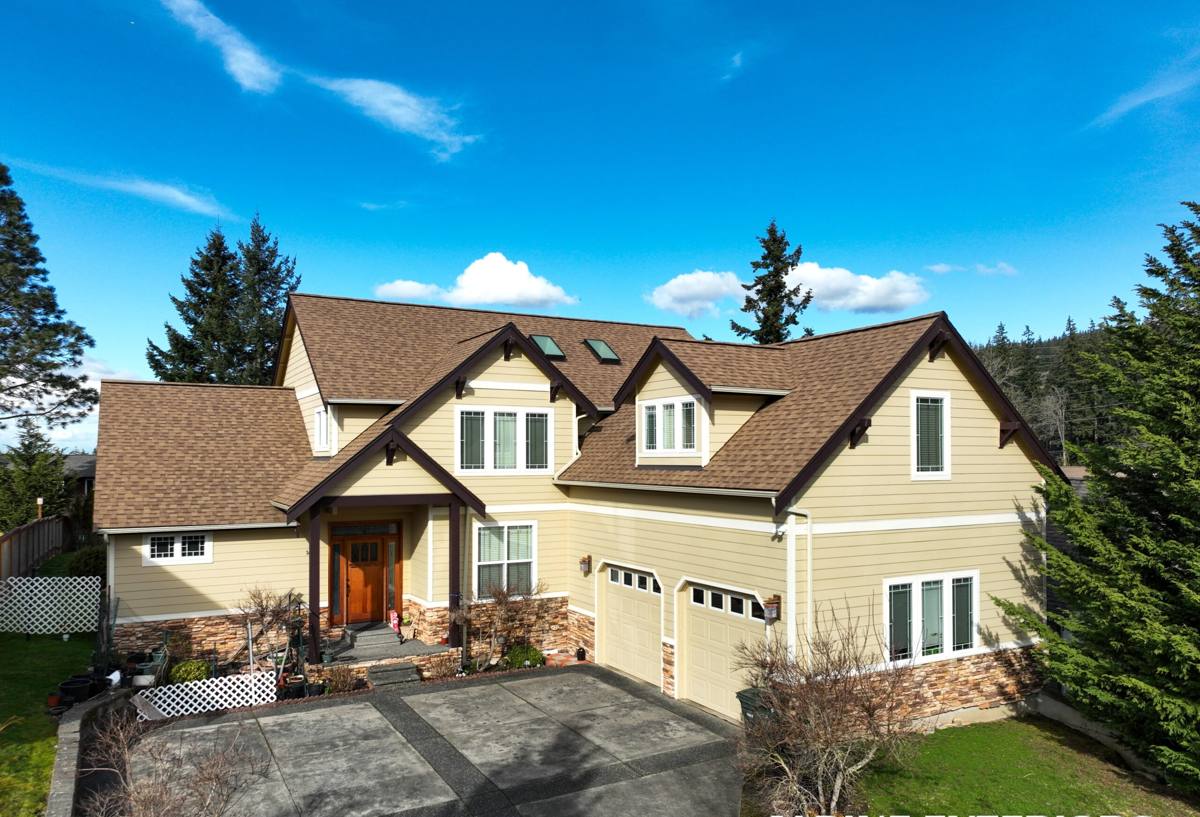
Why We Only Install James Hardie Fiber Cement
We don't install vinyl, LP SmartSide, cedar, primed spruce, Cemplank, or Allura. That's not a marketing line — it's a standard we hold because of what we've seen those products do in exactly this kind of climate over time.
Vinyl expands and contracts with temperature swings, and in salt air its fasteners and trim pieces corrode faster than the panel itself wears out. Wood-based products — cedar, primed spruce, and OSB-core products like LP SmartSide — depend on an intact factory or field coating to keep moisture out of the wood fiber. Once that coating is compromised at a cut edge, a nail hole, or a joint that wasn't caulked correctly, moisture wicks into the substrate and the clock starts on rot, delamination, or swelling. In a place with Edison's rainfall and humidity, that clock runs faster than it would somewhere drier.
James Hardie fiber cement is cement, sand, and cellulose fiber — it doesn't have an organic core to rot, it doesn't support combustion, and it doesn't rely on a coating to keep water out of the material itself (though the ColorPlus finish still matters for appearance and lap protection). That's the core reason we standardized on it. It's not that other products can't be installed correctly — it's that the margin for error is smaller, and the failure modes are more expensive to fix, in a climate like this one.
The Hardie Product Lines We Use in This Area
James Hardie makes climate-engineered product lines, and for the Pacific Northwest we specify HZ5 formulations, which are built for wetter, cooler conditions rather than the HZ10 lines meant for hot, dry, freeze-prone regions.
- HardiePlank lap siding — the most common choice for Edison homes; available in several exposure widths and profiles (smooth, cedarmill texture, beaded)
- HardiePanel vertical siding — used for board-and-batten looks or as an accent on gables and porch areas
- HardieShingle — for homes where a shingle-style accent or full shingle wall fits the design
- HardieTrim — fiber cement trim boards that hold up around windows, corners, and fascia far better than wood trim in wet climates
Most of these come pre-finished with ColorPlus Technology — a factory-applied, baked-on finish that resists fading and chipping better than field-applied paint, and touches up cleanly if a piece ever does get nicked. For a house exposed to bay air and long wet seasons, that factory finish is doing real work, not just saving a paint job.
What a Correct Installation Actually Involves
The material is only half the equation. Fiber cement siding installed with careless flashing or clearances will still let water in, and once water gets behind Hardie board it can sit against sheathing and framing just like it would behind any other material. Correct installation in a climate like Edison's means:
Water Management Comes First
A proper weather-resistive barrier, correctly lapped house wrap or building paper, and flashing at every window, door, and horizontal transition — installed so water sheds outward and down, never trapped behind the plane of the wall.
Clearances Matter More Here
James Hardie specifies minimum clearances from grade, roofing, decks, and walkways — generally several inches minimum, more where practical. Skip those clearances and you're inviting the exact moisture wicking and splash-back that causes problems near ground level, at porch roofs, and around planting beds.
Fastening and Joints
Correct fastener type, spacing, and placement (not too close to panel edges), plus properly sealed and painted butt joints — not caulk alone — to prevent water intrusion at every seam.
Ventilation Behind the Cladding
A rainscreen gap or properly detailed drainage plane lets any moisture that does get past the siding find its way back out instead of sitting against the sheathing — especially valuable on shaded, slow-drying walls.
Siding Options Compared for a Climate Like Edison's
| Factor | Vinyl | Wood / LP SmartSide | James Hardie Fiber Cement |
|---|---|---|---|
| Moisture behavior | Doesn't absorb water, but seams and fasteners are vulnerable; can warp | Relies on intact coating; cut edges and joints are failure points | Won't rot; performs well in sustained damp conditions when installed to spec |
| Salt air exposure | Fasteners and trim corrode over time | Coating breaks down faster near salt air, exposing substrate | Cement composition is inert to salt corrosion; trim fasteners still need to be corrosion-resistant |
| Moss / algae resistance | Can host growth in shaded, damp areas | Similar risk, plus growth can accelerate coating breakdown | Resists growth better; factory finish sheds and cleans more easily |
| Fire performance | Combustible | Combustible | Non-combustible core material |
| Finish longevity | Can fade or become brittle with age | Field or factory coating needs maintenance/repainting over time | ColorPlus factory finish holds color significantly longer than field paint |
How Our Process Works, Start to Finish
We keep the process straightforward because most homeowners are doing this once and want to understand what they're paying for.
1. On-Site Assessment
We look at the actual condition of the existing siding, sheathing, and trim, and we check exposure — which walls take the worst of the wind-driven rain, which stay shaded and slow to dry, where moss has already gotten a foothold. That drives product and detailing decisions, not a one-size-fits-all spec.
2. Written Estimate
A clear scope covering material, prep work (including any sheathing repair we find), flashing and water management details, and finish selection — no vague allowances.
3. Tear-Off and Substrate Check
Once old siding comes off, we inspect sheathing and framing for hidden moisture damage before anything new goes up. This is often where problems from a prior installation actually turn up.
4. Installation to Manufacturer Spec
Weather barrier, flashing, clearances, fastening, and joint treatment all done to James Hardie's published installation requirements — which is also what keeps the manufacturer's warranty intact.
5. Final Walkthrough
We go over the finished job with the homeowner, including basic care and what to watch for seasonally in this climate.
Signs Your Current Siding Is Already Struggling
A lot of siding problems in this area develop slowly enough that homeowners don't notice until they've become expensive. Worth checking for:
- Soft or spongy spots when you press on siding near the bottom courses or around windows
- Persistent moss or algae staining that comes back quickly after cleaning
- Paint that's peeling, bubbling, or chalking well before you'd expect a repaint
- Visible gaps, warping, or buckling at panel seams and corners
- Rust streaks below fasteners or trim
- Musty smells or discoloration on interior walls that share an exterior wall with problem siding
Why It Matters That We Already Work in Edison
Skagit County's building requirements, typical framing practices in older farmhouses and newer builds around Edison, and the local exposure patterns — how a wall facing the bay behaves differently than one tucked behind a tree line — aren't things you learn from a manual. A crew that's already worked this specific stretch of the county has a feel for which details matter most on which walls, what permitting looks like locally, and how a James Hardie installation should be adjusted for a lot that gets more wind-driven rain or more shade than average. That local pattern recognition is part of what keeps a siding job performing for decades instead of needing attention in five years.
Maintenance That Actually Keeps Hardie Siding Performing
James Hardie siding is low-maintenance, not no-maintenance. In Edison's climate, a simple annual rhythm goes a long way: a gentle wash to knock back moss and algae before it takes hold, a visual check of caulked joints and trim for cracking, and prompt attention if a fastener starts showing rust or a panel edge gets damaged. None of this is heavy work, but skipping it in a wet, shaded climate lets small issues turn into bigger ones faster than it would in a drier region.
If you're weighing a siding replacement or repair in Edison, we're happy to take a look and give you a straightforward, no-pressure estimate — just fill out the form below and we'll get in touch.