 Anacortes Roofing
 Roofing in a Salt-Air Climate: What Makes Flounder Bay Different
Flounder Bay sits close enough to the water that the air itself becomes part of the roofing equation. Salt-laden moisture off the bay settles on shingles, flashing, and fasteners day after day, and over years that steady exposure does things a roof twenty minutes inland simply doesn't deal with. Add in the driving, wind-pushed rain that comes off Rosario Strait and the surrounding waters of Skagit County, plus a moss season that can stretch from fall through spring in the Pacific Northwest's damp, shaded conditions, and you have a roofing environment that rewards the right materials and the wrong choices punish homeowners fast.
A roof replacement here isn't just about swapping old shingles for new ones. It's about understanding how corrosion, wind-driven water, and organic growth interact with a specific roof's slope, orientation, and exposure to the bay. We work on homes throughout the Anacortes area, and the roofs closest to the water consistently show wear patterns that inland roofs don't — earlier fastener corrosion, more aggressive moss colonization on north-facing slopes, and granule loss where salt air has been steadily breaking down asphalt shingles for years past what the warranty assumed.
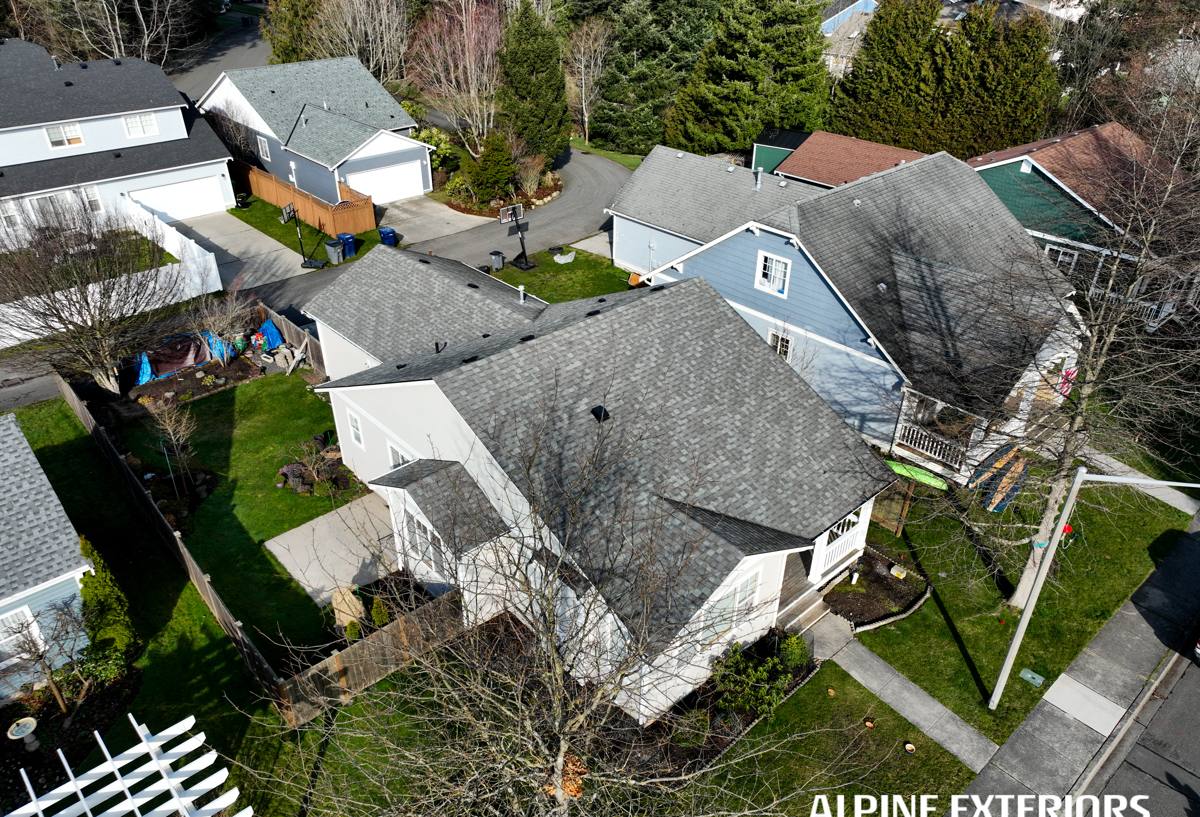
Signs Your Flounder Bay Roof Is Ready for Replacement
Some of these signs are obvious from the ground. Others take a closer look, which is part of why a proper inspection matters more than a quick drive-by estimate.
- Granule loss showing up in gutters or at downspout outlets, especially on slopes that face the water
- Curling, cupping, or cracked shingles, particularly on the roof's south and west exposures where sun and wind both hit hardest
- Moss mats thick enough to hold water against the roof deck rather than just discoloring the surface
- Rusted or corroding fasteners, flashing, or metal roof-vent housings — a common early failure point in salt air
- Soft spots or sagging when walked, which usually means the decking underneath has already taken on moisture
- Daylight visible through the roof deck from inside the attic, or water staining on rafters and sheathing
- A roof that's simply reached the end of its rated service life, even if it looks intact from the street
Any one of these on its own might mean a repair is enough. Several together, especially combined with an aging roof, usually mean patching is just delaying a decision the roof has already made for you.
What a Correct Roof Replacement Actually Involves
Tear-Off and Deck Inspection
We don't install over existing layers. A full tear-off is the only way to actually see the deck, and in a bay-adjacent climate, that matters more than usual — moisture can travel under shingles for years without showing an obvious leak inside the house. Once the old roofing is off, we inspect every section of decking for soft spots, delamination, or rot, and replace only what's actually compromised. No good roof gets built on a bad deck, no matter how good the shingles on top are.
Underlayment and Flashing
This is where a lot of the real weather protection happens, and it's easy to shortcut. In a driving-rain climate, wind can push water sideways and even slightly uphill under poorly sealed edges. That means synthetic or self-adhering underlayment in the right locations, ice-and-water-shield-style membrane at valleys and eaves where water concentrates, and new flashing at every chimney, skylight, sidewall, and roof-to-wall transition rather than reusing old flashing that's already corroding from salt exposure.
Ventilation
A roof that can't breathe traps moisture underneath it, which accelerates deck rot and gives moss and algae exactly the damp environment they need to take hold. Balanced intake and exhaust ventilation — working with your attic's actual airflow rather than just adding vents wherever they're easiest to cut — keeps the underside of the deck dry and extends the life of whatever material goes on top.
Choosing Materials for a Marine Climate
There's no single "best" roofing material for every home — the right choice depends on the roof's exposure, the home's style, and what the homeowner wants to manage long-term. What we can do is lay out the honest trade-offs specific to a salt-air, high-moss environment.
| Material | Salt-Air Performance | Moss/Algae Resistance | Maintenance Reality |
|---|---|---|---|
| Architectural asphalt shingle | Good with corrosion-resistant fasteners and flashing | Better with algae-resistant granules; still needs periodic cleaning | Low to moderate — inspect yearly, clean moss buildup as needed |
| Metal roofing | Excellent when properly coated; fastener quality matters most | Sheds moss and debris well due to smooth, sloped surface | Low — occasional debris clearing, watch fastener seals over decades |
| Synthetic/composite shingle | Very good — doesn't corrode, resists salt-driven degradation | Generally strong resistance, varies by product | Low — durable, but confirm local warranty support before installing |
| Cedar shake | Traditional PNW look, but needs real upkeep near the water | Most susceptible — damp, shaded roofs grow moss faster on wood | Higher — regular treatment and moss removal are part of ownership |
We'll talk through which of these actually fits a given roof's slope, sun exposure, and how much upkeep a homeowner wants to take on — not push whatever's easiest to install. Cedar's look appeals to a lot of people in this region, and it can work well, but it asks more of the owner in a damp, moss-prone spot like Flounder Bay than a metal or composite product does. That's a maintenance conversation worth having before, not after, the roof goes on.
Our Roof Replacement Process
- Inspection and honest assessment — we walk the roof, check the attic, and tell you what we actually find, including if repair is a reasonable option instead of full replacement.
- Written estimate with material options — clear pricing, clear scope, no vague allowances buried in fine print.
- Permitting — handled through the appropriate local jurisdiction before any work begins.
- Material staging and site protection — landscaping, siding, and driveways get protected before tear-off starts.
- Full tear-off and deck repair — old roofing removed, deck inspected and repaired as needed.
- Underlayment, flashing, and ventilation installed correctly — the parts that don't show but determine whether the roof actually lasts.
- New roofing installed to manufacturer specification — because a shortcut here is usually what voids a warranty later.
- Full site cleanup — magnetic sweep for nails, debris hauled off, yard left the way we found it.
- Final walkthrough and warranty paperwork — so you know exactly what's covered and for how long.
Cost Factors for Roof Replacement in Flounder Bay
Every roof is different, so broad ranges only go so far — but the factors that actually move the number are consistent.
| Factor | Why It Matters |
|---|---|
| Roof size and number of planes | More square footage and more valleys/hips mean more material and labor |
| Deck condition | Rot or soft spots discovered at tear-off add repair cost not visible from the street |
| Material selection | Asphalt, metal, synthetic, and cedar carry different material and labor costs |
| Pitch and access | Steep roofs and limited site access near the water can add safety and staging time |
| Flashing and ventilation scope | Chimneys, skylights, and complex rooflines need more custom flashing work |
| Tear-off layers | Removing multiple old layers takes more labor than a single-layer tear-off |
Most full replacements land somewhere in the range of several thousand to the low tens of thousands of dollars depending on these factors — we'll give you a specific number after we've actually looked at the roof, not before.
Moss, Algae, and Long-Term Maintenance
Even a well-installed roof in this part of Skagit County will deal with moss over its lifetime — it's a function of shade, moisture, and the mild, wet winters that define the region, not a sign of a bad job. What changes the outcome is how the roof is set up to shed water and how consistently moss is kept in check before it works its way under shingle edges and holds moisture against the deck. Copper or zinc strips near the ridge, algae-resistant shingle granules, and simple annual inspection go a long way. What doesn't help is aggressive pressure-washing, which strips granules and shortens a roof's life faster than the moss it's meant to remove — we'll walk you through gentler, effective options if you want to handle upkeep yourself between visits.
Why Hire a Crew That Already Works in Flounder Bay
Roofing a waterfront-adjacent home isn't the same job as roofing one a few miles inland, even within the same city. A crew that already works this specific area understands how wind comes off the bay, which slopes take the worst of the driving rain, and how much heavier moss growth tends to run on shaded, water-facing roofs compared to the rest of Anacortes. That's not something you pick up from a single job — it's pattern recognition built from working this stretch of Fidalgo Island repeatedly.
There's also a practical side to local familiarity: knowing the permitting process for the jurisdiction, understanding realistic weather windows for tear-off work in a marine climate, and being able to respond quickly if a tarp needs to go up before a storm rolls in off the water. None of that replaces solid installation fundamentals, but it's the difference between a contractor who's guessing at local conditions and one who already knows them.
Get a Straight Answer About Your Roof
If your roof is showing wear, growing moss faster than it used to, or is simply old enough that you're wondering whether it's time, we're happy to take a look and give you an honest read — no pressure, no inflated urgency. Reach out through the form below for a free estimate, and we'll walk the roof, answer your questions, and give you real numbers to work with.