 Anacortes Roofing
 Similk Beach Sits Right at the Edge of the Weather
Similk Beach is a shoreline community along Similk Bay on Fidalgo Island, tucked between Anacortes and the Deception Pass corridor in Skagit County. That location is beautiful, and it is also demanding on a house. Homes here take on salt-laden air coming off the bay and the Salish Sea, driving rain pushed in by south and southwest storms, and long stretches of shade under the fir and cedar cover that lines so many lots in this part of the island. Siding that would hold up fine on a dry, sunny lot inland can fail years early out here.
Salt Air and Moisture
Salt-carrying air corrodes exposed metal fasteners, degrades caulk faster than inland conditions, and accelerates the breakdown of paint films that aren't formulated to handle it. Combine that with wind-driven rain hitting exterior walls at an angle instead of falling straight down, and you get more water pressure at seams, corners, and butt joints than most siding products are tested for.
Moss, Shade, and a Long Wet Season
Shaded, tree-lined lots near the water stay damp longer after every rain. That's the recipe for moss and algae growth on any siding surface that can hold moisture or that offers organic material for spores to grow on. It's also why gutters, flashing, and the ability of a wall assembly to dry out matter as much as the siding material itself.
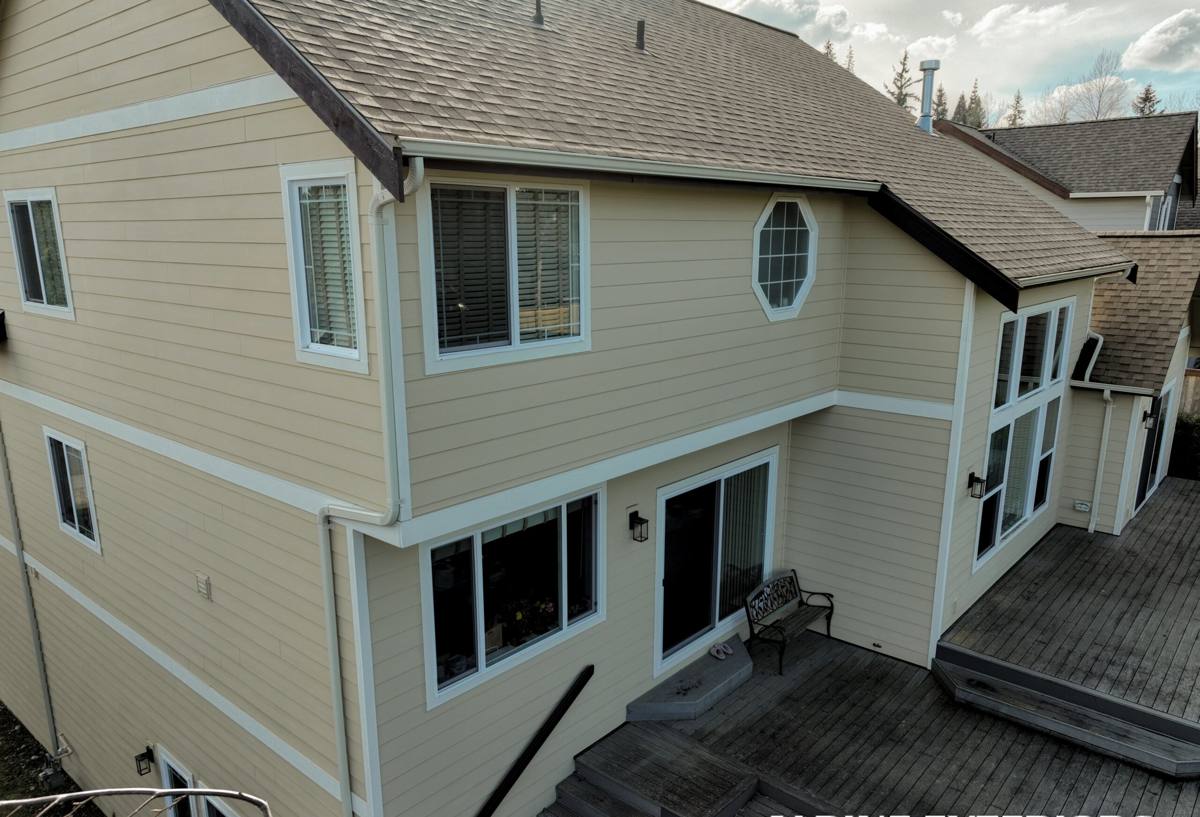
Why We Only Put James Hardie on Homes in This Area
We install James Hardie fiber cement exclusively — not vinyl, not LP SmartSide, not Cemplank or Allura, not primed spruce or cedar. That's a deliberate standard, not a sales preference, and Similk Beach's climate is a good example of why. Hardie's HZ5 product line is engineered specifically for the wet, moderate-freeze conditions of the Pacific Northwest, which is the zone Skagit County falls into. It's fiber cement, so it's non-combustible, doesn't feed moss the way wood-based siding can, and doesn't warp, swell, or delaminate at the edges the way OSB-core products can when they take on repeated moisture.
The factory-applied ColorPlus finish is baked on under controlled conditions and backed by its own finish warranty, which matters here because it resists fading and staining far better than a field-applied paint job has to fight salt air and UV. Fiber cement is also dimensionally stable — it doesn't expand and contract with humidity the way wood does, so caulked joints and butt seams stay tighter for longer, which is exactly where wind-driven rain looks for a way in.
We're not going to tell you vinyl or LP SmartSide are junk — they're not, and each has its place. Vinyl can rattle loose and chalk out in coastal wind and UV exposure, and its seams rely on lap joints that aren't caulked, which gives water a path in driving rain. LP SmartSide is a wood-strand product, so like any wood-based siding, its long-term performance depends heavily on keeping cut edges sealed and moisture out — a tall order in a shaded, damp microclimate. Cedar and primed spruce need real ongoing maintenance to hold up against moss and salt air. We made the call to standardize on one product system we can install to spec, back consistently, and stand behind on every home we touch.
What a Correct Installation Requires Here
James Hardie siding performs the way it's rated to perform only when it's installed correctly. In a salt air, high-moisture environment like Similk Beach, a few details matter more than they would on an easier site.
| Detail | Why It Matters on This Site |
|---|---|
| Rainscreen gap behind the siding | Lets any moisture that gets past the cladding drain and dry out instead of sitting against the wall in a shaded, slow-drying lot |
| Flashing at windows, doors, and penetrations | Wind-driven rain finds every unflashed gap; this is the single most common source of hidden water damage |
| Corrosion-resistant fasteners | Salt air accelerates corrosion of the wrong fastener type, which leads to streaking and eventual fastener failure |
| Manufacturer-spec nailing pattern and clearance | Correct fastener placement and ground/roof clearance keep the board from taking on splash-back moisture |
| Factory-cut and sealed field edges | Every field cut needs primer or sealant on the cut edge — skipping this is the most common installation shortcut that shortens siding life |
| Proper caulk selection and joint prep | Salt air and UV break down low-grade sealants faster; joints need product rated for the exposure |
Our Process for a Similk Beach Home
- On-site inspection — we look at existing siding, sheathing condition, moisture exposure, shade patterns, and drainage around the home before quoting anything.
- Moisture and substrate check — we check for hidden rot or water damage behind the current siding, since that has to be addressed before new siding goes on, not covered up.
- Product and color selection — we walk you through Hardie's board profiles, textures, and ColorPlus palette so the finished look fits the home and the lot.
- Tear-off and sheathing repair — old siding comes off, damaged sheathing is replaced, and the wall is prepped for a proper weather-resistive barrier.
- Weather barrier and rainscreen installation — this is the layer that does the real water-management work, installed before a single piece of visible siding goes up.
- Hardie installation to manufacturer spec — correct fastening, flashing, clearances, and sealed cut edges throughout.
- Final walkthrough — we go over the finished work with you and make sure everything is sealed, aligned, and cleaned up.
Why a Crew That Already Works This Area Matters
A contractor who works Similk Beach and the surrounding Anacortes shoreline regularly already knows how this microclimate behaves — which walls take the worst wind-driven rain, how shaded lots hold moisture longer, and how to schedule around the weather windows that actually exist here rather than fighting the calendar. They also know the Skagit County permitting process and inspection expectations, so there are no surprises mid-project. That local familiarity isn't marketing — it shows up in fewer callbacks and a job that's built for the site it's actually on, not a generic install.
How James Hardie Compares to Other Options Homeowners Consider
| Factor | James Hardie Fiber Cement | Vinyl | LP SmartSide | Cedar |
|---|---|---|---|---|
| Salt air / coastal exposure | Engineered HZ5 line for this climate zone | Can chalk, warp, or rattle loose over time | Performance depends on sealed edges and moisture control | Needs regular refinishing to resist salt exposure |
| Moss and moisture in shade | Doesn't feed organic growth; sheds moisture well | Won't rot but seams can trap moisture | Wood-strand core is moisture-sensitive at cut edges | Naturally moss-prone in shaded, damp settings |
| Fire resistance | Non-combustible | Combustible | Combustible | Combustible |
| Finish durability | Factory ColorPlus finish, separate finish warranty | Color molded in but can fade/chalk | Field-applied or factory finish, needs maintenance | Requires periodic staining or painting |
| Ongoing maintenance | Low — occasional rinse and caulk check | Low but limited repair options if damaged | Moderate — edge sealing and inspection | High — refinishing on a recurring schedule |
Maintenance Once It's Installed
- Rinse siding annually to keep salt residue and organic growth from building up, especially on shaded elevations
- Keep gutters and downspouts clear so water isn't sheeting down the wall face
- Check caulk joints at trim, windows, and corners every year or two and re-seal if it's cracking
- Trim back vegetation that keeps a wall shaded and slow to dry
- Address any paint or finish chipping at cut edges promptly to prevent moisture intrusion
What Affects the Cost of a Project Like This
| Cost Factor | Why It Matters |
|---|---|
| Home size and number of stories | More surface area and taller walls mean more material and labor, plus access equipment on multi-story homes |
| Tear-off vs. new construction | Removing and disposing of old siding, plus repairing any hidden sheathing damage, adds time and cost |
| Siding profile and trim detail | Lap siding, board-and-batten, and shingle-style panels each price differently, and trim-heavy designs take more labor |
| Site access and lot conditions | Sloped, wooded, or tight-access lots common near the water take longer to stage and work safely |
| Extent of moisture or rot repair needed | Sheathing or framing repair uncovered during tear-off is priced separately from the siding install itself |
Questions Worth Asking Before You Hire
- Is the crew licensed, bonded, and insured to work in Washington?
- Do they install James Hardie regularly, or occasionally alongside several other siding brands?
- Will they inspect and repair sheathing damage before siding goes on, not just cover it?
- Do they include a proper rainscreen and flashing plan in the quote, or just the visible siding?
- Can they explain, in plain terms, how the job will handle wind-driven rain on your specific walls?
If your Similk Beach home's siding is aging, moss-streaked, or you're planning ahead for a remodel, we're happy to take a look and give you a straightforward, no-pressure estimate. Use the form below to get started.