 Anacortes Roofing
 Why La Conner Decks Wear Out Faster Than Decks Inland
La Conner sits right on the Swinomish Channel, which means every deck in town is dealing with conditions that a deck twenty miles inland simply doesn't see. Salt-laden air off the water works on fasteners, flashing, and any exposed metal year-round. Add Skagit County's long wet season — months of low sun angle, driving rain, and heavy dew — and you get wood surfaces that rarely get a full chance to dry out between storms. That's the setup moss loves, and it's why so many La Conner decks show green growth, soft spots, and fastener staining well before a deck of the same age would in a drier part of the state.
Composite decking doesn't eliminate every one of these problems, but it changes which ones you actually have to fight. Understanding that trade-off before you buy is the difference between a deck that looks good for fifteen-plus years and one that needs babying every spring.
What Composite Decking Actually Solves — and What It Doesn't
Composite boards are made from a blend of wood fiber and plastic, and on capped products, that core is wrapped in a polymer shell. That shell is what stops water absorption into the board itself, which is the main reason wood decking near the water rots, cups, and splinters. It also means the board's surface won't feed mold and mildew the way bare wood fiber does, since there's no exposed organic material for it to root into.
What composite doesn't do is stop moss and algae from growing on top of the board. Moss doesn't need the board to be organic — it just needs a damp, shaded surface to land on, and La Conner's climate hands it that for months at a time. So composite decking near the channel still needs periodic cleaning; it just doesn't need the sanding, staining, and sealing that wood demands to survive the same conditions.
Where Homeowners Get Surprised
- Composite is genuinely low-maintenance, not zero-maintenance — plan on a rinse and scrub a couple of times a year.
- Not all composite is equal — uncapped or budget boards can still absorb moisture at cut ends and fastener holes.
- Color and finish matter for heat and glare, but they don't change how the board handles moisture — that's a core and cap question, not a color question.
Board Selection: What Actually Holds Up Near the Channel
We don't push one brand as the only option, because the right board depends on your budget, your deck's exposure, and how much sun versus shade it gets. What we do insist on for La Conner installs is a fully capped composite board — capped on all four sides, not just the top — because exposed cut ends and uncapped edges are exactly where salt moisture and standing water find a way in over time.
Beyond that, we look at:
- Density and core construction — denser boards resist the freeze-thaw and wet-dry cycling that's common here in shoulder seasons.
- Fastening system compatibility — hidden-fastener systems reduce the number of metal penetrations exposed to salt air, which matters more here than in a dry inland yard.
- Manufacturer warranty terms — specifically whether it covers moisture-related staining and mold, not just structural failure, since that's the failure mode we actually see in this climate.
The Part Nobody Sees: Substructure and Drainage
A composite deck is only as good as what's underneath it. This is where a lot of decking problems in this area actually start, and it has nothing to do with the boards themselves.
Framing
We use fasteners and hardware rated for coastal and treated-lumber exposure — standard hardware store hardware corrodes faster than most homeowners expect this close to saltwater. Where the budget allows, composite or coated joists reduce long-term maintenance further, since joist rot underneath a perfectly good composite deck is one of the more common repair calls we get in waterfront towns.
Drainage and Airflow
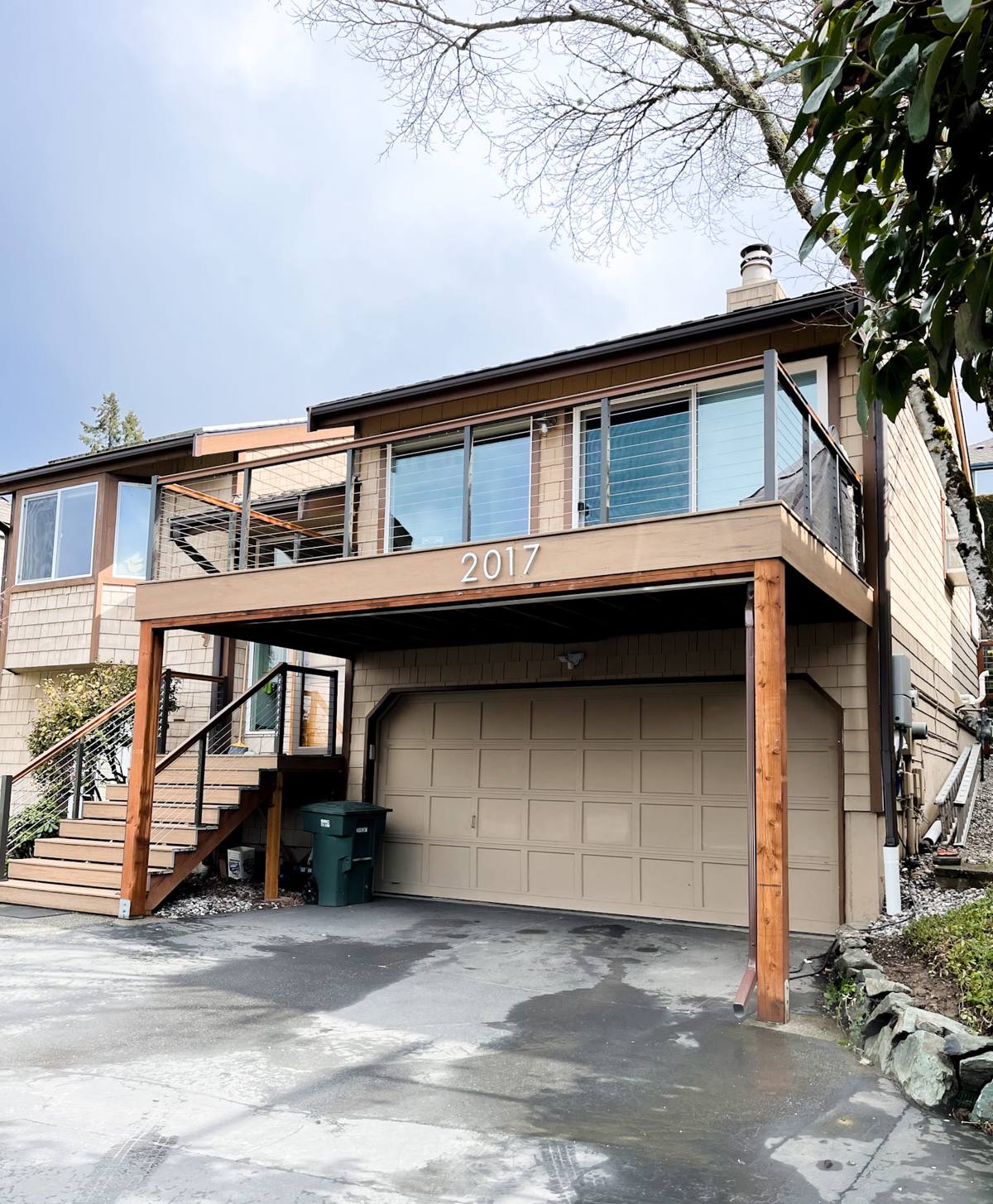
Composite boards need airflow underneath to shed moisture and to keep the ground-level microclimate from turning into a moss incubator. On low-clearance decks, or decks close to grade, we pay close attention to slope, ventilation gaps, and whether water is actually getting away from the structure instead of pooling under it. This is frequently the difference between a deck that stays clean and one that grows moss on the underside of the boards where nobody looks until there's a problem.
Ledger and Flashing
Where the deck attaches to the house, proper flashing keeps driving rain from working its way behind the ledger board and into the wall assembly. This is a small detail that causes large, expensive damage when it's skipped — and it's invisible once the deck is finished, which is exactly why it needs to be done right the first time.
Our Installation Process for La Conner Homes
- On-site assessment — we look at sun exposure, wind direction off the channel, drainage patterns, and the condition of any existing structure before recommending a board or a plan.
- Structural check — existing framing gets inspected for rot, undersized joists, or inadequate ledger attachment before anything new goes on top of it.
- Drainage and ventilation plan — we set slope and clearance specifically for the site, not a one-size-fits-all spec.
- Framing and flashing — corrosion-resistant hardware, proper ledger flashing, and joist protection where it makes sense for the budget.
- Board installation — hidden-fastener systems where the product allows it, tight and consistent gapping for expansion and drainage.
- Finish details — fascia, stair treads, and edge trim capped and sealed at every exposed cut.
- Walkthrough — we show you what maintenance actually looks like for your specific board and site, not a generic care sheet.
Composite vs. Wood vs. PVC: A Straight Comparison
| Factor | Wood | Composite | PVC/Vinyl |
|---|---|---|---|
| Moisture resistance | Low — absorbs water, prone to rot near the channel | High on capped boards | Very high |
| Moss/algae growth on surface | Common, roots into fiber | Grows on surface only, easier to remove | Grows on surface only |
| Maintenance | Annual sanding, staining, or sealing | Periodic wash, no sealing | Periodic wash, no sealing |
| Upfront cost | Lowest | Mid-range | Highest |
| Look and feel | Natural wood grain and warmth | Wood-look, more color/texture options | Uniform, plastic appearance |
| Typical lifespan here | 10–15 years with upkeep | 25–30 years | 25–30+ years |
We install wood decking too, for homeowners who want that look and are willing to keep up with it. But for a family that wants to spend weekends on the deck instead of maintaining it, composite is usually the better fit for this specific climate.
Living With a Composite Deck in La Conner's Climate
Composite decking cuts down on maintenance dramatically, but "low-maintenance" still means a few things on a regular basis, especially this close to the water:
- Sweep and rinse regularly to keep organic debris — leaves, needles, pollen — from sitting wet on the surface and feeding moss growth.
- Scrub with a soft-bristle brush and a composite-safe cleaner a couple of times a year, more often on shaded or north-facing sections.
- Avoid pressure washing at close range or high PSI — it can etch or streak the cap layer on most composite boards.
- Keep planters, furniture, and mats up off the surface periodically so moisture and moss don't get trapped underneath.
- Check fastener heads and edge trim once a year for any early signs of corrosion or lifting, especially after a rough winter.
- Clear gutters and downspouts near the deck so runoff isn't dumping directly onto or under the boards.
What Drives the Cost of a Composite Deck Here
| Cost Factor | Why It Matters in This Area |
|---|---|
| Board tier (capped vs. uncapped) | Fully capped boards cost more but hold up far better against salt air and moisture |
| Substructure condition | Rotted or undersized existing framing adds repair cost before decking can go on |
| Height and railing requirements | Elevated decks near water often need more substantial railing and structural work |
| Fastening system | Hidden-fastener systems cost more in labor but reduce long-term corrosion points |
| Site access | Waterfront and hillside lots can add complexity for material staging and equipment |
| Flashing and drainage detailing | Proper ledger flashing and drainage planning add time but prevent hidden water damage |
We won't quote a number without seeing the site, because the substructure condition alone can swing a project significantly. What we can tell you honestly is that skipping the drainage and flashing details to save money up front is the single most common reason we get called back to fix a "new" deck within a few years.
Why Hire a Crew That Already Works in La Conner
Decking work in a waterfront Skagit County town isn't the same job as decking work in a dry inland subdivision. A crew that hasn't dealt with salt air, moss cycles, and driving rain on a regular basis is more likely to miss the details that actually matter here — the flashing behind the ledger, the airflow under low-clearance sections, the hardware grade that won't corrode in two winters. We work on homes throughout Anacortes and the surrounding Skagit County waterfront, so La Conner's specific climate conditions are something we plan for as a matter of course, not something we're learning on your project.
If you're planning a new deck or replacing one that's showing its age, we're glad to take a look and talk through what makes sense for your home, your budget, and your spot on the channel. Reach out for a free, no-pressure estimate using the form below.