 Anacortes Roofing
 Siding Repair Built for La Conner's Climate
La Conner sits close to the water in Skagit County, and homes here take a different kind of beating than houses even a few miles inland. Salt-laden air off the Swinomish Channel and the broader Puget Sound corridor works on caulk, fasteners, and paint film year-round. Driving rain off winter storms finds every gap in a siding system and pushes moisture where it doesn't belong. And the long, damp shoulder seasons that define this part of Western Washington give moss, algae, and mildew months at a time to take hold on north-facing walls and anything shaded by trees or eaves.
None of that is unusual for the region — it's just what siding here has to survive. The problem is that a lot of siding material wasn't engineered with that combination of exposures in mind, and a lot of "repairs" only address what's visible on the surface. Our crew works this area regularly, so we're not guessing at how La Conner homes fail. We're fixing the same handful of failure patterns over and over, and we know what a repair has to hold up against once we leave.
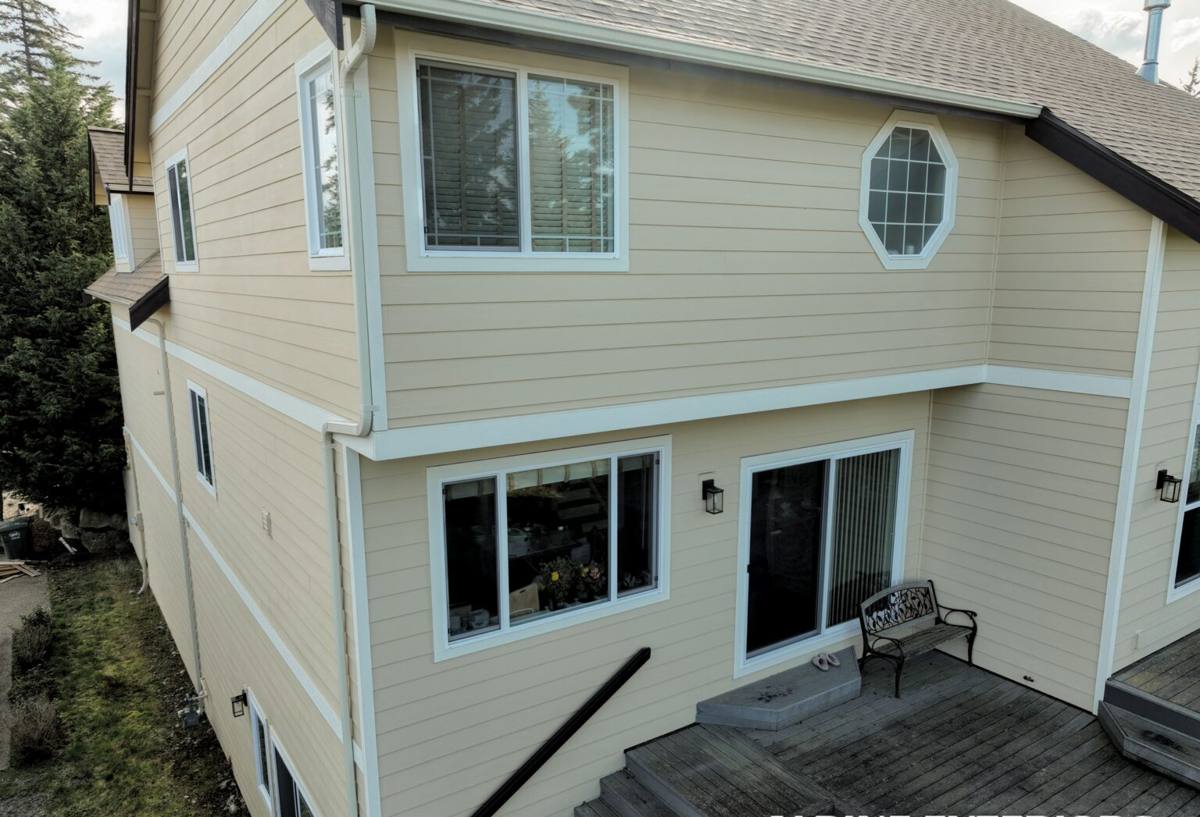
Signs Your Siding Needs Attention
Not every mark on your siding means a problem is building underneath. But a few signs are worth taking seriously, especially on a home this close to salt water:
- Cracked, split, or visibly warped boards, especially near corners and window trim
- Soft or spongy spots when you press on the siding by hand
- Dark streaking, green or black growth, or a persistently damp look on shaded walls
- Caulk joints that have shrunk, cracked, or pulled away from trim and seams
- Peeling or bubbling paint, particularly on the lower courses near grade
- Nail heads working loose, popping through, or leaving rust trails down the face of the board
- A musty smell near exterior walls inside the house, or interior drywall staining that lines up with an exterior wall
Any one of these on its own might be a straightforward, contained repair. Several of them together — or damage that keeps reappearing in the same spot after a patch — usually means water is getting behind the siding, not just sitting on top of it. That distinction changes the entire scope of the fix.
Why the Same Spots Fail Repeatedly
In this climate, siding failure is rarely random. It clusters wherever wind-driven rain hits hardest, wherever moss holds moisture against the wall, and wherever original flashing or caulking was undersized for the exposure. If you've patched the same corner or window twice already, the underlying moisture path was never closed the first time — only the symptom was.
What a Correct Repair Actually Involves
A siding repair that's done right isn't just about matching color and covering the damaged board. It starts with figuring out why that section failed in the first place. On a La Conner home, that usually means checking the flashing above windows and doors, the condition of the water-resistive barrier behind the siding, and whether the original installation left any gaps for wind-driven rain to exploit.
| Step | What We're Checking | Why It Matters Here |
|---|---|---|
| Surface inspection | Cracking, moss, paint failure, fastener condition | Shows where moisture and salt exposure have concentrated |
| Probe test | Soft spots, hidden rot behind the visible surface | Confirms whether damage is cosmetic or structural |
| Flashing & barrier check | Window/door flashing, house wrap continuity, seams | Driving rain finds any gap in this layer first |
| Material match | Profile, exposure, and finish of replacement pieces | Mismatched boards trap water differently than the original run |
| Sealant & fastener spec | Marine-grade or manufacturer-approved caulk and fasteners | Standard hardware corrodes faster in salt air |
Skipping any one of those steps is how a "fixed" wall ends up with the same problem back within a year or two. We'd rather take the extra time to open up a section and confirm what's underneath than nail a new board over a wall that's still wet.
When Repair Isn't the Right Answer
Sometimes the honest answer is that a section of wall, or the whole exterior, has moved past what a patch can fix. That's usually true when we find rot in the sheathing itself, when the original siding material has failed broadly rather than in isolated spots, or when the home is old enough that the siding is simply at the end of its service life. We'll tell you plainly when that's the case rather than billing you for a repair that won't hold.
This is also where the material already on your home matters. Solid wood and engineered wood products can perform well for years, but once moisture gets past the paint film and into the substrate, that damage tends to spread rather than stay put — particularly in a climate that doesn't dry out for long stretches of the year. Vinyl siding doesn't rot the same way, but it doesn't stop water either; it relies entirely on what's behind it, and it becomes brittle and prone to cracking in cold, salt-air exposure over time. Neither is a material we install, and when we're called in to repair a home clad in either one, we'll do the repair honestly — but we'll also tell you what we're seeing underneath.
Why We Rebuild in James Hardie Fiber Cement
When a repair grows into a replacement — for a section of wall or the whole exterior — we install James Hardie fiber cement, and only James Hardie. That's a deliberate standard, not a default. Fiber cement doesn't feed rot, doesn't absorb water the way wood does, and is non-combustible, which matters on a property with any wildfire exposure risk. Hardie's ColorPlus factory finish is baked on under controlled conditions rather than field-painted, which holds up better against the UV and salt exposure a waterfront-adjacent home sees than a job-site paint job typically will.
Hardie also builds region-specific product lines engineered for different climate demands — including versions formulated for damp, moisture-heavy environments like ours, rather than a single one-size-fits-all board. Paired with a transferable manufacturer warranty, it's a system built to be repaired in isolated sections decades from now without the whole wall needing to come off, provided the original installation was done to spec.
What "Installed to Spec" Means for Repairs Later
Fiber cement performs exactly as well as its installation. Correct fastener placement, proper clearances at grade and roof lines, and sound flashing detail are what let a future repair stay small and contained instead of turning into a bigger project. That's as true for the work we do today as it is for whoever repairs this siding fifteen years from now.
Our Process for La Conner Homeowners
- On-site inspection. We look at the damaged area and the surrounding wall, not just the spot you called about.
- Honest diagnosis. We tell you whether this is a contained repair, a larger moisture issue, or a sign the exterior is nearing replacement.
- Written scope and estimate. You know what's being done, in what material, and why, before we start.
- Repair or rebuild. Matching Hardie material and correct flashing detail where we're replacing sections; full system installation where the scope calls for it.
- Final walkthrough. We check the finished work with you and flag anything nearby worth keeping an eye on.
Why a Crew That Already Works La Conner Matters
A contractor who's worked this specific stretch of Skagit County has already seen how salt air ages fasteners, where moss builds up fastest given the tree cover and shade patterns common here, and how far wind-driven rain travels up a wall during a winter storm off the water. That's not something you can fully substitute with general siding experience from a drier part of the state. It also means faster response — we're not routing a crew in from across the region for a job that needs to happen before the next storm system moves through.
Keeping Siding in Good Shape Between Repairs
Most of what shortens siding life in this climate is preventable with basic maintenance. A few habits go a long way:
- Keep gutters and downspouts clear so runoff doesn't sheet down the siding face
- Trim back vegetation that shades walls and keeps them from drying out
- Rinse moss and algae off siding gently before it establishes a heavy foothold
- Check and refresh exterior caulk joints every couple of years, especially around trim and penetrations
- Walk the exterior after major storms and note any new cracking, staining, or loose boards
- Keep soil and mulch beds from piling up against the bottom edge of the siding
What Affects Siding Repair Cost
| Factor | Why It Changes the Scope |
|---|---|
| Extent of moisture intrusion | Surface patch vs. opening the wall to check sheathing and barrier |
| Material match availability | Matching an older profile or discontinued color can take more work |
| Accessibility | Second-story sections, tight setbacks, or landscaping can add labor time |
| Number and location of damaged sections | Scattered small repairs vs. one concentrated area |
| Flashing or trim replacement needed | Failed flashing behind the siding adds scope beyond the board itself |
We'll always walk you through where your specific job falls on that list before we give you a number — there's no useful "average price" for siding repair without seeing the wall.
If you're seeing cracking, staining, moss buildup, or soft spots on your La Conner home's siding, we're happy to come take a look. The estimate is free, there's no pressure to move forward, and you'll get a straight answer about whether you're looking at a repair or something bigger.