 Anacortes Roofing
 Why Ship Harbor Siding Takes More Punishment Than It Looks Like It Should
Ship Harbor sits on the water side of Fidalgo Island, close enough to the Strait of Juan de Fuca and the ferry lanes that homes here catch weather most inland Skagit County properties never deal with. It's not one big storm that wears siding out in this part of Anacortes — it's the daily grind of salt-laden air, wind-driven rain that hits walls sideways instead of falling straight down, and a shade-and-moisture pattern that keeps moss and mildew active for most of the year. Siding that's fine in Sedro-Woolley or Mount Vernon can fail early a few miles away in Ship Harbor simply because the exposure is different.
Salt Air and Coastal Exposure
Airborne salt is corrosive and hygroscopic — it pulls moisture out of the air and holds it against whatever surface it lands on. On siding, that means fasteners, trim, and any exposed wood fiber get a slow, steady moisture load even on days it isn't raining. Paint films that aren't rated for it chalk and fade faster near the water, and any product with exposed wood substrate is more vulnerable to the swelling and softening that salt-assisted moisture causes.
Driving Rain and Wind-Driven Moisture
Anacortes gets less annual rainfall than Seattle, but Ship Harbor's open water exposure means a bigger share of it arrives as wind-driven rain — water pushed horizontally into wall assemblies rather than shedding straight down a roofline. That's a different engineering problem than rainfall volume. It puts pressure on every joint, seam, and penetration in the siding system, which is why lap and panel gaps, caulk lines, and flashing details matter more here than they would on a sheltered inland lot.
Moss, Mildew, and the Long Shade Season
Skagit County's wet season runs long, and many Ship Harbor lots carry mature evergreen cover that keeps north and west walls damp and shaded well into the year. That combination — moisture plus shade — is exactly what moss and mildew need. Siding material that holds surface moisture or has a porous substrate gives biological growth more to work with; material that sheds water and dries quickly gives it less.
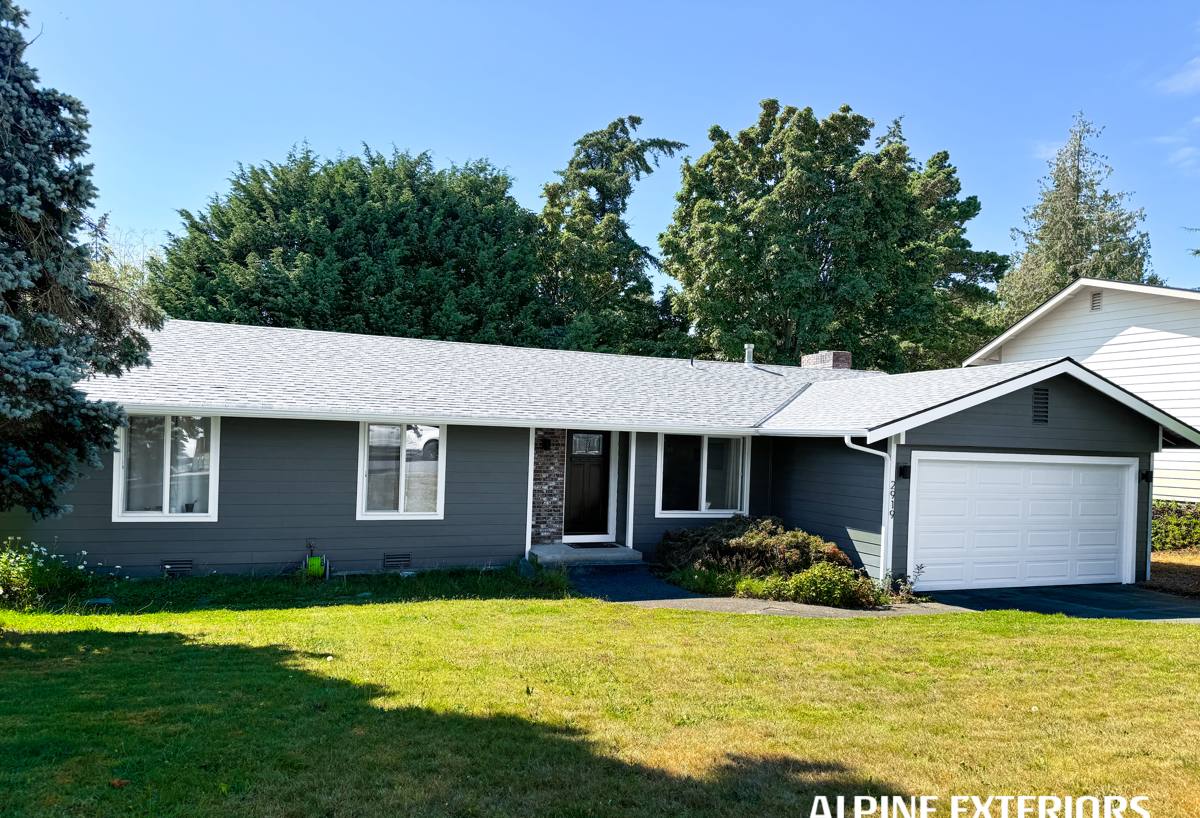
What Correct Fiber Cement Installation Looks Like Here
Fiber cement siding is a good material choice for this climate, but the material alone doesn't solve anything — the installation does. A lot of the siding problems we get called out to inspect in coastal Skagit County trace back to installation shortcuts, not product failure. For a Ship Harbor home, three details matter more than usual.
A Real Drainage Gap Behind the Siding
Fiber cement should be installed over a drainage plane — house wrap or building paper plus a rainscreen gap, or at minimum a properly lapped water-resistive barrier — so that any water that does get past the siding face has somewhere to go besides the sheathing. On a wind-driven-rain site like Ship Harbor, skipping this step is one of the most common reasons siding looks fine from the curb while the wall assembly behind it is quietly rotting.
Flashing and Water Management at Every Penetration
Windows, doors, hose bibs, light fixtures, deck ledgers — every penetration through the siding plane is a potential entry point. Correct flashing means head flashing over openings, kick-out flashing where a roofline meets a wall, and butt joints and inside/outside corners that are sealed or capped per the manufacturer's detail, not just caulked and hoped for. Caulk is a backup, not a water management strategy.
Fastening, Clearances, and Reveal to Manufacturer Spec
James Hardie publishes specific nailing patterns, minimum clearances from grade, decks, and roof lines, and gapping requirements at butt joints and trim. Those numbers exist because of exactly this kind of exposure — undersized clearance from grade or a roof surface lets splash-back moisture sit against the bottom of the siding, and improper fastening can cause telegraphing or cracking as the panel reacts to moisture and temperature changes over the years.
Why We Install Only James Hardie Fiber Cement
We standardized on James Hardie for every siding job we take on, including projects in Ship Harbor, because it's a non-combustible fiber cement product engineered specifically for climate zones like the Pacific Northwest. Hardie's HZ5 formulation is built for regions with the kind of moisture cycling and moderate freeze-thaw exposure you get this close to the water, and the ColorPlus factory finish is baked on under controlled conditions rather than field-applied — which matters directly for salt-air fade resistance and long-term color hold. It also carries a strong, transferable limited warranty, which only means something if the installation itself was done to spec. That's why we treat the installation details above as non-negotiable, not optional upgrades.
How Fiber Cement Compares for a Site Like This
Homeowners in Ship Harbor often ask how fiber cement stacks up against the other materials they see around Anacortes. Here's an honest, side-by-side look at how each performs under this specific combination of salt air, driving rain, and long shade.
| Material | Salt Air / Moisture Behavior | Wind-Driven Rain Performance | Moss & Mildew Resistance | Typical Maintenance |
|---|---|---|---|---|
| James Hardie fiber cement | Non-combustible, engineered for moisture cycling; ColorPlus finish resists fading and chalking | Strong when flashed and gapped to spec | Dense, low-porosity surface resists growth better than wood-based products | Periodic rinse; repaint only if not ColorPlus finished |
| Vinyl siding | Won't rot, but expands/contracts more with temperature swings; seams can loosen over time | Can allow water intrusion at loose seams and corners | Growth sits on the surface and can be rinsed, but panels can warp | Low, but repairs to warped or cracked panels are common |
| Cedar / wood siding | Absorbs moisture readily; salt air accelerates weathering of the finish | Vulnerable at joints and end grain if finish isn't maintained | High susceptibility, especially on shaded elevations | Frequent refinishing/staining and inspection |
| Engineered wood (e.g., LP-type products) | Wood-strand core is sensitive to sustained moisture exposure at edges and cuts | Performance depends heavily on correct edge sealing and flashing | Moderate; factory finish helps but edge exposure is the weak point | Inspection of cut edges and caulk lines recommended |
Our Process for Ship Harbor Siding Projects
Every fiber cement job we run in this part of Anacortes follows the same sequence, adjusted for the specific exposure of the lot — a shaded, evergreen-lined property gets different attention than an open, water-facing one.
- Walk and assessment: we look at wall orientation, existing moisture damage, roofline and deck penetrations, and shading before we ever talk product.
- Removal and sheathing check: old siding comes off and we inspect the sheathing underneath for rot or soft spots before anything new goes up.
- Water-resistive barrier and drainage plane: house wrap or paper installed and lapped correctly, with a drainage gap where the wall assembly calls for it.
- Flashing at every penetration: windows, doors, and any wall-mounted fixtures get proper flashing before siding closes over them.
- Hardie installation to manufacturer spec: correct fastening pattern, clearances from grade and roof surfaces, and gapping at joints and trim.
- Final inspection and walkthrough: we check caulking, trim, and paint lines and go over care with the homeowner before we consider the job done.
Cost Factors Specific to Ship Harbor Homes
Fiber cement siding pricing is driven by square footage and product line, but a handful of site-specific factors move the number for a Ship Harbor property more than they would for a typical inland job.
| Factor | Why It Matters Here |
|---|---|
| Extent of moisture damage behind existing siding | Wind-driven rain exposure means a higher chance of sheathing repair being needed before new siding goes on |
| Number of penetrations and trim details | Each window, vent, and fixture needs correct flashing, which adds labor beyond the flat wall areas |
| Access and site conditions | Sloped lots, mature landscaping, and proximity to the water can affect staging and scaffolding needs |
| Product line selected | Lap, panel, and shingle profiles carry different material and install costs |
| Trim and accessory package | Corner boards, frieze boards, and soffit details add up separately from the field siding |
Maintenance Checklist for Coastal Fiber Cement Siding
Fiber cement is low-maintenance compared to wood, but "low-maintenance" isn't "no-maintenance" — especially this close to the water. A short annual routine catches problems while they're still cheap to fix.
- Rinse siding with a garden hose once or twice a year to clear salt residue and organic buildup, especially on shaded, north- and west-facing walls
- Check caulk lines at trim, corners, and window/door flashing for cracking or separation
- Look for moss or mildew starting at the bottom courses and in shaded areas, and address it early rather than letting it establish
- Confirm gutters and downspouts are clear so roof runoff isn't sheeting down onto siding it wasn't designed to handle
- Keep landscaping and mulch beds pulled back from the bottom edge of the siding to maintain the manufacturer's minimum grade clearance
- After a significant windstorm off the water, do a visual walk-around for loosened trim or displaced panels
Why a Crew That Already Works Ship Harbor Matters
Fiber cement installation instructions are the same on paper everywhere, but knowing which details to prioritize on a given lot comes from having worked that specific stretch of coastline. A crew that's done siding elsewhere in Anacortes and Skagit County knows which elevations in this neighborhood take the worst of the wind-driven rain, which lots hold shade long enough to need extra attention to moss-prone areas, and how salt exposure changes fastener and flashing choices near the water. That local pattern recognition is what keeps a correctly installed system correct for the long run, not just on install day.
If you're planning a siding project in Ship Harbor, we're happy to take a look and walk you through what your home specifically needs — no pressure, no obligation. Fill out the form below to schedule a free estimate.