 Anacortes Roofing
 Ship Harbor's Marine Exposure: What Siding Is Up Against
Ship Harbor sits right up against the water on Fidalgo Island, close enough to Rosario Strait and Guemes Channel that homes here take weather straight off the marine layer. That's different from siding a house a few miles inland in Anacortes or elsewhere in Skagit County. Wind carries salt spray onto exterior walls, rain arrives sideways more often than it falls straight down, and the tree cover that gives a lot of these lots their privacy also keeps walls shaded and slow to dry. None of that is a reason to avoid living here — it's just information a siding job has to account for.
We install siding across Skagit County, but a job in Ship Harbor gets planned differently than one on a dry, open lot east of town. The material has to tolerate salt exposure without degrading, the installation has to manage water aggressively, and the finish has to hold up in conditions that are hard on paint. That's the whole basis for this page: what this specific location asks of a siding system, and how we address it.
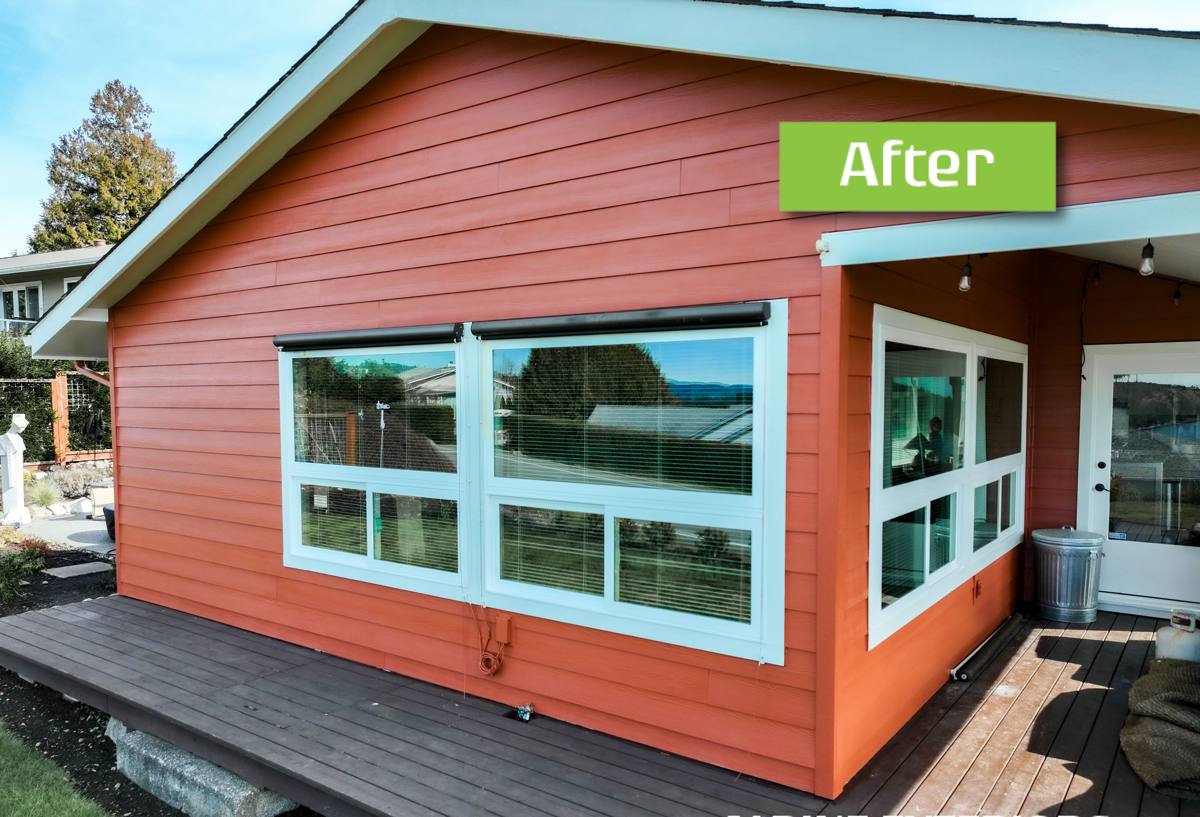
Salt Air, Driving Rain, and a Long Moss Season — the Three-Part Problem
Three things compound on a waterfront lot like this, and they don't act independently — each one makes the others worse.
Salt Air and Corrosion
Airborne salt settles on siding, trim, and especially fasteners and metal flashing. Over years, it accelerates corrosion on anything not rated for coastal exposure and can dull or degrade finishes that weren't engineered for it. This is one of the reasons fastener choice and flashing material matter as much as the siding itself.
Driving Rain and Wind-Driven Moisture
Wind off the water pushes rain into joints, laps, and penetrations that would stay dry on a calmer site. Wind-driven rain doesn't just fall on a wall — it gets forced sideways and even slightly upward at eaves and corners, which means water management behind the siding matters more here than almost anywhere else in the county.
Moss, Shade, and Standing Damp
Skagit County's wet season is long to begin with, and shaded, tree-lined lots near the water extend it further. Surfaces that don't get direct sun and airflow stay damp longer, which is exactly what moss and algae need to take hold. On siding, sustained damp contact is the real threat — not the moss itself, but what it signals about a surface that isn't drying out between rain events.
Why We Standardized on James Hardie for Homes Like Yours
We install James Hardie fiber cement siding exclusively. We don't offer vinyl, LP SmartSide, Cemplank, Allura, primed spruce, or cedar, and in a location like Ship Harbor the reasons get more concrete, not less.
Vinyl siding is inexpensive and low-maintenance in mild conditions, but it's a plastic product that expands and contracts with temperature swings, and its seams and panels rely on overlap rather than a sealed surface — in sustained wind-driven rain, that overlap system is more likely to let moisture track behind it over time. LP SmartSide and similar engineered-wood products use an OSB-based substrate with a resin-treated surface; it performs well when the finish and caulking are maintained on schedule, but wood-based substrates are far less forgiving of prolonged moisture contact than fiber cement, and a shaded, salt-exposed wall is a tough place for that margin to hold up for decades. Cedar is a real, attractive product, but it's an ongoing maintenance commitment — staining or sealing on a recurring cycle — and in a damp, shaded microclimate like parts of Ship Harbor, that cycle only gets shorter.
James Hardie fiber cement is cement, sand, and cellulose fiber — it doesn't rot, it isn't a food source for moss or mildew the way wood can be, and it's non-combustible. It's also engineered with region-specific product lines built around exactly the moisture behavior this coastline produces. That's the fit we're solving for here, not brand preference.
Choosing the Right Hardie System for This Location
HZ5 Climate-Engineered Formulation
James Hardie makes different formulations for different climate zones. For the Pacific Northwest, including Anacortes and Skagit County, that means HZ5 — engineered for a wet, moderate-freeze climate rather than a hot, dry one. Using the correct zone formulation isn't optional; it's the difference between a product designed for this rainfall pattern and one that isn't.
ColorPlus Factory Finish
ColorPlus is baked on at the factory under controlled conditions, which gives it more consistent coverage and better fade and wear resistance than field-applied paint — and it comes with its own finish warranty. In a salt-air environment where field-applied paint tends to chalk and fade faster, a factory finish is a meaningful advantage, not a cosmetic upgrade.
Trim, Soffit, and Fascia Continuity
Siding is only as good as the trim and water-shedding details around it. We treat trim boards, soffit, and fascia as part of the same system as the field siding — same manufacturer, same finish family, consistent gaps and clearances — so the whole envelope handles wind-driven rain the same way, not just the flat wall sections.
What Correct Installation Looks Like Here
Water Management Behind the Cladding
Fiber cement siding is not itself a waterproofing layer — it's a rain screen over a water-resistive barrier, and that barrier, along with flashing at every window, door, and penetration, is what actually keeps a wall assembly dry. On a wind-driven-rain site, we pay close attention to lapping order (upper layers over lower, always shedding down and out), head flashing above openings, and drainage paths so any moisture that does get behind the cladding has somewhere to go.
Fastening and Clearances
Manufacturer-specified fastener spacing and embedment matter everywhere, but corrosion-resistant fasteners matter more in salt air specifically. We also hold the clearances James Hardie specifies — ground clearance, clearance above roof lines and decks, gaps at butt joints — because those gaps are what let a wall dry out between rain events instead of staying wet against grade or roofing.
Sealed and Primed Cut Edges
Any field-cut edge exposes raw fiber cement that isn't factory-finished. Left untreated, that's a weak point for moisture intake. We prime or seal cut edges per manufacturer specification as a standard step, not an upsell.
Comparing the Options for a Site Like This
| Factor | James Hardie Fiber Cement | Vinyl | Wood-Based (LP SmartSide, Cedar) |
|---|---|---|---|
| Salt air tolerance | Strong — inorganic, non-combustible substrate | Fair — can chalk/fade faster near water | Fair to poor without diligent maintenance |
| Wind-driven rain behavior | Rigid panel/lap system with engineered clearances | Overlap-dependent; can flex in high wind | Vulnerable if finish or caulking lapses |
| Moss/moisture resistance | Won't rot; not an organic food source | Won't rot, but seams can trap moisture | Organic substrate — sustained damp is the main risk |
| Finish maintenance | Factory ColorPlus finish, long repaint interval | Color molded in, but can fade/chalk | Field paint/stain on a recurring cycle |
| Fire performance | Non-combustible | Combustible (melts/deforms) | Combustible |
This isn't a claim that other products can't be installed well — it's why, given this site's exposure, we've standardized on the one we're confident holds up here for decades with minimal owner maintenance.
Our Process From Estimate to Finished Job
- On-site assessment of the specific walls taking the most wind and rain exposure, plus a look at existing moisture damage, flashing condition, and trim
- A written scope specifying the Hardie products, colors, and trim system for your home — no vague allowances
- Removal of old siding down to the sheathing so we can inspect and, where needed, correct the water-resistive barrier and flashing before anything new goes up
- Installation to manufacturer clearance, fastening, and sealing specifications
- A final walkthrough covering what maintenance (if any) the new siding actually needs going forward
Signs Your Ship Harbor Siding Needs a Closer Look
- Persistent moss or algae streaking on north- or shade-facing walls that returns soon after cleaning
- Soft or spongy spots when you press on siding near the ground, decks, or roof lines
- Paint that's chalking, peeling, or fading noticeably faster on the sides that face the water or prevailing wind
- Visible gaps, warping, or separation at butt joints and corners
- Rust staining running down from fasteners or metal trim
- Interior signs like peeling paint, musty smell, or discoloration on walls that back up to exterior siding
Any one of these is worth a look. Together, they usually mean water has been getting behind the siding for a while, not that the siding is simply due for a fresh coat of paint.
Why Hiring a Crew That Already Works Ship Harbor Matters
A siding crew that mostly works drier, inland lots will still install Hardie siding correctly by the book — but they may not think to plan for the specific wind direction that hits a given Ship Harbor lot, or recognize which walls need extra attention to flashing because of how the site sits relative to the water. Working this coastline regularly means knowing which details are worth extra time here: corrosion-resistant fasteners as a default rather than an add-on, tighter attention to head flashing on the walls that take the worst of the weather, and realistic expectations about how shaded, tree-covered sections will perform even with the right product.
It also means understanding the permitting and building department process for Anacortes and Skagit County, and, where applicable, working within any neighborhood or waterfront-specific requirements without that becoming a surprise mid-project.
Ready When You Are
If your Ship Harbor home's siding is showing wear, or you're planning ahead before the next wet season sets in, we're happy to take a look and talk through what your home actually needs — no pressure, no obligation. Use the form below to request a free estimate.