 Anacortes Roofing
 Why Decks in Similk Beach Wear Out Differently
Similk Beach sits close enough to the water that salt-laden air is a daily fact of life, not an occasional event. Combine that with the driving rain that rolls in off Similk Bay and the Salish Sea, plus a moss season that can stretch from late fall well into spring, and you have three separate forces working against a deck at the same time. A deck built to a generic national spec — the kind sold at big-box stores with no thought to coastal Skagit County conditions — will show its age here years before it would somewhere inland.
Salt air accelerates corrosion in fasteners, hardware, and connectors, sometimes hidden from view under the decking boards where a homeowner never sees it until a board finally gives way. Driving rain finds its way into any gap around a ledger board, post base, or stair stringer that wasn't flashed and sealed correctly the first time. And moss doesn't just look bad — on a deck surface it holds moisture against the wood or composite, and on stairs and low-traffic corners it turns into a genuine slip hazard, especially on the shaded north or east sides of a house that stay damp longest.
None of this means a deck in Similk Beach can't last decades. It means the build has to account for these three conditions from the ground up, not just at the surface.
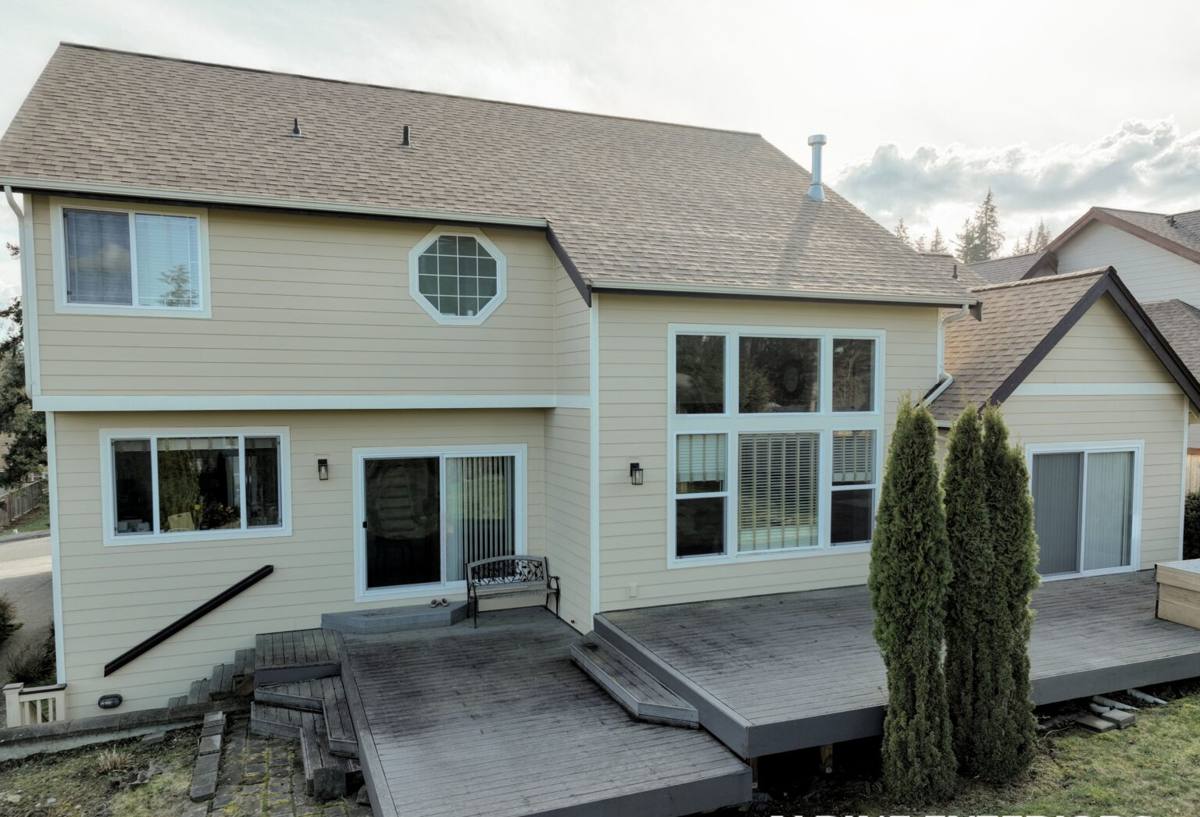
Signs a Deck Needs Replacement, Not Another Repair
We get a fair number of calls asking whether a deck can be patched instead of replaced. Sometimes the answer is yes. But there's a point where repair spending stops making sense and starts throwing money at a structure that's failing underneath. Here's what we check before recommending either path:
- Soft, spongy, or spring-back decking when you walk across it, especially near the house or at board ends
- Rust streaking or crumbling metal at joist hangers, post bases, or ledger bolts
- A ledger board pulling away from the house, or visible gaps where it meets the siding or rim joist
- Posts that wobble at the base, even slightly, when pushed
- Persistent moss or black staining that returns within weeks of cleaning
- Stair stringers that flex or feel uneven underfoot
- Railings that move more than a small amount when leaned on
- A deck more than 15-20 years old built before current flashing and hardware standards were common practice
One or two of these on their own might mean a targeted repair. Several at once, or any structural movement at posts or the ledger, usually means the framing has been compromised long enough that replacement is the honest recommendation.
What a Correct Deck Replacement Actually Involves
A deck is only as good as the parts nobody sees once it's finished. The framing, flashing, and fastening decisions made in the first few days of the job determine whether the deck is still solid in twenty years or soft in eight.
Ledger Board and Flashing
The ledger board — the piece that bolts the deck to the house — is the single most common failure point on decks built without proper flashing. In a climate with as much driving rain as Similk Beach sees, water pushed sideways by wind will find any unsealed seam. A correct installation uses flashing that directs water out and away from the house framing, a gap or drainage channel behind the ledger so trapped moisture can escape rather than sit against the rim joist, and corrosion-resistant structural screws or bolts rated for the load. This is not a place to cut corners, because a ledger failure is a structural failure, and it happens gradually and invisibly behind the decking boards.
Footings and Posts
Footings need to be sized and set to local frost and soil conditions, with post bases that hold the post above the concrete rather than letting wood sit in standing water. Post-to-beam and beam-to-footing connections should use rated hardware rather than nails alone — this matters more here than in a dry climate because any hardware exposed to salt air will corrode faster than the manufacturer's generic rating assumes.
Joists, Joist Tape, and Hidden Fasteners
Every joist top should be protected with a self-adhering flashing tape before decking goes down. It's a small material cost that prevents water from soaking into the top of the joist through screw holes and board gaps — one of the most common causes of joists rotting from the inside out while the deck surface still looks fine. For the visible decking, we favor hidden fastener systems where the product supports them, both for a cleaner look and because face-screwed boards create thousands of extra puncture points where water can work its way in over time.
Choosing Decking Material for This Climate
There's no single "best" decking material — there's a best material for a given budget, maintenance appetite, and exposure. In a salt-air, high-rain environment like Similk Beach, the trade-offs shift a bit compared to a drier inland location.
| Material | Coastal Performance | Maintenance | Typical Lifespan |
|---|---|---|---|
| Pressure-treated wood | Good if fasteners and flashing are corrosion-resistant; needs sealing to handle rain and salt exposure | Annual cleaning, periodic staining/sealing | 10-15 years before major work |
| Cedar | Naturally rot-resistant but softer and more prone to moss and graying near the water | Regular cleaning and refinishing to keep its color and shed moisture | 15-20 years with upkeep |
| Capped composite | Strong choice — the cap resists moisture absorption and staining better than uncapped composite or wood | Occasional washing, no staining or sealing | 25-30 years, backed by manufacturer warranty |
| PVC decking | Fully synthetic, essentially immune to moisture absorption and salt corrosion of the board itself | Low — washing only | 25-30+ years |
We're honest with clients that composite and PVC cost more upfront but ask far less of you over the years — no annual staining, no sanding down splinters, and no worrying about a board cupping after a wet winter. Wood remains a valid choice for homeowners who want that traditional look or a lower entry cost and are willing to keep up with sealing on a regular schedule. What we steer people away from is uncapped, budget composite from a decade-plus ago — earlier generations of that product had known moisture-absorption issues in wet climates, and we'd rather set that expectation honestly upfront than sell a product we don't think will hold up here.
Railings, Stairs, and Code Requirements
Railings and stairs are where a lot of older decks fall out of compliance without anyone noticing until an inspection flags it. Current code generally requires guardrails on any deck surface more than 30 inches above grade, with baluster spacing tight enough that a 4-inch sphere can't pass through, and railing heights and stair handrail requirements that vary slightly depending on the specific application. When we replace a deck, we bring the railing and stair assembly up to current code as part of the job — not as an upsell, but because a wobbly or out-of-spec railing is a liability we're not willing to hand back to a homeowner.
Stair stringers deserve the same attention as the main frame: proper support at the base, corrosion-resistant fasteners, and, where the stairs meet grade, a footing or landing pad that won't heave or settle unevenly over time.
Drainage: What Happens Under the Deck Matters Too
On an elevated deck, water that passes between the boards has to go somewhere. Without a plan for it, that water pools against the house foundation, saturates the ground around footings, or drips onto whatever's stored or living underneath the deck. Depending on the deck's height and how the space below is used, we'll discuss options ranging from simple grading and gravel drainage at ground level to an under-deck drainage system that channels water off to the side and keeps the space below usable and dry. This is worth planning at replacement time, because retrofitting drainage under a finished deck is far more disruptive than building it in from the start.
Our Process From Estimate to Finished Deck
We keep the process straightforward because homeowners have enough going on without guessing what happens next:
- On-site assessment of the existing deck, including a look underneath at the framing, ledger connection, and footings — not just the surface
- A written estimate that breaks out material options so you can compare costs and trade-offs directly rather than guessing
- Confirming permit requirements with the applicable local jurisdiction before any demolition starts
- Tear-off and disposal of the old deck
- Framing, ledger flashing, footings, and joist protection built to hold up to salt air and driving rain, not just pass a minimum inspection
- Decking, railing, and stair installation
- Final walk-through so you know how to maintain the new deck and what warranty coverage applies
We don't skip the permitting step, even when a homeowner would rather move faster. Skagit County and the City of Anacortes have their own requirements depending on exactly where a property sits, and a deck built without the right permit can complicate things later — at resale, at insurance time, or if a future addition ties into it.
Why Hire a Crew That Already Works Similk Beach
General contractors who mostly build inland don't always think about ledger flashing details, hardware corrosion resistance, or drainage the way a crew that works this shoreline every week does. We've seen what happens to decks here over 10 and 20 year timelines — which fastener grades hold up, which decking products handle the moss and moisture well, and which shortcuts show up as callbacks a few winters later. That's not a criticism of any one product or crew; it's just the difference between building to a generic spec and building for this specific stretch of coastline. Anacortes and the surrounding Skagit County waterfront communities, Similk Beach included, ask a bit more of an outdoor structure than most parts of the country, and we build accordingly.
Keeping a New Deck Looking Good After Replacement
Even a well-built deck benefits from a bit of seasonal attention in this climate. A rinse or light wash a couple of times a year keeps moss from getting a foothold, especially on shaded sections. Wood decking needs its sealer or stain reapplied on the schedule the product calls for — skipping a cycle in a wet climate catches up with you faster than it would somewhere drier. Composite and PVC decking need far less, but it's still worth an annual check of railings, stair connections, and any visible hardware for early signs of corrosion, particularly closer to the water.
If your deck in Similk Beach is showing its age, or you'd simply rather build it right the first time on a new home, we're happy to take a look and walk you through your options honestly — including telling you when a repair makes more sense than a full replacement. Use the form below to request a free, no-pressure estimate.