 Anacortes Roofing
 Similk Beach Sits in a Tough Spot for Exterior Siding
Homes along Similk Beach sit close enough to the water that salt-laden air is a daily fact of life, not an occasional weather event. Add in the driving rain that comes off Puget Sound during fall and winter storms, plus a shoulder season damp enough to keep moss and algae established on north-facing walls for months at a time, and you have a set of conditions that will find every weakness in a siding system. Wood siding checks and swells. Vinyl chalks, warps in direct afternoon sun, and never really stops the moisture at the seams. Cheaper fiber cement products that skip factory-applied finish leave raw edges exposed to exactly the kind of wind-driven moisture this neighborhood gets more of than most of Anacortes.
None of this is unusual for Skagit County's coastline — it's just more concentrated in a beachfront pocket like Similk Beach than it is a few miles inland. Siding here has to handle salt exposure, sustained moisture, and a moss season that can run from October well into spring, all without a lot of intervening dry-out time.
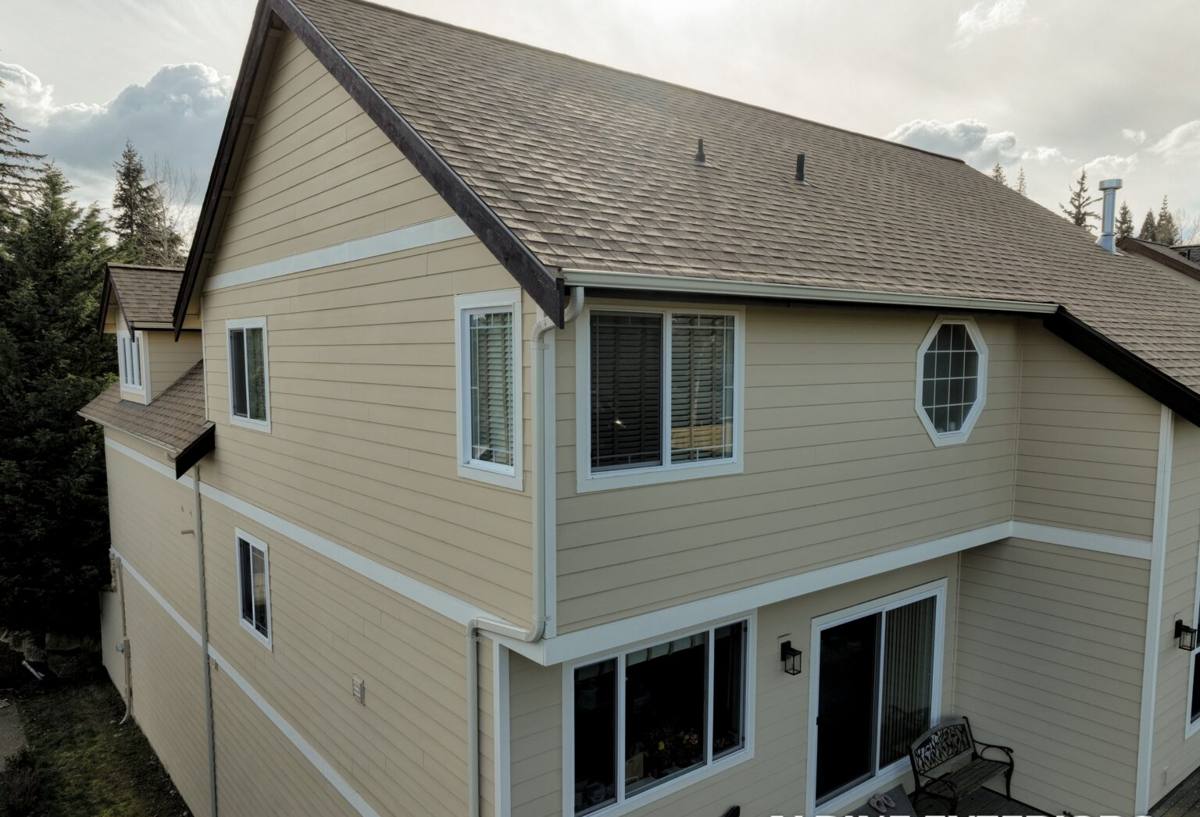
What Siding Actually Needs to Do on This Stretch of Shoreline
Before we talk about products, it helps to be clear on what the siding's job actually is. On a Similk Beach home, siding needs to:
- Shed wind-driven rain without letting water track behind the cladding at laps, corners, and penetrations
- Resist moisture absorption into the material itself, not just the surface coating
- Hold a factory finish that doesn't rely on the homeowner repainting every few years to stay protected
- Stay dimensionally stable through repeated wet-dry cycling so caulk joints and paint lines don't fail early
- Resist the kind of surface staining and moss colonization that shaded, damp walls are prone to
A siding product that does all five of these well will outperform one that only looks good on day one. This is the filter we run every material through, and it's why we've narrowed what we install down to a single system.
Why We Install Only James Hardie Fiber Cement
We install James Hardie fiber cement siding exclusively. We don't install vinyl, LP SmartSide, Cemplank, Allura, primed spruce, or cedar. That's not a marketing position — it's a standard we've settled on after weighing what each of those products asks of a homeowner over 20-plus years near saltwater.
Vinyl is inexpensive and low-maintenance in the short term, but it's a thin, flexible material that expands and contracts with temperature swings, and its seams are a permanent water-entry risk if the wall assembly behind it can't manage that moisture. Wood species like cedar and primed spruce look good freshly installed, but they need ongoing refinishing to hold up against constant damp, and in a moss-prone, salt-air environment that upkeep schedule gets demanding fast. Engineered wood products like LP SmartSide use a wood-strand core that, however well treated, is still an organic substrate — edge sealing and caulk maintenance become non-negotiable, not optional, in a climate this wet. Other fiber cement brands may use similar base chemistry to Hardie, but the factory finish system, the climate-specific product engineering, and the warranty backing are where the real differences show up.
James Hardie fiber cement is non-combustible, dimensionally stable, and available with a factory-applied ColorPlus finish that's baked on rather than field-brushed. Hardie also engineers regional HZ5 product lines specifically for wetter climates, which matters more here than it would somewhere drier. The warranty is transferable to a future owner, which is worth something on a coastal property where resale value depends on the exterior holding up to inspection.
What Correct Installation Requires
Fiber cement siding is only as good as the installation behind it. A correct Hardie install on a Similk Beach home includes:
- A drainable water-resistive barrier and rainscreen gap so incidental moisture can drain and dry rather than sit against the back of the panel
- Manufacturer-specified fastener type, spacing, and embedment depth — under-driven or over-driven fasteners are one of the most common failure points we see on prior installs
- Correct clearance at grade, decks, and roof lines so panels never sit in standing water or trap debris
- Properly lapped and sealed flashing at every window, door, and penetration, installed before siding goes up, not caulked over afterward
- Factory-cut and factory-primed panel edges wherever possible, with field cuts sealed per Hardie's specifications
- Correct joint spacing and the right caulk or sealant system at butt joints and trim intersections
Skipping any one of these doesn't show up immediately. It shows up in year three or four, as staining, soft trim, or paint failure at the joints — right when it's expensive to trace back to an installation shortcut.
Our Process for a Similk Beach Siding Job
The steps don't change much from house to house, but the details we pay attention to shift depending on how exposed the property is to weather off the water.
- On-site assessment. We walk the full exterior, checking the existing wall assembly, current siding condition, moisture staining patterns, and how exposed each elevation is to wind and rain — the water-facing side of a Similk Beach home typically needs more attention at flashing and joints than the leeward side.
- Substrate and moisture check. Before any new siding goes up, we confirm what's underneath is sound. Rot, soft sheathing, or a failed water-resistive barrier gets addressed first — covering a moisture problem with new siding just delays and hides it.
- Product and profile selection. We go over Hardie's plank, shingle, and panel profiles along with ColorPlus color options, and talk through what fits the home and holds up to salt air and moss exposure.
- Installation. Rainscreen gap, flashing, fastening, and joint sealing all follow Hardie's published specifications — this is where the earlier "correct installation" checklist gets applied on the actual house.
- Final walkthrough. We inspect every elevation, joint, and penetration with you before calling the job done, and go over basic care so the finish holds up as intended.
Comparing Siding Options for a Coastal Skagit County Home
| Factor | James Hardie Fiber Cement | Vinyl | Cedar / Primed Wood |
|---|---|---|---|
| Salt air resistance | Strong — non-organic substrate, factory finish | Moderate — can chalk and become brittle over time | Weak without frequent refinishing |
| Moisture behavior | Dimensionally stable, engineered HZ lines for wet climates | Seams are a chronic water-entry risk | Absorbs moisture, prone to swelling and rot |
| Moss / algae resistance on shaded walls | Good with a properly ventilated rainscreen assembly | Moderate; traps moisture at seams | Poor — organic surface invites growth |
| Finish maintenance | Factory-baked ColorPlus, long repaint intervals | Color built into material but fades/chalks over time | Repainting or restaining every few years |
| Fire resistance | Non-combustible | Combustible, can melt/deform near heat sources | Combustible |
| Warranty | Long-term, transferable to future owners | Varies widely by manufacturer and grade | Typically none beyond initial paint/stain product |
Maintenance in a Salt Air, Moss-Heavy Environment
Even the right siding needs some basic upkeep near the water. A rinse-down once or twice a year knocks salt residue and surface grime off before it builds up, especially on the elevation facing the water. Keeping gutters clear and vegetation trimmed back from north- and shade-facing walls cuts down on the standing dampness that moss needs to establish. Caulk joints at trim and penetrations are worth a visual check annually — catching a failed bead early is a five-minute fix; ignoring it for a few seasons can let moisture into the wall assembly behind otherwise sound siding.
None of this is heavy maintenance compared to wood, but it's not zero-maintenance either, and homeowners who go in expecting a quick annual look-over get the most out of a Hardie system long-term.
Signs a Similk Beach Home May Need New Siding
- Persistent dark streaking or moss growth that comes back within weeks of cleaning
- Soft or spongy spots when you press on siding near the bottom courses or around windows
- Visible gaps, warping, or bowing panels, especially on the water-facing side
- Paint or caulk failing faster than it used to, particularly at butt joints and trim
- Interior signs — peeling paint, musty smell, or staining on interior walls that back up to exterior siding
Why It Matters That We Already Work This Neighborhood
Similk Beach isn't a generic subdivision — its exposure to wind and salt varies noticeably from the water-facing lots to the ones set back further, and a crew that's worked the area knows which elevations need extra attention at flashing and joints before a problem ever shows up. We're an Anacortes-based contractor, and jobs in Similk Beach and the surrounding Skagit County shoreline are a regular part of our schedule, not a special trip. That familiarity means fewer surprises during tear-off, a clearer sense of what the existing wall assembly is likely to look like once old siding comes off, and a realistic timeline that accounts for the marine weather window rather than a generic estimate.
If you're weighing your options for a Similk Beach home — whether the current siding is failing, aging out, or you're just tired of the upkeep — we're happy to take a look and walk you through what a correct James Hardie installation would involve for your specific house. There's no pressure and no cost for the estimate; fill out the form below and we'll get in touch.