 Anacortes Roofing
 Why Siding Fails Faster in West Anacortes
West Anacortes sits close enough to the water that homes here deal with a different set of stresses than siding just a few miles inland. Salt-laden air moves through the neighborhood off Fidalgo Bay and the surrounding waterways, and that airborne salt settles on exterior walls, works into seams and fastener heads, and accelerates corrosion and material breakdown in ways that drier, inland siding never experiences. Add in wind-driven rain that comes in sideways during winter storms, and siding that isn't installed or flashed correctly starts taking on moisture at exactly the joints and laps that are supposed to shed it.
Then there's the moss. Skagit County's long wet season, mild temperatures, and heavy tree cover create ideal growing conditions for moss and algae, and north- and west-facing walls in shaded or tree-lined West Anacortes yards are especially prone to it. Moss holds moisture against the siding surface far longer than open air ever would, which is exactly the kind of prolonged dampness that causes rot in wood-based products and coating failure in anything with a weak factory finish. None of this is unique to one house — it's the baseline condition every exterior wall in this neighborhood is working against, year after year.
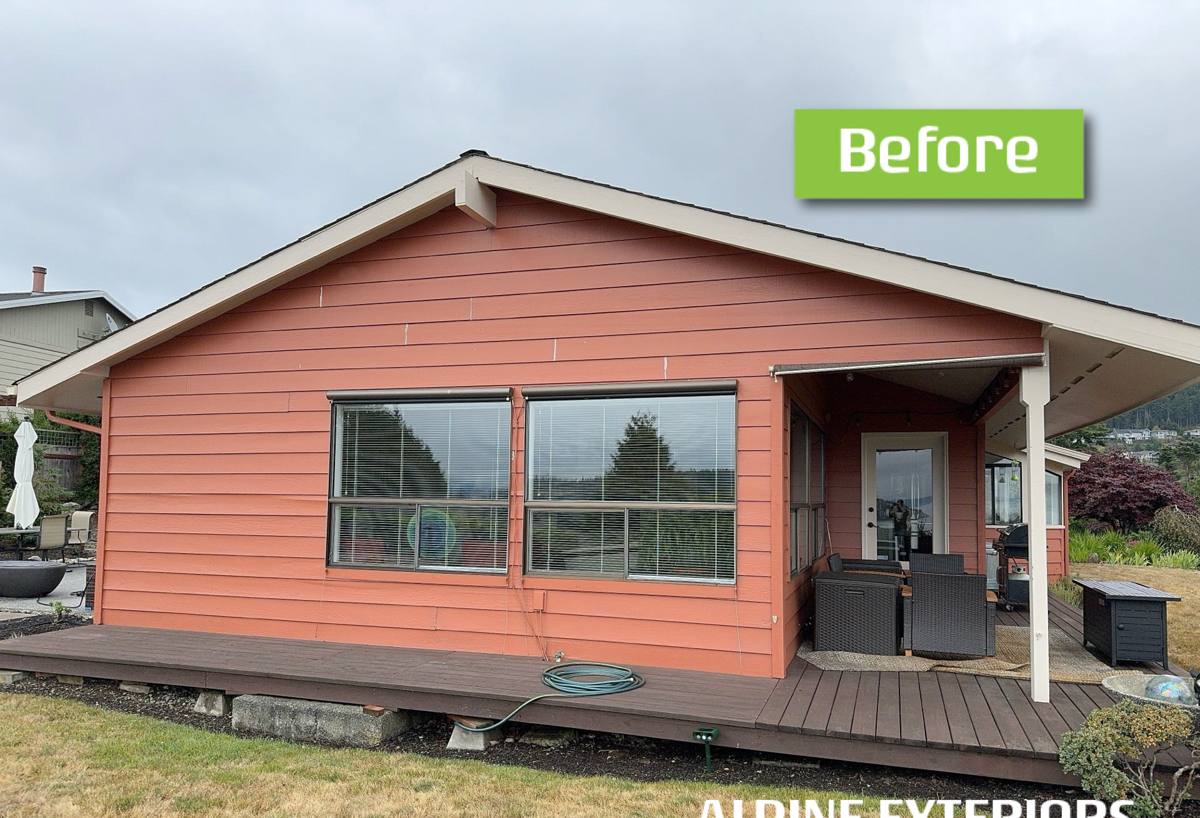
What Siding Damage Actually Looks Like Here
Most siding repair calls in this area fall into a handful of recognizable patterns. Knowing what to look for helps you catch problems while they're still a repair and not a full re-side.
Common Warning Signs
- Soft or spongy spots when you press on a wall, especially near the bottom courses or around window and door trim
- Visible moss or dark green-black staining that keeps coming back after cleaning
- Cracked, bubbled, or peeling paint that exposes bare material underneath
- Gaps or separation at butt joints, corners, and around penetrations like hose bibs and vents
- Warping or bowing panels, particularly on walls that catch the prevailing wind and rain
- Rust streaks around fastener heads or trim connections
Any one of these on its own might be a minor fix. Several of them together, or damage that's spread across more than one wall section, usually means water has been getting behind the siding for a while and the repair needs to address what's underneath, not just what's visible.
Repair or Replace: How We Make That Call
Not every damaged section needs to come off the whole house. A big part of doing this job honestly is telling a homeowner when a targeted repair will hold up and when it won't. Here's how we generally think through it.
| Factor | Leans Toward Repair | Leans Toward Replacement |
|---|---|---|
| Extent of damage | Isolated to one wall or a few panels | Spread across multiple walls or elevations |
| Underlying sheathing | Dry, solid to the touch | Soft, delaminating, or visibly rotted |
| Age of existing siding | Still within its expected service life | Near or past end of life, failing coating |
| Cause of damage | Impact damage, a single failed joint, isolated moss staining | Systemic moisture intrusion, chronic flashing failure |
| Material match | Product still available or a close match exists | Discontinued profile or color, patchwork would be visible |
We'll always walk the exterior with you and explain what we're seeing before recommending a direction. If a repair is the honest answer, that's what we'll propose — we're not trying to sell a full re-side when a section repair will genuinely hold up in this climate.
What a Correct Repair Actually Involves
A siding repair that's done right is more than swapping a damaged board for a new one. In a wet, salt-exposed environment like West Anacortes, the work that happens behind the siding matters as much as what you see on the wall afterward.
Steps We Don't Skip
- Remove the damaged section carefully to avoid cracking adjacent, still-good panels
- Inspect the water-resistive barrier and sheathing underneath for hidden moisture damage or rot
- Repair or replace any compromised sheathing before new siding goes back on — patching over a wet substrate just hides the problem
- Re-flash penetrations, seams, and butt joints so water is directed out and down, not trapped behind the new material
- Install matching or compatible siding material with correct fastener spacing and clearances
- Caulk and finish to match the surrounding wall so the repair blends in rather than standing out
Skipping the inspection step is the single most common shortcut that turns a small repair into a repeat callback. If moisture has already reached the sheathing, putting new siding over it just buys a little time before the same spot fails again.
Why We Repair and Rebuild With James Hardie
When a repair calls for new material — whether it's a few boards or an entire wall section — we use James Hardie fiber cement, and we don't deviate from that even for a small patch job. There's a practical reason: fiber cement doesn't rot, doesn't feed moss the way wood fiber can, and holds up to the salt air and moisture cycling that define this part of Skagit County. It's also non-combustible, which matters in a region that sees dry-season wildfire smoke and occasional ember exposure even this close to the water.
We also standardize on Hardie because of the factory-applied ColorPlus finish. A repaired section painted on-site with a brush-matched color will start to weather differently than the surrounding panels within a season or two — you'll see the seam. Hardie's factory finish is baked on under controlled conditions and backed by its own finish warranty, so a repair using ColorPlus product ages at the same rate as the rest of the wall instead of becoming a visible patch. Hardie's HZ5 product line in particular is engineered for wet, moisture-prone climates like ours, which is exactly the profile West Anacortes fits.
We don't install vinyl, LP SmartSide, primed wood, or other fiber cement brands, even for repair work. That's a deliberate standard, not a sales pitch — we've seen how each of those products performs over time in a marine climate, and fiber cement from Hardie is what we're willing to put our name behind and warranty.
Our Process for West Anacortes Repairs
Because we already work regularly in this neighborhood, our process here is dialed in around its specific conditions.
What to Expect
- An on-site inspection where we look at the damage, probe for soft sheathing, and check adjacent areas that might be developing the same problem
- A clear explanation of whether we're recommending a repair or a larger scope, with the reasoning behind it
- A written estimate that separates material, labor, and any sheathing or flashing repair that's needed
- Scheduling that accounts for our wet season — we don't install fiber cement siding in active rain, and we'll tell you upfront if weather is going to affect timing
- A finished repair that's color-matched and flush with the surrounding wall, not an obvious patch
Working in the same area repeatedly means we already understand which wall orientations in West Anacortes tend to take the worst weather, which helps us spot developing problems on the rest of your exterior while we're already there for a repair.
Maintenance That Extends the Life of a Repair
A properly executed repair should last, but a little homeowner upkeep goes a long way in this climate. None of this requires special equipment or professional service on a regular basis.
- Rinse siding with a garden hose once or twice a year to clear salt residue and airborne grime, especially on walls facing the water
- Trim back tree branches and shrubs that keep a wall shaded and damp, since that's where moss takes hold first
- Check caulking at trim, corners, and penetrations annually and re-caulk if it's cracked or pulling away
- Walk the exterior after major windstorms to check for loosened panels or trim, particularly on the sides that catch prevailing wind and rain
- Address small moss growth early with a gentle wash rather than letting it build up over a season
These small habits catch problems while they're still cosmetic, which is a lot cheaper and less disruptive than catching them after they've reached the sheathing.
Why Local Experience Matters for a Repair Job
Siding repair is one of those jobs where local knowledge shows up in the details. A crew that hasn't worked in this specific climate might not think to check sheathing behind moss staining, might not know which wall orientations in this neighborhood take the worst of the driving rain, or might not carry the flashing details that hold up against salt air over years rather than months. We've done this work throughout Anacortes and Skagit County long enough to know that a repair here needs to be built for exposure, not just patched for appearance.
That local familiarity also means faster, more accurate estimates — we're not guessing at how West Anacortes weather affects a wall, we've seen it firsthand on homes nearby.
If you're seeing soft spots, persistent moss, or cracked paint on your siding, we're happy to take a look and give you an honest read on whether it's a repair or something bigger — no pressure, no obligation. Fill out the form below to schedule a free estimate.