 Anacortes Roofing
 Oak Harbor's Marine Climate Is Hard on Siding
Oak Harbor sits on Whidbey Island, surrounded by the Salish Sea, which means homes there deal with a combination most inland siding is never engineered for: near-constant salt-laden air, wind-driven rain that hits walls sideways instead of falling straight down, and a wet season that stretches on long enough to grow moss on anything that stays damp and shaded. We're based across the water in Anacortes, in Skagit County, and we cross Deception Pass regularly to work on Oak Harbor homes because the exterior challenges on that side of the water are, if anything, more constant — more exposed shoreline, more open wind, more salt.
Siding on Whidbey Island doesn't get a break between storms the way siding further inland might. Marine air carries fine salt particles that settle on every exterior surface, and combined with regular rain, that's a slow, steady corrosive and moisture load on fasteners, caulk joints, and any material that isn't dimensionally stable. None of this is dramatic on its own — it's cumulative. Siding that's marginal on day one shows it within a few years on a lot like this.
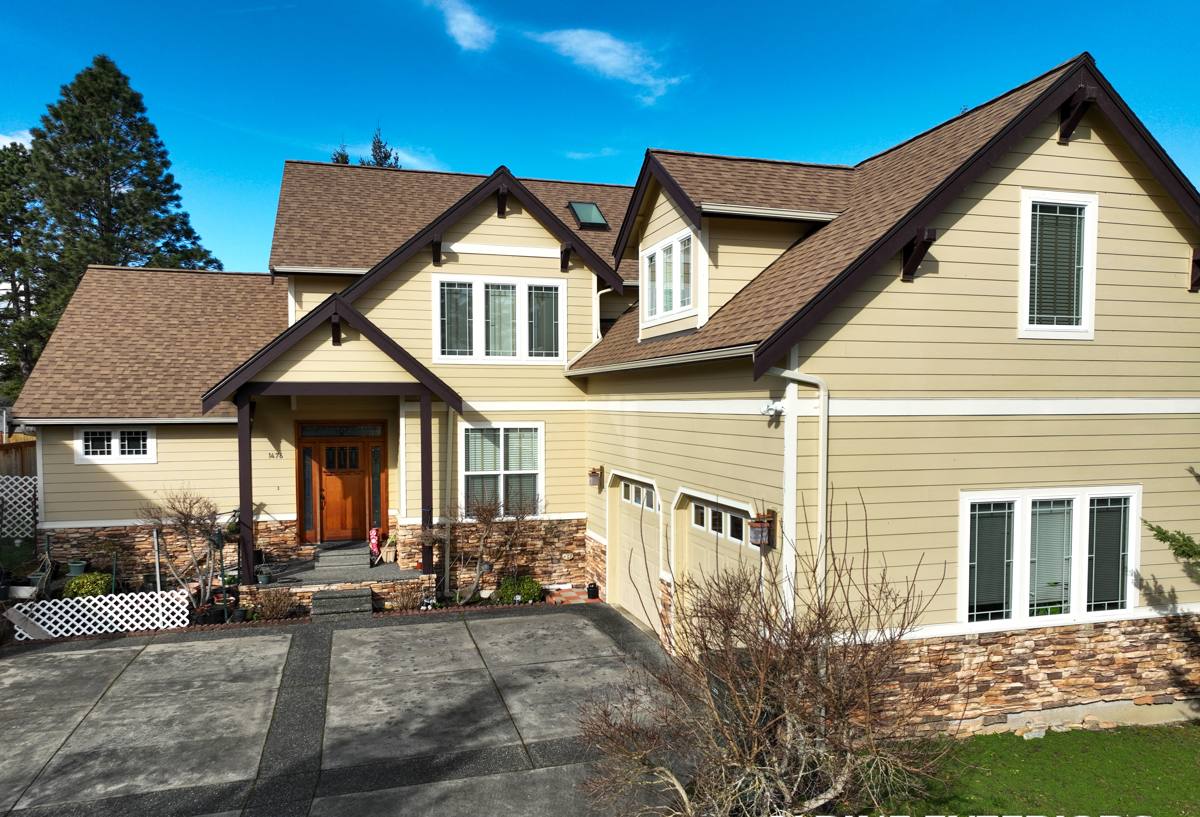
What That Climate Does to the Wrong Material
Vinyl and Salt Air
Vinyl siding expands and contracts a lot with temperature swings, and over time salt air accelerates the breakdown of its surface finish, leading to fading and a chalky look years before a homeowner expects it. It also relies on unsealed, overlapping panels — fine for shedding straight-down rain, less fine for the sideways, wind-driven rain common on exposed Whidbey Island lots.
Wood and Engineered Wood Siding
Cedar and primed spruce look good on day one but need a maintenance schedule most homeowners underestimate — recoating, caulk inspection, and prompt attention to any spot where the finish has worn through. In a climate with this much sustained moisture and a long moss season, any gap in that maintenance schedule shows up as trapped water, and trapped water in wood siding doesn't announce itself until the damage is already done.
LP SmartSide and Similar Engineered Wood Panels
These products perform reasonably well when installation and maintenance are followed to the letter, but they're wood-based, and wood-based siding is more sensitive to the exact conditions Oak Harbor delivers year-round: sustained dampness, salt exposure, and shaded north- and west-facing walls that never fully dry out between storms.
Why We Install Only James Hardie Fiber Cement Siding
We made the decision to install James Hardie fiber cement exclusively and not offer vinyl, LP SmartSide, Cemplank, Allura, or bare wood siding as alternatives. Fiber cement is made from cement, sand, and cellulose fiber — it's non-combustible, it doesn't expand and contract the way vinyl does, and it isn't food for the moisture and rot problems that affect wood-based products. James Hardie backs its siding with a strong transferable warranty and factory-applied ColorPlus finish, and its HZ5 product line is specifically engineered for climates like ours — high humidity, freeze-thaw cycles, and heavy moisture exposure.
We're not saying every other product is unusable everywhere. We're saying that for the specific combination of salt air, driving rain, and moss-friendly shade that Oak Harbor homes deal with, Hardie is the material we're willing to put our name behind and warranty our workmanship on.
Hardie Product Lines We Use
| Product | Best For | Why It Fits Oak Harbor |
|---|---|---|
| HardiePlank Lap Siding | Most home exteriors | Traditional look, engineered HZ5 formulation resists moisture and cracking |
| HardiePanel Vertical Siding | Accent walls, gables, modern styling | Fewer horizontal seams for water to work into on exposed elevations |
| HardieTrim Boards | Corners, window and door trim, fascia | Dimensionally stable trim that won't rot or pull away from caulk joints |
| ColorPlus Technology Finish | Any of the above | Factory-baked finish resists salt-air fading better than field-applied paint |
What a Correct Installation Involves
Fiber cement siding is only as good as the installation behind it. In a climate that gives moisture every opportunity to find a way in, the details most homeowners never see are the ones that determine whether siding lasts 10 years or 40.
- A properly lapped, continuous weather-resistive barrier behind the siding, not just wrapped loosely around the house
- Correct flashing at every window, door, and roof-to-wall intersection — the single most common failure point on re-sides we inspect
- Manufacturer-specified fastening pattern and fastener spacing, using corrosion-resistant fasteners suited to a salt-air environment
- Proper gapping between siding and trim, and between siding and any dissimilar material, to allow for drainage and drying
- Field-cut ends sealed on all sides before installation, not caulked over after the fact
- Minimum clearance maintained between the bottom of the siding and grade, decks, and roof lines so water isn't wicking up from below
- Caulk used only where Hardie's specifications call for it — over-caulking traps moisture as often as it keeps it out
Our Process, Start to Finish
- On-site inspection and estimate. We look at your existing siding, trim, and sheathing condition, not just take measurements from the driveway.
- Tear-off and sheathing check. Once old siding is off, we inspect the sheathing underneath for any moisture damage before anything new goes up — this is often where hidden problems from a prior install surface.
- Weather barrier and flashing. This is the step that determines long-term performance more than any other, and it's the one that's invisible once the job is done.
- Hardie siding installation to manufacturer spec. Correct fastening, gapping, and sealed cut ends throughout.
- Trim, caulk, and touch-up. Finish work at corners, windows, and doors, using ColorPlus touch-up product where needed so the factory finish stays consistent.
- Final walk-through. We go over the finished work with you before calling the job done.
What Affects the Cost of Fiber Cement Siding in Oak Harbor
Every home is different, so we don't quote pricing without seeing the house, but these are the factors that move a project up or down in scope:
| Factor | Impact on Cost |
|---|---|
| Home size and number of stories | More surface area and staging needs increase labor |
| Condition of existing siding and sheathing | Rot repair or sheathing replacement adds scope beyond the siding itself |
| Amount of trim, window, and corner detail | More cut lines and flashing points means more labor per square foot |
| Site access | Waterfront, sloped, or tight lots common on Whidbey Island can add setup time |
| Siding profile and finish selection | Plank width, texture, and color affect material cost |
As a general rule, full fiber cement re-sides are a five-figure investment on most homes, but the range within that is wide — the only way to get a real number is a walk-through.
Why a Crew That Already Works Oak Harbor Matters
A contractor who mostly works inland jobs isn't necessarily thinking about corrosion-resistant fasteners as a default, or about how much more aggressive moss growth is on a shaded, damp Whidbey Island wall compared to a sunnier lot a few miles inland. We cross Deception Pass for Oak Harbor jobs regularly enough that accounting for salt exposure and wind-driven rain isn't an adjustment we make on the fly — it's just how we spec every job on that side of the water. That matters for material choices, fastener selection, and where we pay extra attention during flashing and sealing.
It also matters for logistics — material staging, scheduling around ferry and bridge traffic, and coordinating with local permitting — none of which is complicated, but all of which goes smoother with a crew that's done it before.
Maintenance After Installation
Fiber cement is low-maintenance compared to wood or vinyl, but "low-maintenance" isn't "no-maintenance," especially in this climate. A little attention goes a long way toward getting the full lifespan out of the material and finish.
- Rinse siding periodically to remove salt residue, especially on walls facing open water or prevailing wind
- Keep gutters and downspouts clear so water isn't overflowing onto siding below the roofline
- Check caulk joints at trim and penetrations once a year and have any cracked or missing caulk addressed promptly
- Watch shaded, damp-prone walls for early moss or algae growth and clean it gently before it spreads
- Keep plantings and mulch pulled back from direct contact with the bottom edge of the siding
If you're weighing a full re-side or replacing damaged sections on a home in Oak Harbor, we're happy to take a look and give you a straight, no-pressure estimate — just fill out the form below.