 Anacortes Roofing
 Why Siding Choice Matters More in Mount Vernon Than It Looks
Mount Vernon sits in the Skagit River valley, close enough to Puget Sound that homes here deal with a combination most siding products were never engineered for: near-constant winter moisture, wind-driven rain that hits walls sideways instead of falling straight down, salt-tinged marine air drifting in off the water, and a moss season that can stretch from late fall through spring. None of these are dramatic events. They're slow, cumulative pressure — the kind that doesn't show up as a problem in year one or two, but shows up as rot, cupping, or peeling paint by year eight or ten if the siding and the installation weren't matched to the conditions.
That's the real story behind most premature siding failures we see in this area. It's rarely one bad storm. It's years of moisture finding a way in through a seam, a fastener, or a joint that wasn't detailed correctly, combined with a material that couldn't handle sustained dampness in the first place. Siding for a Mount Vernon home has to be judged on how it performs in month 100, not how it looks on install day.
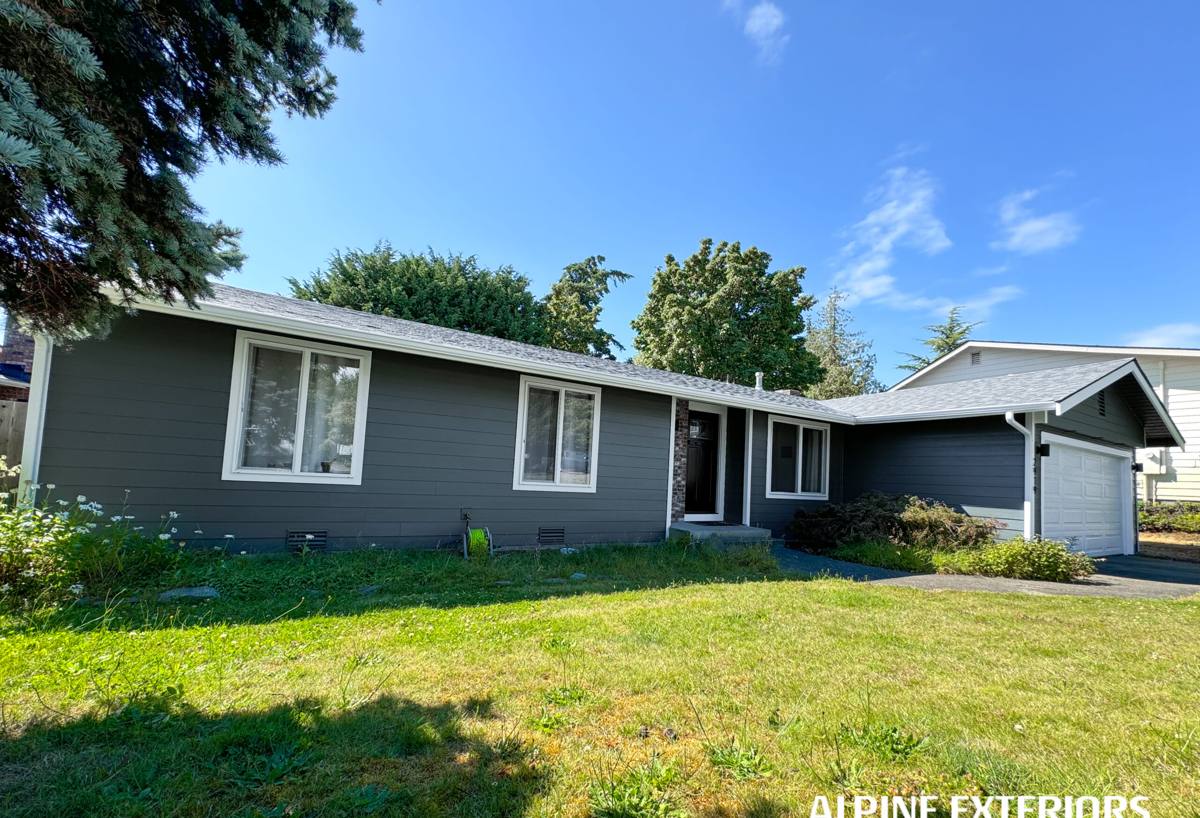
What the Skagit Valley Climate Actually Does to Siding
Driving Rain and Sustained Dampness
Wind off the Sound and through the valley pushes rain into wall assemblies at angles, not just straight down onto roofs and gutters. Siding materials that rely on surface coatings to stay watertight are under more stress here than they would be in a drier inland climate, because they rarely get a long stretch of dry weather to fully shed moisture between rain events.
Moss and Organic Growth
Shaded elevations, north-facing walls, and areas near trees or landscaping stay damp for extended periods, which is exactly what moss and mildew need to establish themselves. On porous or wood-based siding, that growth holds moisture directly against the surface — a slow, ongoing source of decay that's easy to miss until the material underneath has already softened.
Salt-Influenced Marine Air
Mount Vernon isn't oceanfront, but its position in the Skagit Valley near Puget Sound means homes still see marine-influenced air and humidity swings that accelerate the breakdown of paint films and lower-grade coatings faster than a purely inland climate would.
Why We Install Only James Hardie Fiber Cement Siding
James Hardie siding is fiber cement — a blend of cellulose fiber, sand, and portland cement — not wood, not vinyl, and not a wood-composite product. That composition matters directly for a climate like this one:
- It doesn't rot. Fiber cement has no wood fiber for moisture to break down over time, which removes the single biggest failure mode we see on siding in this region.
- It holds paint and color longer. Hardie's ColorPlus factory finish is baked on under controlled conditions and backed by its own finish warranty, so it resists the fading and peeling that field-applied paint struggles with under repeated wet-dry cycles.
- It's non-combustible. Fiber cement doesn't contribute fuel to a fire the way wood-based sidings can, which is a meaningful difference for insurance and for peace of mind.
- It's engineered by climate zone. Hardie builds its HZ5® product line specifically for the wetter, milder climate of the Pacific Northwest, with formulation and installation specs matched to sustained moisture exposure rather than a one-size-fits-all approach.
We don't install LP SmartSide, vinyl, Cemplank, Allura, primed spruce, or cedar. Each of those has legitimate strengths, but every one of them asks a Mount Vernon homeowner to accept a maintenance burden, a moisture vulnerability, or a coating limitation that we don't think holds up over the long run in this climate. Standardizing on one product means we install it the same correct way every time, and we stand behind it without hedging.
What a Correct James Hardie Installation Actually Involves
Fiber cement siding performs the way it's designed to only when it's installed to Hardie's published specifications. A rushed or generic install can undercut even the best material. The details that matter most on a Mount Vernon home include:
| Installation Detail | Why It Matters Here |
|---|---|
| Weather-resistant barrier behind the siding | Provides a secondary drainage plane so any moisture that gets past the siding has somewhere to go besides the wall sheathing |
| Proper clearance from grade, decks, and roof lines | Keeps the bottom edge of the siding out of standing water and splash-back, a common rot-start point in wet climates |
| Correct fastener type, spacing, and placement | Prevents cracking, buckling, and water intrusion at panel edges over years of wet-dry cycling |
| Sealed and flashed joints, seams, and penetrations | Stops wind-driven rain from working its way behind panels at the most vulnerable points |
| Correct gapping between panels and trim | Allows for expansion and contraction without forcing water into tight, unsealed joints |
These aren't optional refinements — they're the difference between siding that reaches its full service life and siding that develops moisture problems well ahead of schedule, regardless of how good the material itself is.
Signs Mount Vernon Homeowners Should Watch For
If your current siding is wood, engineered wood, or an older fiber cement product, a few warning signs suggest it's time for an honest evaluation rather than another round of touch-up paint:
- Paint that's peeling, bubbling, or failing faster than it used to, especially on north-facing or shaded walls
- Soft or spongy spots when you press on the siding near the bottom edge or around windows
- Persistent moss, algae, or dark streaking that comes back shortly after cleaning
- Visible gaps, warping, or cupping in individual boards or panels
- Rising energy bills that suggest moisture or air infiltration behind the siding
Any one of these on its own might be minor. Several together usually mean moisture has already gotten past the surface, and that's worth having a professional look at before it spreads.
Our Process on a Mount Vernon Home
1. On-Site Assessment
We walk the exterior, check for existing moisture damage, and evaluate how sun exposure, shade, and drainage on your specific lot are affecting different elevations of the house.
2. Tear-Off and Substrate Check
Old siding comes off and we inspect the sheathing underneath for any hidden rot or damage before anything new goes on — covering a compromised substrate is how future problems get sealed in rather than solved.
3. Weather Barrier and Flashing
A proper drainage plane and flashing details go in around every window, door, and penetration, matched to how wind-driven rain actually hits this area.
4. James Hardie Panel Installation
Panels, fasteners, and joints are installed to Hardie's HZ5 climate-zone specifications, with the clearances and gapping this region's moisture cycle requires.
5. Final Walkthrough
We review the finished work with you, check every seam and trim detail, and make sure the job matches what was scoped before we call it done.
Why Local Installation Experience Matters
Manufacturer specs are a starting point, not a substitute for judgment. A crew that regularly works Mount Vernon and the broader Skagit County area already knows which elevations on a given lot take the brunt of the weather, where moss tends to establish first, and how the valley's fog and humidity patterns differ from a drier inland job. That local pattern recognition shows up in the small decisions — flashing details, clearance calls, sequencing around weather — that a generic installation approach can miss.
What to Ask Before Hiring Anyone for Siding Work
- Are they a certified or factory-trained James Hardie installer, or installing it "off the shelf" without specific training?
- Will they show you the weather-resistant barrier and flashing plan before panels go on, not just the finished look?
- Do they inspect and address substrate damage before covering it, or just install over what's there?
- Can they explain how their installation approach differs for a wetter, marine-influenced climate versus a dry one?
- Is the warranty — both material and labor — written down, or just a verbal assurance?
Caring for James Hardie Siding After Installation
Fiber cement is low-maintenance compared to wood or engineered wood, but "low-maintenance" isn't "no-maintenance" in this climate. A rinse with a garden hose once or twice a year removes the pollen, dust, and organic buildup that feeds moss before it gets established. Keep an eye on caulking around windows and trim, since sealant is the one part of the system that wears out well before the siding itself does. Trim back vegetation and tree limbs that keep a wall shaded and damp longer than the rest of the house. None of this is a heavy lift, but it's what lets the material reach the long service life it's built for.
What This Means for Your Home
Mount Vernon's combination of valley moisture, wind-driven rain, and a long moss season rewards siding decisions that hold up over decades, not just the first few winters. James Hardie fiber cement, installed to spec with the right flashing, clearances, and fastening, is the product and process we've standardized on because it matches what this climate actually demands. If your current siding is showing wear, or you're planning ahead for a replacement, we're happy to take a look and give you a straightforward, no-pressure estimate — use the form below to get started.