 Anacortes Roofing
 Why Oak Harbor Siding Wears Differently
Homes around Oak Harbor sit close to open water, and that changes what siding has to deal with year after year. Salt-laden air corrodes exposed fasteners and trim faster than it would twenty miles inland. Wind-driven rain off the Sound doesn't just fall straight down — it gets pushed sideways into lap joints, corner boards, and anywhere caulk has started to give up. And because this part of Skagit County stays damp and shaded through much of the fall and winter, moss and algae get a long runway to establish themselves on north-facing walls and anywhere siding stays wet longer than it should.
None of that is unusual for the Pacific Northwest. But it does mean siding here has a shorter margin for error than siding in a drier climate. A product that's marginal in Spokane can fail outright in a marine-exposure neighborhood like Oak Harbor. That's the lens we bring to every siding replacement we quote here — not "what's the cheapest way to cover the wall" but "what actually holds up to this specific exposure."
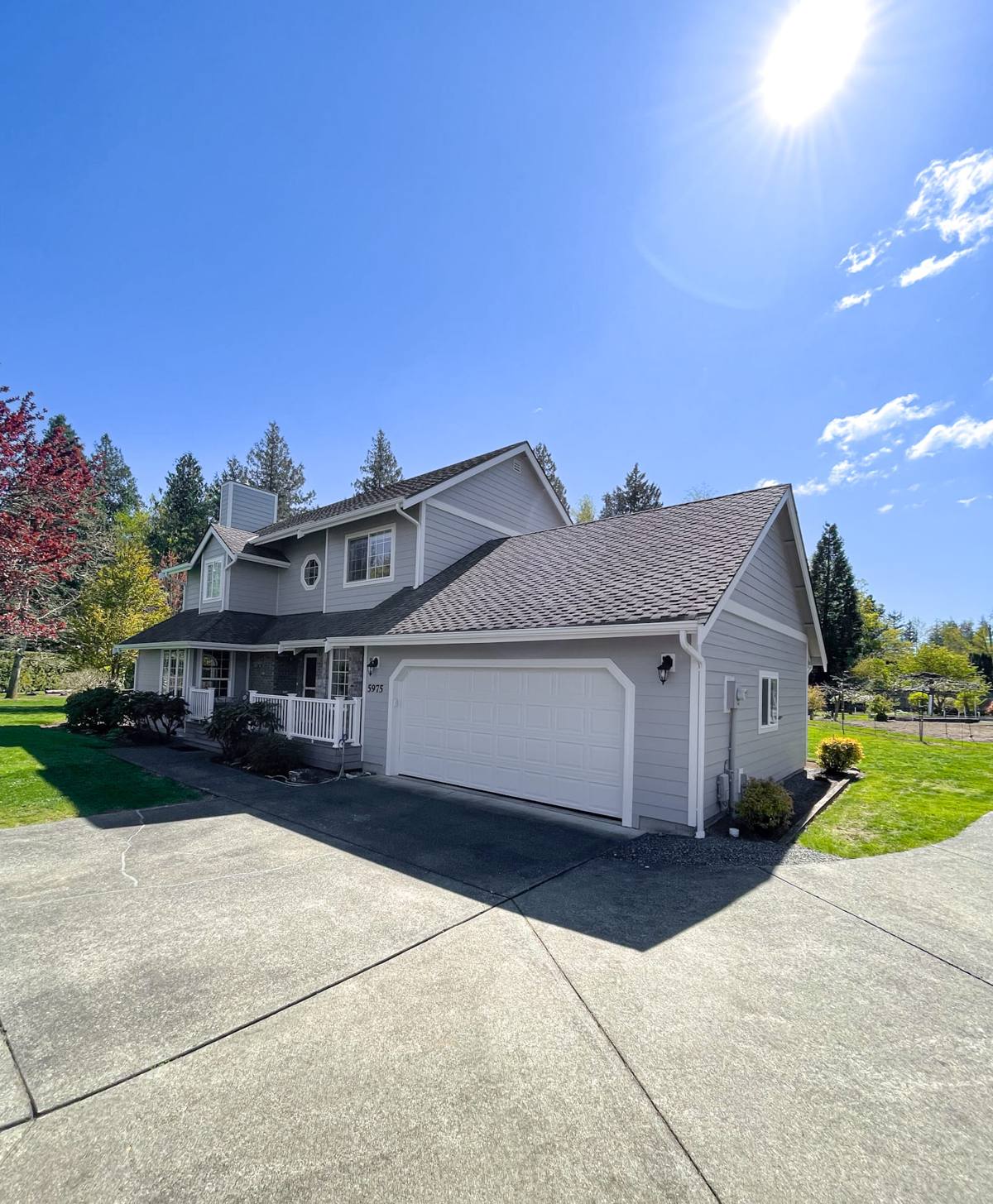
Signs Your Siding Has Crossed From Repairable to Replace-Worthy
Not every siding problem means a full tear-off. But there's a point where patching stops making sense and a full replacement becomes the more honest recommendation. Watch for:
- Soft or spongy spots when you press on the siding, especially near the bottom courses and around window trim — a sign moisture has gotten behind the material
- Paint that won't hold anymore, peeling or bubbling within a year or two of repainting, which usually means moisture is pushing out from underneath
- Persistent black or green staining that comes back within a season of cleaning, even in shaded or north-facing areas
- Visible gaps, warping, or delamination at panel edges and seams
- Rising energy bills alongside drafts near exterior walls, which can point to a compromised water-resistive barrier behind aging siding
- Siding that's simply reached the end of its practical service life for its material — many original vinyl or wood installations in this area are well past the point where patching is cost-effective
If you're only seeing one or two isolated spots, a repair may genuinely be the right call. If you're seeing several of these at once, or if a contractor keeps coming back to patch the same wall, that's usually the tell that the underlying material or the original installation has failed and a full replacement is the more honest fix.
What a Correct Siding Replacement Actually Involves
It Starts Underneath the Siding, Not With It
The siding itself is the part homeowners see, but the work that determines whether it lasts happens underneath. A correct replacement means stripping the old siding down to the sheathing, inspecting for rot or moisture damage, and repairing anything compromised before anything new goes back up. Skipping this step and installing new siding over damaged sheathing just hides a problem that will keep spreading.
Water Management Is the Whole Job
Once the sheathing is sound, the water-resistive barrier goes on — a weather-resistant house wrap that's the actual line of defense against wind-driven rain, with the siding as the outer shell. Flashing at windows, doors, and any wall penetration has to be layered correctly, shingle-style, so water moving down the wall never gets trapped behind a lap joint or funneled into a seam. In a marine-exposure area, this detailing matters more than the brand of siding you choose. Good material installed with sloppy flashing will fail. Correct flashing under an average product will usually outperform it.
Fasteners, Gaps, and Finish Details
Corrosion-resistant fasteners, correct nailing patterns, and proper gapping at butt joints and corners all affect how the siding handles expansion, contraction, and moisture over time. Caulking gets used at transitions and terminations, not as a substitute for correct flashing. These are the details that separate a siding job that looks fine at the walkthrough from one that's still performing in fifteen years.
Why We Only Install James Hardie Fiber Cement
We get asked fairly often about vinyl, LP SmartSide, cedar, and other fiber cement brands like Allura or Cemplank. Each of those has a place, and none of them are bad products in every circumstance. But for the exposure conditions around Oak Harbor — salt air, sustained wind-driven rain, and a long wet season that favors moss and algae growth — we've standardized on James Hardie fiber cement and stopped installing anything else. Here's the honest reasoning:
- Vinyl is affordable and low-maintenance in mild climates, but it can warp or crack under temperature swings, its seams are a weak point for wind-driven rain intrusion, and its color is baked into the material with no factory finish comparable to ColorPlus — fading is a matter of when, not if.
- LP SmartSide and other engineered wood products perform well when installation and maintenance are perfect, but they're wood-based, which means they're more sensitive to sustained moisture exposure than fiber cement — a real concern in a climate that doesn't dry out much between fall and spring.
- Cedar and primed spruce are beautiful materials, but they demand ongoing maintenance — refinishing, caulking, moisture monitoring — that most homeowners underestimate until the upkeep bill arrives, and they're the most vulnerable of the common options to the moss and algae growth this area is known for.
- Other fiber cement brands use the same basic material science as Hardie, but we've standardized on Hardie's specific engineering, factory finish, and warranty structure rather than mixing products across jobs.
James Hardie fiber cement is non-combustible, doesn't absorb and swell with moisture the way wood-based products can, and comes with a factory-applied ColorPlus finish that's engineered to hold color and resist fading far longer than field-applied paint. Hardie also makes climate-specific HZ product lines — the HZ5 line is engineered for wetter, harsher climates like ours, with performance characteristics tuned for exactly the kind of exposure Oak Harbor sees. Combined with a strong transferable warranty, it's the product we're comfortable standing behind on a home that's going to spend the next several decades a short distance from salt water.
Comparing Siding Options for a Marine-Exposure Property
| Factor | Vinyl | Wood / LP SmartSide | James Hardie Fiber Cement |
|---|---|---|---|
| Moisture resistance | Moderate — seams are vulnerable | Lower — wood-based, sensitive to sustained wet exposure | High — engineered for moisture and non-combustible |
| Color longevity | Fades over time, no refinishing option | Requires repainting/refinishing on a cycle | Factory ColorPlus finish holds color long-term |
| Maintenance | Low, but limited repair options when damaged | Higher — regular inspection and refinishing needed | Low — occasional wash, no repainting cycle required |
| Wind-driven rain performance | Fair, seam-dependent | Good if maintained perfectly | Strong with correct flashing detail |
| Warranty structure | Varies widely by manufacturer | Varies, often shorter on finish | Strong transferable manufacturer warranty |
Our Process for an Oak Harbor Siding Replacement
1. On-Site Assessment
We walk the property, check for the moisture, staining, and material fatigue described above, and look specifically at how the home is oriented to wind and rain exposure — a north wall near open water gets treated differently than a sheltered south wall.
2. Plan and Product Selection
We talk through the Hardie product line, profile, and color that fits the home and your budget, and give you a clear, written scope before anything starts.
3. Tear-Off and Sheathing Inspection
Old siding comes off, sheathing gets inspected, and any rot or damage gets repaired and documented before we move forward — no surprises added mid-project without a conversation first.
4. Water Barrier and Flashing
House wrap and flashing go in correctly at every window, door, and penetration, because this is the step that actually determines how the wall performs in a storm.
5. Installation
Hardie siding goes up to manufacturer spec — correct fastener type and spacing, correct gapping, correct joint treatment.
6. Final Walkthrough and Cleanup
We walk the finished job with you, answer questions, and leave the site clean.
Why Local Experience in Oak Harbor Matters
A siding crew that's worked this specific stretch of Skagit County knows things a crew from out of the area has to learn on your job. They know which walls typically take the worst of the wind-driven rain, how moss tends to establish on shaded siding here, and how to sequence a tear-off around a weather window that can close fast near open water. They also know the local permitting process and how to schedule around the wetter months instead of getting caught mid-project by a stretch of driving rain.
That local pattern recognition doesn't replace good installation practice — it supplements it. The fundamentals of correct flashing and water management are the same everywhere. But knowing this area's specific failure points means we're watching for the right things during both the estimate and the install.
Maintaining Your New Siding
Hardie fiber cement is low-maintenance, not no-maintenance. A simple annual routine keeps it performing:
- Rinse the exterior with a garden hose once or twice a year to clear salt residue and organic buildup before it takes hold
- Check caulking at trim, windows, and penetrations annually and touch up anywhere it's cracked or pulled away
- Keep gutters clear so overflow doesn't run down the siding face repeatedly in the same spot
- Trim back vegetation and landscaping that keeps a wall shaded and damp longer than the rest of the house
- Address any impact damage or chipped ColorPlus finish promptly rather than letting it sit exposed
Get a Straight Answer on Your Siding
If you're not sure whether your Oak Harbor home needs a repair or a full replacement, we'll tell you honestly which one it is. We offer free, no-pressure estimates — walk the property with us, ask questions, and get a clear scope before you decide anything. Use the form below to get started.