 Anacortes Roofing
 Why Similk Beach Homes Wear Out Siding Faster
Similk Beach sits close enough to the water that homes here take a different kind of beating than a house a few miles inland in Anacortes or elsewhere in Skagit County. Salt-laden air moves off the water and settles on exterior walls day after day, year-round. Add in driving rain that comes in sideways during winter storms, and a moss season that can stretch from fall through spring in the shaded, damp corners of a lot, and you have three separate stresses working on the same siding at the same time.
None of these stresses is dramatic on its own. Salt air doesn't rot a wall in a season. One rainstorm doesn't cause rot. A patch of moss doesn't collapse a board. What actually damages siding here is the combination, repeated for years without a break — moisture that doesn't fully dry between rain events, salt residue that holds onto that moisture a little longer, and organic growth that keeps a shaded wall damp even on days when the rest of the house has dried out. Siding that isn't built for that cycle, or that wasn't installed with the details this climate demands, shows it early: swelling, soft spots, peeling paint, and moss creeping up from the bottom courses.
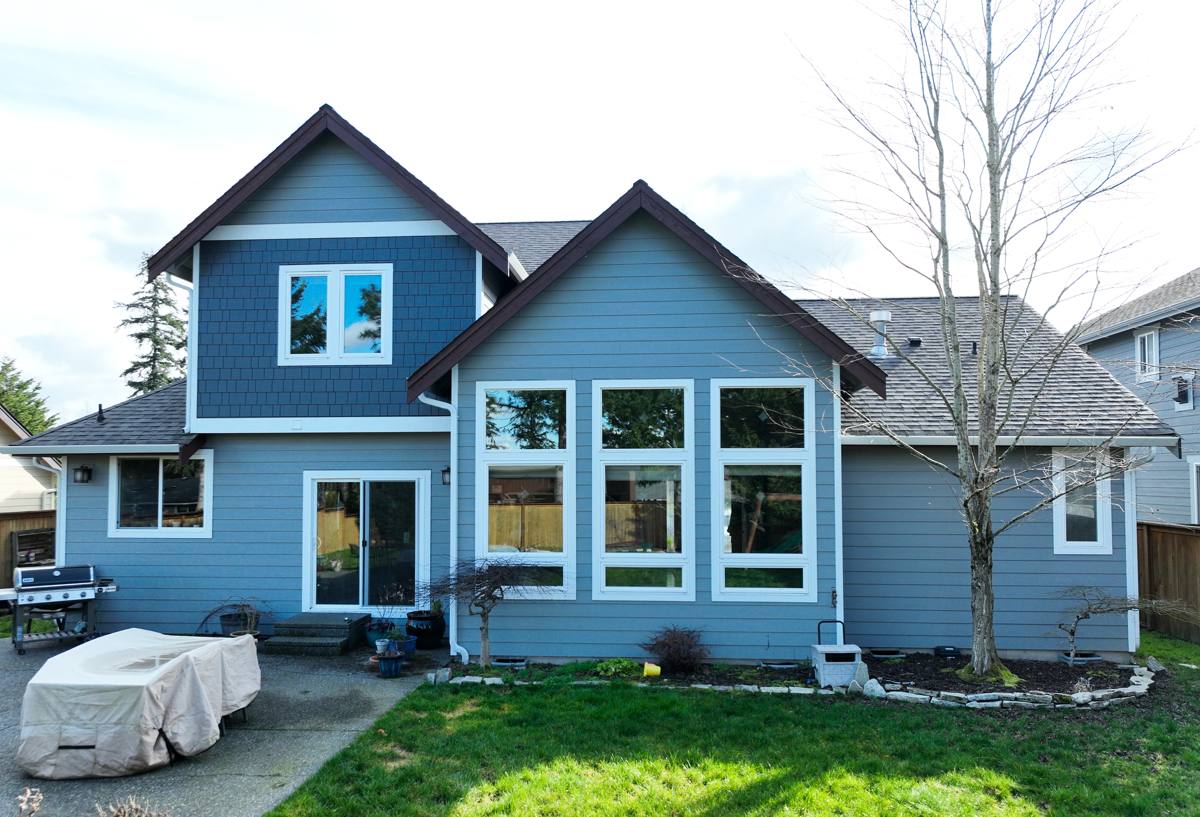
What Waterfront Exposure Actually Does to a Wall
Salt Air
Airborne salt is hygroscopic — it pulls moisture out of the air and holds it against whatever surface it lands on. On a wall close to Similk Bay, that means siding, fasteners, and trim spend more time damp than the same materials would a mile or two away from the water. Over years, that constant low-grade moisture exposure is what separates a wall that ages gracefully from one that needs early repair.
Driving Rain
Anacortes doesn't get the heaviest rainfall totals in Western Washington, but wind off the water turns rain into a horizontal force that pushes water up under laps, around trim, and into any gap in the water-resistive barrier. A siding system that relies on face-sealing alone — caulk and paint doing all the work — tends to fail here faster than a properly drained and back-ventilated assembly.
Moss and Organic Growth
Shaded north walls, areas under overhangs that don't get direct sun, and anywhere debris collects at a butt joint or behind a downspout are prime moss territory. Moss holds moisture against the siding surface long after the rest of the wall has dried, and it works its way into any seam or damaged coating it can find.
What a Correct Siding Installation Involves Here
Given all of that, a correct installation in Similk Beach isn't just about which siding product goes on the wall — it's about the assembly behind it. We treat the following as non-negotiable on every job in this area, regardless of which house style or color the homeowner picks:
- A continuous water-resistive barrier installed shingle-style (upper layers overlapping lower layers) so any water that gets past the siding drains down and out, not into the sheathing
- Correct flashing at every window, door, and roof-to-wall intersection — the majority of siding failures we see start at a flashing detail, not the field of the wall
- Proper fastener type, spacing, and depth for the specific product, since under- or over-driven fasteners are one of the most common causes of early siding problems
- Minimum clearance between the bottom of the siding and grade, decks, patios, and roof lines, so splashback and standing water don't sit against the material
- Correctly caulked and sealed joints only where the manufacturer specifies — not as a substitute for good flashing and drainage
- Attention to shaded, low-airflow wall sections where moss and mildew are most likely to take hold, including realistic expectations about maintenance in those spots
Skip any one of these and the siding itself almost doesn't matter — water will find its way in eventually. This is also why we don't treat siding installation as a one-day nail-it-up job. The prep and the details around the siding are where the long-term performance actually gets decided.
Why We Install Only James Hardie Fiber Cement
We made the decision to install James Hardie fiber cement siding exclusively, and nowhere is that decision easier to justify than on a waterfront job like Similk Beach. Fiber cement is made from cement, sand, and cellulose fibers — it doesn't absorb and swell with moisture the way wood-based products can, and it isn't a petroleum-based material that softens or expands with heat and cold the way vinyl does. That combination of dimensional stability and moisture resistance matters more here than almost anywhere else in the county.
A few specifics worth knowing:
- HZ5 engineered performance — James Hardie makes region-specific product formulations under its HZ system, engineered for the moisture and freeze-thaw conditions of the Pacific Northwest, rather than a single generic formulation sold everywhere in the country
- ColorPlus factory finish — the color coat is baked on at the factory under controlled conditions, which holds up better against UV and moisture than field-applied paint, and it comes with its own finish warranty
- Non-combustible core — fiber cement doesn't contribute fuel to a fire, which matters given Western Washington's increasingly active wildfire seasons even on the coast
- Won't rot, and pests don't feed on it — there's no cellulose-rich wood fiber for moisture or insects to break down
- A strong, transferable limited warranty — backed by the manufacturer, not just our own workmanship guarantee
We get asked fairly often why we don't offer vinyl, LP SmartSide, or a lower-cost fiber cement alternative alongside Hardie. The honest answer is that we'd be installing a product on a customer's home that we don't believe holds up as well in this specific climate, just to have a cheaper option on the price sheet. We'd rather be straightforward about that up front than sell something we don't stand behind.
How James Hardie Compares to Other Siding Options in This Climate
| Factor | James Hardie Fiber Cement | Vinyl | Wood / Engineered Wood |
|---|---|---|---|
| Moisture behavior | Doesn't absorb or swell; stable when installed to spec | Doesn't absorb, but can warp or buckle with heat and doesn't manage trapped moisture behind it | Absorbs moisture readily; prone to swelling and rot without diligent maintenance |
| Salt air resistance | Cement-based, unaffected by salt corrosion | Resistant itself, but fasteners and seams are common weak points | Salt-laden moisture accelerates rot and coating breakdown |
| Moss / organic growth | Factory finish resists staining; surface doesn't feed growth | Can stain and support surface growth in shaded areas | Organic surface is more hospitable to moss and mildew |
| Fire performance | Non-combustible | Combustible, can melt or deform in heat | Combustible |
| Finish longevity | Factory-applied ColorPlus finish, warrantied | Color is through the material but can fade and chalk | Field-applied paint or stain needs regular recoating |
| Long-term maintenance | Periodic washing; repaint only if desired down the line | Low, but repairs and color-matching aging panels can be difficult | Regular repainting, caulking, and rot inspection required |
Our Installation Process for Similk Beach Homes
- On-site assessment — we walk the exterior, check existing siding and sheathing condition, identify shaded and moisture-prone areas specific to the lot, and note any flashing or drainage issues already present
- Removal and sheathing inspection — old siding comes off and we inspect the sheathing underneath for hidden rot or moisture damage before anything new goes on; problems found here get addressed, not covered up
- Water-resistive barrier and flashing — a new drainage plane is installed correctly lapped, with flashing at every penetration and transition
- Hardie installation to manufacturer spec — correct fastener schedule, clearances, and joint treatment for the specific James Hardie product and profile chosen
- Trim, caulking, and finish detailing — final sealing only at the joints the manufacturer calls for, plus trim work that sheds water rather than trapping it
- Walkthrough — we go over the finished work with the homeowner, including any wall sections that will need occasional cleaning given their sun and airflow exposure
Living With Fiber Cement Siding Near the Water: Realistic Maintenance
James Hardie siding is low-maintenance, not no-maintenance, and we'd rather set that expectation clearly than oversell it. In a waterfront setting like Similk Beach, a little routine care goes a long way toward keeping the siding looking and performing the way it should for decades.
- Rinse the exterior with a garden hose once or twice a year to clear salt residue and general grime, focusing on walls facing the water
- Keep an eye on shaded, low-airflow areas for early moss or mildew growth and address it before it spreads or discolors the finish
- Trim back vegetation and branches that keep a wall section shaded and damp longer than the rest of the house
- Check and maintain gutters and downspouts so water isn't sheeting down a wall or splashing back up onto the lower courses
- Inspect caulked joints periodically and have any cracked or missing sealant addressed promptly
- Watch for any impact damage (from debris, equipment, or storms) and have it repaired rather than left exposed
What Siding Installation Typically Costs
Exact pricing depends on the size and shape of the house, the amount of trim and detail work, whether there's existing siding to remove, and what condition the sheathing is in underneath. In general terms, the biggest cost drivers are:
| Cost Factor | Why It Matters |
|---|---|
| Home size and wall complexity | More square footage, corners, and architectural detail means more material and labor |
| Existing siding removal | Tear-off and disposal add labor and dump costs compared to new construction |
| Sheathing condition | Rot or moisture damage found during removal has to be repaired before new siding goes on |
| Product profile and trim package | Lap width, shingle-style siding, and trim details affect both material cost and install time |
| Site access | Waterfront lots with limited access or steep grades can add setup and staging time |
We give straightforward, itemized estimates rather than a vague ballpark, so a homeowner can see exactly what's driving the number before deciding to move forward.
Why It Matters That We Already Work in Similk Beach
A crew that regularly works waterfront properties in and around Anacortes already knows what a Similk Beach job tends to require before the first board goes up — which wall orientations will need extra attention to moss and drainage, how far salt spray typically carries onto a given lot, and how local wind patterns tend to drive rain during a winter storm. That's not something a crew coming from outside Skagit County, or one that mostly works standard inland tract housing, picks up on the first try.
It also means we're a known, findable name if a question ever comes up years after the job is done — not a company that did one project in the area and moved on. For an installation that's meant to last decades in a demanding climate, that local continuity is worth as much as the material specification sheet.
If you're considering new siding for a home in Similk Beach, we're happy to walk the property, look at what your walls are dealing with, and put together a clear, no-pressure estimate for a James Hardie installation built for this exact climate. There's a form below to get that conversation started.